8 star plants of RHS Sandringham 2026
Discover plants that stood out at the first ever RHS Sandringham Flower Show, and inspiring floral ideas to take home


RHS Sandringham
Flower Show
Designer planting schemes and cracking combos to try at home, inspired by the first-ever RHS Sandringham Flower Show
Whether you have a huge border to fill or just a few pots in a corner, a well thought-out combination of plants – which not only look good together, but actually enjoy similar conditions and help each other thrive – can create an effect way above and beyond the sum of its parts.
Inspired by the newest RHS show, here are seven combinations that will work hard in your outdoor space for years to come.

The cast:
As used in: The Royal Legacy Garden by Catherine MacDonald
Why it works: within a restrained red and burgundy colour palette, interest is created by contrasting flower and foliage forms that all share these tones, creating heat and vibrancy in a way that remains sophisticated
Perfect for: a sunny spot that can get quite dry, as all of these plants are fairly drought-tolerant, or a gravel garden or a grouping of pots.

The cast:
As used in: The RHS Pollywiggle Garden by Joe & Laura Carey
Why it works: a refined feel created by a unifying colour scheme in which interest is generated through contrasting flower forms (spires, flat heads and daisies)
Perfect for: a moist border that still gets plenty of sun.

The cast:
As used in: Mindful Chef’s Gathering by Sophie Godber
Why it works: orange and blue/purple are on opposite sides of the colour wheel (complementary colours), meaning they really pop when put together as a result of the colour contrast. There’s also a pleasing contrast between the spire and flat, daisy-like flower shapes
Perfect for: a sunny spot in a dry border or gravel garden, as both plants are fairly drought-resistant once established.

The cast:
As used in: 100 Sweet Summers by Kitti Kovacs
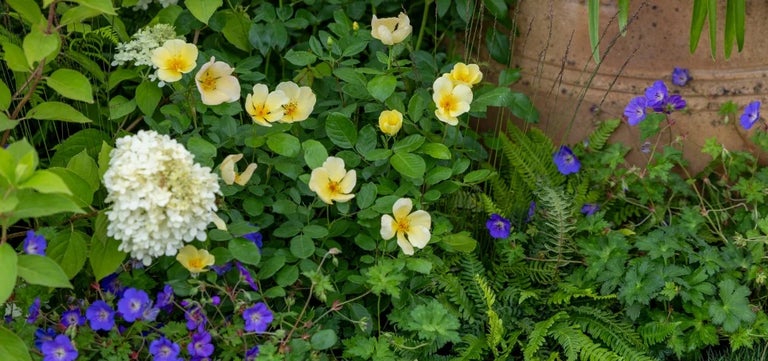
Why it works: interest is generated by the three contrasting leaf shapes. Pale pink flowers are also offset beautifully by dark foliage
Perfect for: a shady spot or pot display in shade.

The cast:
As used in: Time to heal (Long Border) by Dr Sarah Fleming
Why it works: as in no. 3, this combination plays with contrasting flower forms within the same colour palette
Perfect for: a moist border that gets some sun.

The cast:
As used in: RNIB Talking Books Garden by Paul Hervey-Brookes
Why it works: two classic, long-flowering stalwart perennials that again create a perfect blue-orange complementary colour contrast. This combo works well in a trough planter for me at home, with Anemanthele lessoniana grass weaving through for textural lightness
Perfect for: a border or container that sees some sun.

The cast:
As used in: 100 Sweet Summers by Kitti Kovacs
Why it works: uses the ‘thriller, spiller, filler’ rule of designing a planted container, which ensures plants occupy different spaces within the arrangement – Oenothera is the thriller, Sanguisorba the filler and Erigeron the spiller. The pink hues in the gaura and Erigeron are picked up in the magenta of the Sanguisorba
Perfect for: a container that sees some sun.
If plants are your passion, consider subscribing to The Plant Review.
About the author – Olivia Drake
With a background in biology, Olivia is passionate about sustainable horticulture, biodiversity and the role gardening can play in conservation. She is trained as a botanical horticulturist and previously worked in public gardens around the UK and abroad.