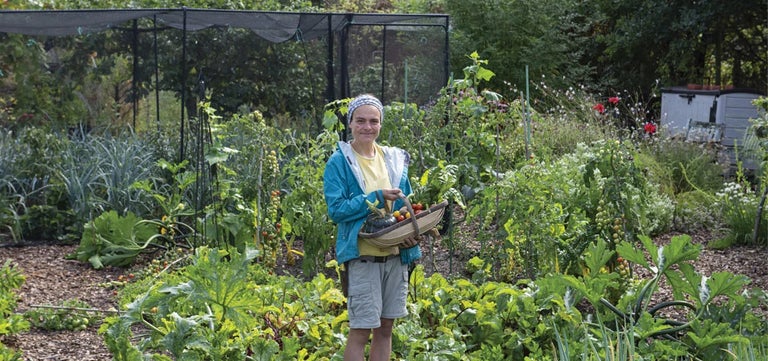
Liz’s allotment life: Growing for self sufficiency
A weekly diary from RHS Wisley edibles expert‚ Liz Mooney

RHS Wisley Edibles Horticulturalist Liz Mooney shares what she’s sowing, growing and harvesting right now and how she’s navigating the hungry gap
We’re now well into the hungry gap and have reached the point where my stored potatoes and parsnips have run out.
I stored the potatoes in hessian sacks in a cool, dry, frost-free location, which kept them going until around mid-March. The parsnips I harvested in late February, then blanched and froze, finishing the last of them this week.

For around 10 months of the year, these crops provide most of my carbohydrates, so April and May are always a bit of an adjustment – I tend to switch to pasta and rice for a while. I look forward to returning to homegrown potatoes come June.
However, there is still plenty to eat, and this is where vegetables really come into their own, often coming into growth earlier than .
At the moment, I’m enjoying:
The asparagus varieties are, I’m afraid, long forgotten, but I do know they were RHS Recommended: Award of Garden Merit selections. At RHS Wisley‚ we grow several excellent cultivars, including ‘Guelph Millennium’, ‘Gijnlim’, ‘Connover’s Colossal’ and ‘Backlim’.

Lovage (Levisticum officinale) is one I use regularly in stir-fries as a celery substitute. It’s more pungent than celery, so you only need a small amount, but the leaves and stems add a great depth of flavour. As a perennial, it’s quick to come back into growth in spring and is a really useful crop during the hungry gap when other flavours are in short supply.
I tend to keep things fairly simple in the kitchen‚ mostly stir-fries and salads‚ but asparagus puff pastry tart is a particular favourite of mine at this time of year.
Salad burnet (Sanguisorba minor) isn’t as widely grown as it deserves to be, but it’s a brilliant addition to the plot.
It produces fresh, cucumber-flavoured leaves that are perfect for salads at this time of year, and as a hardy ‚ it comes back year after year with very little attention.
Later in the season, it produces attractive flowers that help support pollinators and beneficial insects.
I bought my plants from a specialist herb nursery at one of the RHS shows – it’s well worth seeking out good suppliers if you’re looking to try something a little different‚ such as the Kitchen Garden Plant Centre, Incredible Vegetables, Jekka’s or Tamar Organics.

This weekend was a little quieter than planned due to a temporary lack of water on the allotment site. It should be resolved soon, so I’ve delayed a few seed sowings by a week – at this stage, soil temperature matters more than the calendar, so it shouldn’t cause any real problems.
There were still plenty of jobs to get on with.
Planting potatoes
Early April is a good time to get potatoes in the ground, and I’ve gone for a mixture of cultivars, mainly first and second earlies such as ‘Charlotte’ and ‘Rocket’. These earlier cultivars should crop before the main blight period later in summer, helping to reduce the risk of losing the harvest.
I plant them by digging a hole and dropping them in. Potatoes are a fairly easy, low-maintenance crop, but a staple of my diet from June onwards and the flavour is infinitely better than shop-bought.
Weeding
There’s not too much to tackle yet, but I like to keep on top of it by regularly the plot. Catching weeds early makes a big difference, and a quick pass on a dry day is usually enough to stop them from establishing.
My personal preference is a push-pull hoe, which I find the most efficient.
Watering
The in my grow hut needed a little water, which I had to bring from home. They were sown a few weeks ago, and the mix of beetroot, spinach, lettuce and other salad crops are germinating well and should be ready to plant out in a few more weeks.
At this stage, I try to keep the just moist – overwatering can lead to weaker root systems.

seedlings
The lettuce I sowed in the ground a few weeks ago is doing really well and needed thinning. This gives the remaining plants enough space to develop properly and improves airflow.

I did have to remove a few volunteer potatoes from missed tubers, which disturbed things slightly, and a local mole has caused a bit of disruption – but there’s still plenty coming through.
Next weekend I’m planning a big push on seed sowing as conditions continue to improve.
I’ll share what’s going on‚ and how it’s all progressing.