How gardening helped me thrive with ADHD
For Anya Lautenbach, gardening isn’t just a pastime – it’s a place to belong and to focus

From adapting the garden to finding time for herself, Judith Witter reflects on the realities of caring for her husband living with Parkinson’s, and why gardening together matters so much to them
“Gardening with a disability can be both wonderful and difficult. It can be companionship and hard work. It can give two people enormous pleasure and leave the carer exhausted. It can help preserve something precious in a relationship while, at the same time, making visible what is changing.”
Judith Witter lives with her husband, Peter, in a village not far from Leatherhead, in Surrey. They moved there in 2007 and have been tending their garden together ever since. In 2017 and 2019, the couple took part in Open Gardens and, in 2024, opened their gates to the National Garden Scheme.

However, 2017 was also the year Peter was diagnosed with Parkinson’s.
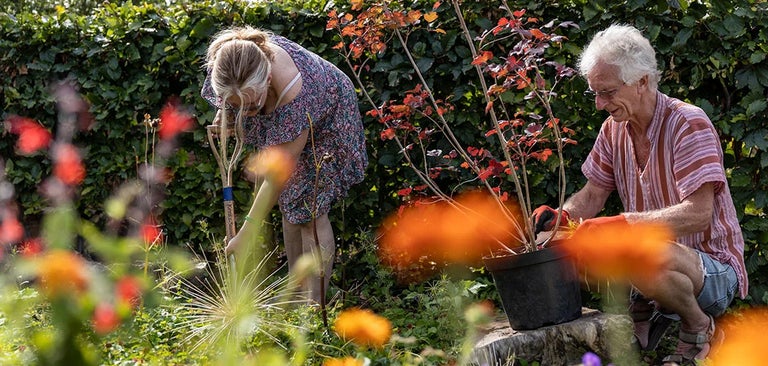
“Since that moment, I have been in charge of our garden,” said Judith, “but that doesn’t mean Peter has stopped gardening. He still has more physical strength than me, so he digs holes and digs out plants, while I do the planting and make the decisions about what goes where. There is real pleasure in working together and we still do it.”
Things get more complicated when the symptoms of the illness suddenly reveal themselves. When Peter is responding well to his Parkinson’s medication, Judith explains, he is determined and gritty and will push on with heavy work. But as its effects begin to wear off, or if he’s pushing himself too hard, he might lose his balance or energy, going from his usual slightly lop-sided walk to short, shuffling steps. He might also suddenly become unable to coordinate the movements needed to get himself out of a border.
“I am the carer, so I have to cope with what I think of as the ‘Parkinson’s dancing around the garden’, where Peter keeps moving to maintain his balance but could suddenly change direction or stop. All of this becomes part of my thought process while gardening.”
Gradually, Judith and Peter found themselves modifying their garden to adapt the amount and type of work they can carry out.
The first step was replacing many of their herbaceous plants with shrubs. “Herbaceous planting requires hard work, as it can look messy if not maintained. Shrubs still need trimming to keep their shape and vitality, but they don’t need the same pruning, and dividing. They give the garden a more consistent look, although that very changeability of herbaceous plants is part of what makes them so enjoyable to me,” Judith said.
The couple also swapped small, seasonal pots for larger containers. “We used to have lots of small seasonal pots for colour. Pelargoniums, salvias and other summer plants would be followed by masses of for winter and spring. They would be really beautiful, but producing that beauty required intense physical effort several times a year.”
Now, they mostly grow shrubs, euphorbias, herbaceous plants and a few bulbs for seasonal change. “Large pots give us the stability and physical accessibility needed for longer-term maintenance,” Judith explained.


Compromise has become key to their everyday life, both inside and outside the garden. “I don’t want to take away his independence or his pleasure in doing something he can still do well. Nor do I want Parkinson’s to turn every activity into something that has to be supervised,” said Judith. Losing some of the flexibility and seasonal exuberance was the only way to gain something she and her husband had a better chance of maintaining.
“We are changing something we have made together because I can see my husband changing physically in front of me, and there is grief in that. Sometimes, I am crying inside while dealing with what, on the surface, is simply a gardening problem.”
When Judith is gardening alongside her husband, she is not simply gardening. She is also keeping an eye on him, anticipating his movements and managing any obstacles they might encounter along their way.
“I have to think about where he’s going before he gets there, whether there is a way out and whether I could actually help him if he became stuck. There is no neat division between the gardener and the carer.”
This is the side of gardening with Parkinson’s that Judith would like people to be more aware of. “We talk a lot about the benefits of gardening , from breathing fresh air and gaining a sense of purpose to its positive effects on fitness and mental wellbeing . However, this perception ignores my reality, which can feel very lonely. If gardening really is for all, then it has to include not just adapted tools, raised beds, easier paths and sensible advice, but also the complicated human reality of gardening when disability enters a relationship. It must allow for the fact that the disabled gardener may still be strong, determined and desperate to carry on, while the person alongside them may be physically less strong but carrying much of the responsibility for them both.”

To navigate this tension, Judith stresses how essential it is for carers to find ways to recharge themselves, cultivating interests that belong to their own lives rather than to their role as carers.
“I belong to a wonderful group that visits a different garden each month. I can see what other gardeners are doing and learn from them, and afterwards we have lunch in a pub. We talk about gardens, but also about what is going on in our lives. Both parts matter to me.
“I’m also part of my local Women’s Institute, whose members are experiencing all sorts of things in their lives. Sometimes, support happens quite simply between two women who find themselves opening to each other and understanding what the other person is carrying.”
Even more importantly for her is the need to accept the disability while recognising how much gardening continues to mean to them both.
Her advice is to “not pretend that disability disappears in the garden, but make room for the joy and the difficulty, the independence and the vulnerability, the laughter and the grief. Peter and I still garden together not because gardening has somehow defeated Parkinson’s, but because, despite Parkinson’s, we want to keep going.”

Judith’s learnings for carers of people gardening with Parkinson’s:
In 2026, Parkinson’s UK was at the RHS Chelsea Flower Show with the Show Garden Parkinson’s UK - A Garden for Every Parkinson’s Journey. Designed by award-winning gardener and BBC presenter Arit Anderson, whose sister lives with this complex neurological condition, the space reflected the moments of adaptation, challenge, hope and connection experienced by people living with Parkinson’s.

Here are Arit and Parkinson’s UK’s top tips for gardening with Parkinson’s: