Margaret’s century among the Teesdale wildflowers
The 100-year-old horse-riding botanist committed to saving rare plants

The remarkable contribution of India’s pioneering scientist EK Janaki Ammal
Sometimes described as “India’s first female botanist”, Edavalath Kakkat Janaki Ammal was a trailblazing botanist and plant cytologist who developed innovative sugarcanes, helping India to grow its own supply, so it didn’t need to rely on imports.
As an eminent scientist, she used her status and influence to protect and preserve the Silent Valley National Park, which is full of rare orchids. In 1946 she became the first female scientist to be employed by the RHS.
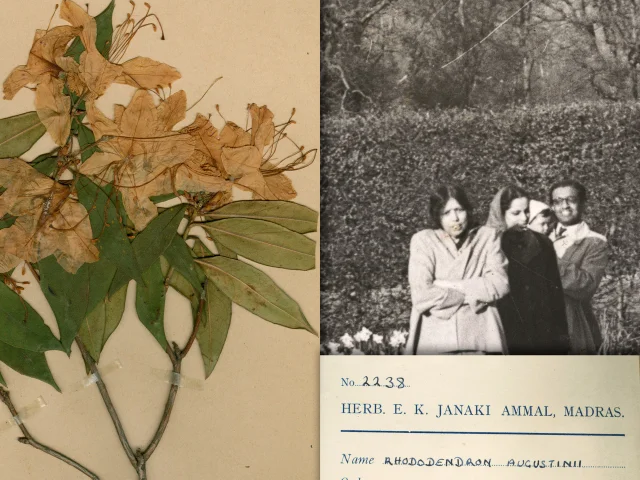
"Her ground-breaking work had been somewhat forgotten when it was brought to my attention while digitising herbarium specimens of Rhododendron collected by Janaki in 1950. The heritage I share with her and the similar journeys we have followed to RHS Garden Wisley sparked a wish to find out more about her and her work."
Janaki added “a spoonful of sugar” to the indigenous cultivars of sugarcane in India. Between 1934 and 1939, Janaki worked on sugarcane genetics at the Sugarcane Breeding Institute in Coimbatore and, while most Indians will not know her name, they are certain to have tasted the fruits of her labour. Through crossbreeding of species and cultivars in the laboratory, she created a high-yielding strain of sugarcane better suited to the Indian climate, making India less reliant on imports.

"In India, at that time, once you reached 16 you were expected to find a suitable match and settle down. Janaki refused to do that, and luckily, her father supported her decision. Her father and siblings encouraged her to follow her dream."
Janaki was born in 1897 into a Thiya family from Tellichery (now Thallassery) in Kerala, south-west India. Her family was seen as belonging to a lower caste. This, at least in part, caused her to reject marriage and devote her life to scholarship.
Schools and colleges started by missionaries in North Malabar ensured that Janaki received the best education available, and she also benefited from a library that her father created in the family home. His interests in ornithology, botany and natural sciences were passed on to his children.
"At that time, for women, going to college and receiving an education was not the norm. Studying at the University of Michigan and earning a PhD would have been a massive thing, especially as her family was considered lower caste. People would assume she would have a lower caste job too."
While working as a lecturer at the Women’s Christian College, Madras, in the early 1920s she received a scholarship from the University of Michigan to study botany where she achieved a Master of Science in 1925 and, in 1931, became the first female Doctor of Botany in the United States with her thesis titled Chromosome Studies in Nicandra physalodes (the shoo fly plant).

In 1934 Janaki started work at the Sugarcane Breeding Institute in Coimbatore. As well as her work improving sugarcane cultivars she established that Saccharum spontaneum, the sugarcane that is exported from India all over the world to this day, had originated in India and helped analyse the geographical distribution of sugarcane across India. She also experimented with creating hybrids of sugarcane with other members of the grass family like Indian corn or maize (Zea), millet (Sorghum), cogon grass (Imperata) and even bamboo (Bambusa), which had never been done before.
Though she experienced professional success at Coimbatore, being a woman in a male-dominated field led to clashes with her peers who failed to give her work the recognition it deserved. She expressed her frustration at not being allowed to publish her own findings in a letter to Cyril Darlington, a British cytogeneticist and evolutionist, saying she thought of leaving Coimbatore after “facing brutal persecution” in the “pseudo-scientific” atmosphere.
Janaki had enjoyed a brief spell at the John Innes Institute at Merton Park, south London, while studying for her PhD and in 1939 she returned there, joining as an assistant cytologist (a scientist who studies plant cells). Here she developed her long working relationship with Cyril Darlington. They corresponded until his death in 1981 and their letters reveal how close their friendship became.
Her work at the Institute focused on studying ploidy (the number of sets of chromosomes) in a wide range of garden plants. Janaki and Darlington co-authored the 1945 Chromosome Atlas of Cultivated Plants. It features around 100,000 plants and is still used by plant breeders today. While at the Institute, she also worked on medicinal plants and plants such as lemongrass (Cymbopogon), thornapple (Datura), yam (Dioscorea), mint (Mentha) and nightshade (Solanum).

In 1946 Janaki became the RHS’s first female scientist, working at RHS Garden Wisley on a salary of £300. Before her arrival, she had experimented with colchicine on Asparagus, Clarkia, Lilium, Magnolia, Morus and Rhododendron resulting in the creation of a number of new tetraploids. Producing tetraploids meant creating plants with four sets of chromosomes rather than two, often resulting in plants with increased vigour. The Wisley Herbarium still contains specimens pressed by Janaki. Her sample of Rhododendron yakushimanum ‘Koichiro Wada’ has become the nomenclatural standard (the definitive specimen of a , similar to a type specimen for a species).
At Wisley she investigated the effects of colchicine on a number of woody plants, including Magnolia, by applying a stock solution of colchicine in water to the growing tip of young once the cotyledons (seed leaves) have fully expanded. Doubling of chromosomes occurs, giving the cells twice the usual number. The resulting plants have heavier textured leaves; their flowers are variable, often with thicker petals, helping them last longer. As Magnolia kobus seeds were available in quantity, a number of seedlings were treated by Dr Janaki Ammal and ultimately planted on Battleston Hill at Wisley. The colchicine tetraploid cultivar Magnolia kobus 'Janaki Ammal'was named after her.

Janaki’s work was highly respected around the world: the Wisley plant accessions register (a record of plants received, in what numbers and from where) from this time shows numerous plants being sent to her. The Australian botanist Constance Margaret Eardley was sent to Wisley for a year to study under her.
Janaki travelled, speaking for the RHS at international conferences and undertaking a plant collecting expedition to Nepal during 1948–49, returning to Wisley with specimens including Fragaria, Iris, Rhododendron, Rosa and Rubus.
In one of the letters to Darlington from this period, Janaki described her time in Nepal as “a massive change” from her simple life at Wisley, as she was being assisted by “peons, mukhias, havaldars and gurkas” (local officials) and had been provided with a state car and local botanist to assist her. After nine years away, she thought “India looked like a land where time had stopped a thousand years ago”. She collected seeds of Amaranthus paniculatus as a grain, vegetables like rat-tail radishes with roots 2ft long, luffas that were 6ft tall and “pumpkins big enough to make Cinderella’s coach”.
Janaki returned to India in 1951 following an invitation by PT Jawaharlai Nehru, Prime Minister of the newly independent country, to lead a project to reorganise the Botanical Survey of India. Compiling an updated inventory of the country’s rich plant resources was a huge undertaking and not without its challenges. The chief botanist on the project, Hermenegild Santapau, a Kew-trained Catalan, chose to send the specimens collected to herbaria around the world. Janaki believed a truly systematic study of India’s flora could not be done if specimens were collected by foreign botanists and studied only in British herbaria.
In 1977 the government of India gave Janaki one of its most prestigious awards, the Padma Shri. She worked as a chairman of the Cytogenetics Department, Honourable Professor of Botany and an Emeritus Scientist in Jammu and Kashmir.
Today, Janaki’s legacy is also in the thriving rainforests of Silent Valley National Park in Kerala. The Silent Valley had been threatened by flooding and the construction of a hydroelectric plant, but Janaki had realised that this would be a devastating loss for India and campaigned to save it while also attempting to document the flora found there.
In 1984, less than a year after Janaki’s death, the Silent Valley was declared a National Park, its unique flora saved for future generations. It’s now a flourishing area that people visit and even safari in.
To celebrate her remarkable career and contribution to plant science, two Indian plant breeders, Girija and Viru Viraraghavan bred a new yellow rose, which they named ‘E.K. Janaki Ammal’. It was the breeders’ understanding that Janaki only wore yellow saris in her later years. Other plants have been named in her honour: Sonerila janakiana, a tuberous species in the Melastomataceae, and Decalepis (Janakia) arayalpatra, a medicinal plant from the Western Ghats region of Kerala.
The John Innes Institute offers postgraduate scholarships in her name to students from developing countries. India offers a number of scholarships in her name, ensuring that her work continues to be known by future scientists.
"She will always be remembered as the first female scientist at RHS Wisley. She followed the teachings of Mahatma Gandhi and believed in living simply."
“Janaki always wanted to serve her country. She wanted to put the country where she was born on the map, and only left because in India, men and women were treated so differently in the workplace,” says RHS Herbarium Curator and Digitiser Mandeep Matharu.
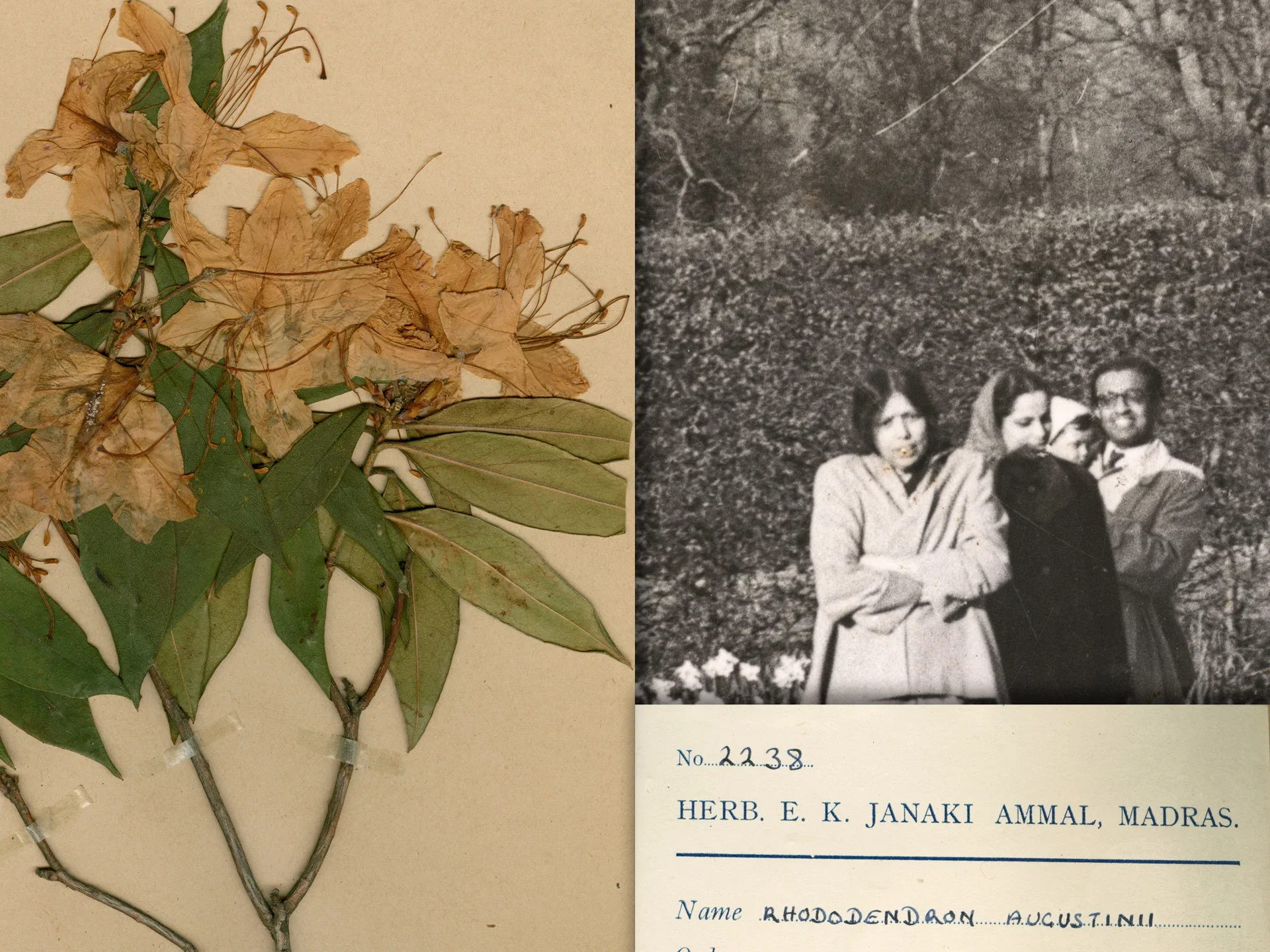
E K Janaki Ammal on RHS Digital Collections
Explore the remarkable life and work of pioneering botanist E K Janaki Ammal through the RHS Digital Collections. Dive into the archives to see photographs and herbarium specimens that celebrate her groundbreaking contributions to science and horticulture.
View the collection
About the author - Mandeep Matharu
Mandeep is a Herbarium Curator (Digitiser) at RHS Garden Wisley.