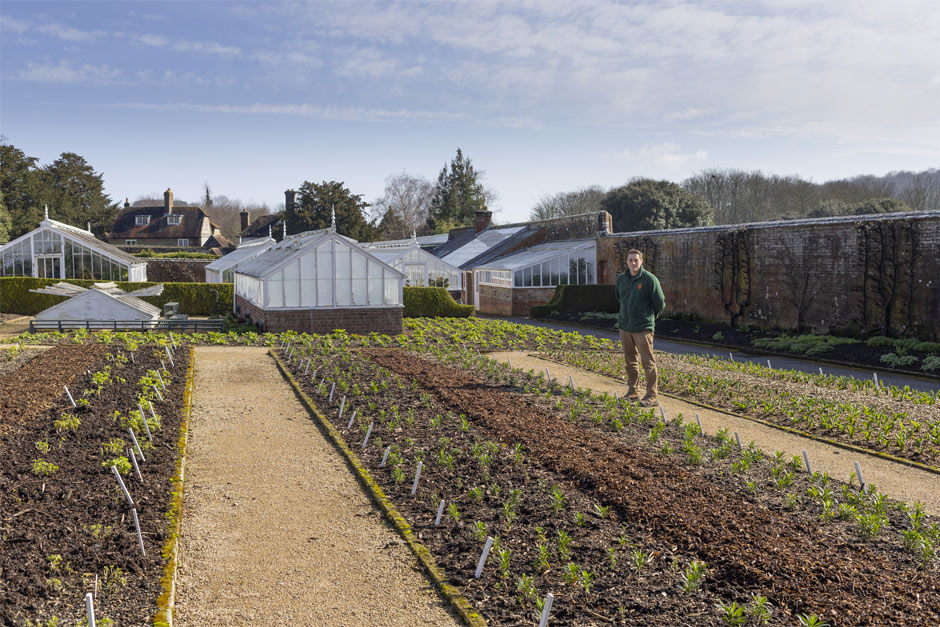
Beneath the entrance arch of Hooton’s Walled Nursery, the cobbles are worn from centuries of gardeners’ boots. Beyond, a gravel path, lined by gnarled pear trees and broken-paned glasshouses, leads downhill to the sales area, where Dean Charlton and his dad Glenn are busy restocking.
Since taking on the historic overgrown site in December 2023, Dean and Glenn have artfully landscaped its discarded past. Excavated bricks and bottles have been incorporated into retaining walls, a fallen-branch handrail accompanies steps constructed from long-buried Yorkstone slabs, concrete blocks rescued from decrepit cold frames are now cut to shape with elegant curves, and a shed is patched with corroded metal staging. “We keep unearthing all sorts,” says Dean. “I feel like Bilbo Baggins in the treasure lair.”
But this nursery’s real wizardry lies in its pairing of traditional propagation techniques with modern ecological principles. “I’ve never worked with peat,” says 37-year-old Dean. “I learned to cultivate the old-fashioned way, but always used sustainable materials.” The plants on sale are mostly resilient perennials. In May, Allium siculum subsp. dioscoridis (Bulgarian honey garlic) is already studded with fairytaleturret seedheads and Agastache ‘Blue Boa’ (giant hyssop) is in vibrant violet flower. These are healthy, happy plants, affirmed by a sign pushed into a pot of Verbena rigida that reads: “Will flower its heart out”.
“We grow nearly everything ourselves: sowing seeds, taking A method of growing new plants from parts of an existing plant, such as sections of root, stem, leaf or bud. When prepared correctly and planted in the right conditions, they can produce roots and eventually become independent plants. There is a wide range of different methods for taking cuttings, depending on the plant and time of year.
The plan was always that Dean would, one day, bring his expertise back home to Rotherham to run a nursery with his dad. So it was serendipitous that the lease on this handsome walled garden in the hillside village of Hooton Roberts, five miles from the family home, came up as Glenn approached retirement. Part of the Fitzwilliam Wentworth Estate, it dates to the 1700s when the 4 acres of clay within its sandstone walls grew fruit and veg for the manor house that’s now the local pub.
The site’s more recent past as a commercial nursery had left the land in a less well-to-do state, however, with crumbling infrastructure to boot. Rotting wooden glasshouses leant precariously in the direction of the prevailing wind, and brambles rampaged through the ripped polytunnels. The Charltons chose to preserve these derelict remnants and use the garden’s past to reimagine its future.
Greenhouses were straightened and strengthened with RSJs. Ground that hadn’t seen sun for decades was cleared and the dug-up debris repurposed. “We could have pushed the shed by the entrance arch over with a finger,” says Glenn. “It would have been easier to buy a new one, but that’s not our ethos, so I fixed it. This is the original potting bench,” he says, running a hand over its pitted surface. “I like to think of the gardeners who’ve stood here before me. I like that Dean is here now, doing things his way.”
To get the nursery fit for purpose, Dean’s mum Linda painted, sister Lauren put together a website, friends gifted cuttings, local gardeners volunteered their time and occasional weekend working parties sped progress. Creating stock beds, as a source of propagation material and a living catalogue for customers to view, was a priority. But there’s also a hub and huge firepit for social gatherings, where music and merrymaking featured in the wassail to awaken the orchard for an abundant harvest. “These customs helps us connect to the land,” says Dean. “I’m a dreamer, who takes threads and weaves them together. Thankfully, Dad’s a realist who works out how we make the dream happen.”
And the dream? “The life of a plant before it gets to your garden, and the process of finding it, should be part of your gardening journey,” says Dean. “If you want a cheap pint, you know where to go, but you could go find a microbrewery to enjoy a local cask beer made with love and care, in a place that’s as inspiring and interesting as the ale. That’s what we’re doing here. You won’t find this quality or quirkiness in a garden centre.”
They only propagate 30 or so pots of each Gardeners often use the word variety when referring to a specific plant, but the correct botanical term is 'cultivar'. Whichever word you use, it means a distinctive plant or plants, given a specific cultivar name and usually bred to enhance certain characteristics, such as flower or fruit size, colour, flavour or fragrance, plant size, hardiness, disease resistance, etc. Additionally, it is worth knowing that, botanically, variety has another meaning - it refers to a naturally-occurring distinct plant that only has slight differences in its looks. For example, Malva alcea var. fastigiata differs from typical plants by having an upright habit.
How the long-gone gardeners of the site’s past would smile if they could see how old knowledge in new hands is forging a fresh take on gardening sustainably within these timeworn walls. Beneath the dinosaur ribs of a rusting polytunnel frame is an arid stock bed of weird and wonderful sedums well-suited to a future climate. A square of lawn has been sown for picnicking and morris dancing, and plans are afoot to train a trio of oak trees downwards, creating an arching effect. “In time, the nursery will look mythical, unimaginable,” says Dean. “I want to inspire people to put down their phones and discover plants, because that’s where the real magic is.”
Dean’s favourite catmints