From ballet to brambles‚ Barry Clarke and his love of Rubus
Ballet dancer turned botanist Barry Clarke is moving his National Plant Collection of Rubus to the Sir Harold Hillier Gardens, an RHS Partner Garden. Here he talks cliff-edge expeditions in China, battling deer in Hampshire, and why brambles deserve a place in our gardens
Amy Oliver
Associate Editor, The Garden
5-minute read
How did you go from ballet to brambles?
I danced with many companies all over the world for nearly 11 years, but by my late twenties, I’d fallen out of love with it and the backstage politics. Aged 27, I retired and poured my savings into a plant nursery on the Isle of Wight, selling mostly exotics. My parents thought I’d gone mad. My love of plants started years before with orchids, but later I kept stick insects – I had more than 100 species in a shed – and they liked eating bramble leaves. I wondered if they’d also eat the more unusual Rubus I’d seen while dancing in Japan. They didn’t, but I was hooked. I’ve since been all over the world hunting for Rubus and have 252 species in my Plant Heritage National Plant Collection.
What is it about Rubus?
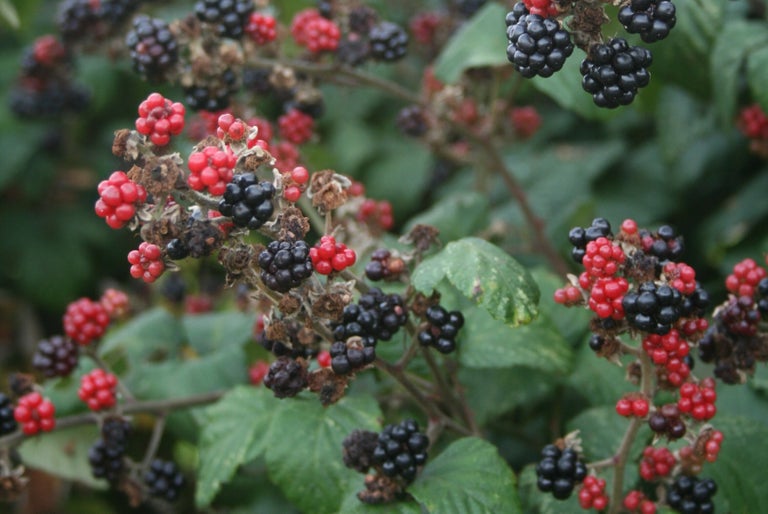
The diversity of the genus is immense and that excites me – there are more than 1,000 species. Some, such as Rubus ellipticus (Himalayan raspberry), are real monsters, and then there’s the alpine raspberry, which is very delicate. Within one genus you’ve got plants that behave like climbers, others that form neat carpets and some that shoot up like bamboo. Some are elegant shrubs and others have spectacular foliage or coloured stems. Their leaves can be corrugated, glossy, silver-backed, or even bronze and hairy. Flowers range from delicate white to the only true red species, Rubus calophyllus, and fruits can be black, red, orange and even blue. There are loads in the UK too, such as the giant Himalayan blackberry, which was brought over decades ago, got loose and . In just a few feet of hedgerow, you will likely find several Rubus species.
1
of
2
Barry’s collection of brambles will join Rubus cockburnianus ‘Goldenvale’, just one of more than 200 Rubus to see across the Sir Harold Hillier Gardens, Hampshire
How did it become an official National Plant Collection?
I didn’t set out to create one, but it seemed like an interesting thing to do. For years, the plants were crammed into my quarter-acre garden in Hampshire, literally growing towards the door. Then I bought a woodland to put them in, but the deer just ate everything – I lost rare plants overnight. I’m so pleased the collection is now moving to our deer-proof nursery at RHS Partner Garden the Sir Harold Hillier Gardens, Hampshire. Visitors will be able to see the full range by late spring – there are 50 different Rubus in the wider gardens and the rarer species will be in the nursery, viewable by appointment. I’m excited they’ll finally have the space to grow properly like they do in the wild.
Have you gone in search of Rubus growing in the wild?
Yes, I’ve collected in Taiwan, studied species in New Zealand and the RHS awarded me a travel bursary for two trips to southern China to collect them. China was like a sweet shop for Rubus. I was saying “stop the car” every five minutes. I’ve had some pretty memorable trips. I’ve been lost in the wild twice, once in the Cuban jungle during which I had to climb a tree in the fading light to try and find a way out. In Malaysia‚ I came face-to-face with a Malayan pit viper and a wild dog, and in China I dangled over a cliff trying to get fruit from a R. reflexus var. lanceolobus. In the end‚ the botanist travelling with me climbed out across a tree limb to get some. He then came face-to-face with a bee’s nest and was stung quite badly. I felt so guilty.
Which Rubus would you recommend for gardeners?
Some make great ground cover.R. henryi (Henry’s raspberry) has glossy evergreen leaves and roots from every , so it makes a very neat carpet. Once R. thibetanus (ghost bramble) loses its leaves in winter its white thorny stems are great for winter interest. If you want fruit and foliage, Japanese wineberry, R. phoenicolasius, is hard to beat. Foliage wise, R. trifidus has lovely autumn colour on maple-like leaves, R. corchorifolius has purple young shoots, and some Chinese species have silver-backed leaves that are almost iridescent – fantastic for a tropical-look garden.
Specimen of R. henryi var. henryi, grown from cuttings gifted to Barry from the Botanic Gardens, Copenhagen
A 2009-preserved specimen of R. ‘Rushbrook Redleaf’, introduced by Barry in 2007.
And we should talk about vigour, shouldn’t we?
Some are vigorous, yes, but not all. People fear they’ll take over, but many species are well-behaved. Even the big ones can be controlled with pruning or root barriers. Honestly, bamboo is worse. The key is knowing the plant’s habit. Most root easily from their tips, so if you keep them in check you should be OK. You do need to give space to the Rubus grown for their winter stems. In the Winter Garden at the Sir Harold Hillier Gardens R. cockburnianus ‘Goldenvale’ and R. biflorus are vigorous and can also . We treat them like Cornus and cut them back hard each year – definitely a big gauntlet job. The Japanese wineberry can also become vigorous. Some have stems so if you do cut them back, you won’t get the flowers and the fruits. You can grow some of the smaller Rubus with weeping habits in pots for several years, but they all do much better directly in the ground.
There are very few that produce excellent fruit to eat, and if they do, it’s in small amounts, so I’d never advise people to grow them just for fruit instead of a cultivated blackberry. That said, the Japanese wineberry is the best for taste. I’ve also grown R. setchuenensis from China, which fruits in November and has a flavour a bit like candy floss, but early frosts can damage the flowers and fruits. There’s one, R. mesogaeus, that has tiny little blue fruits with the most beautiful taste. In general, Rubus fruits are very good left for wildlife.
Are they tough as old boots like native brambles?
Most are perfectly hardy in the UK. Some, such as R. chamaemorus (cloudberry), grow near the Arctic while others, such as R. volkensii, get almost to the desert regions. Rust disease pops up occasionally, but they’re generally resilient, and although deer love eating them most will come back from the roots. In heavy rain, you can also lose the bloom – the white substance – on R. thibetanus (ghost bramble). Ours are sheltered by neighbouring plants. Soil wise, acidic to neutral is good, but some prefer a limier soil. It depends on what species you’re growing. They generally require quite high levels of moisture – I consider them forest-edge plants.
Now your collection is moving, is that it for you and Rubus?
No chance. I’ve still only scratched the surface of the genus. I’ll keep collecting and can plant more at Hilliers. I’m the Botanist and Plants Records Officer there, but I’m often referred to by some as The Rubus Man, which is nice. Travelling around the world and being part of different ballets meant I never felt a connection to anywhere, but having this plant collection at Hilliers really enhances my connection to the place. I have other passions, but Rubus will always be my number one – their diversity is endless. They absolutely deserve a place in our gardens.
Barry’s best Rubus for...
Everything: R. phoenicolasius
The Japanese wineberry has foliage and flowers that are pretty enough, but it has spectacular hairy red stems in winter and then amazing fruits that are sweet, sticky and great frozen.
Winter interest: R. biflorus
When its leaves fall, the two-flowered raspberry is just a mass of pure white winter stems and thorns‚ and it really glows like frost. It’s like something out of Sleeping Beauty.
Foliage: R. lineatus
A gorgeous, tall shrub with a lovely weeping habit, the silky-leaved bramble can get up to 6m if happy and has the most amazing, deeply veined foliage.
Flowers: R. odoratus
A North American species with perhaps the largest flower of all. Called the flowering raspberry, it is deep pink and rose-like.
Enjoyed this article?
This piece comes from The Garden, the monthly magazine sent to RHS members. Filled with expert advice, planting inspiration and seasonal ideas, it’s one of the many benefits of RHS membership. Become a member to receive your copy each month.