Pick your pumpkin – the best to grow for eating and carving
It’s pumpkin season, but which are the best ones when it comes to taste and carving for Halloween? Find expert advice from RHS horticulturists on their tried and tested varieties

As hundreds of pumpkins and squashes take over the RHS Gardens this autumn, discover our favourite varieties, pick up growing inspiration and savour pumpkin-themed events
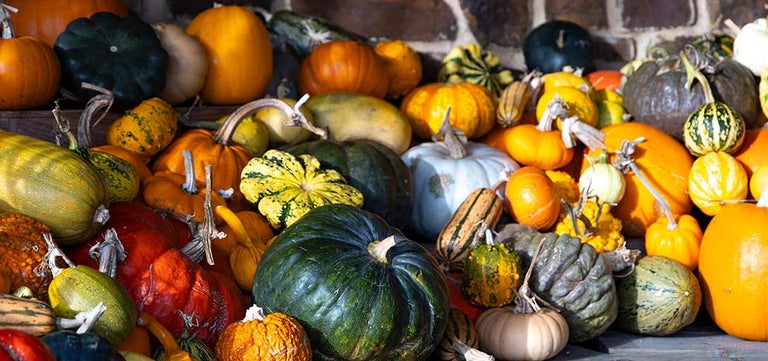
The joy of growing and showing pumpkins isn’t just for Halloween. These wonderfully versatile veggies, along with their cousins from the cucurbit family, squashes and gourds, come in an astonishing array of shapes, colours and sizes and are much more varied, exciting and tastier than the classic orange carving pumpkin.
Across the five RHS Gardens, our edible teams have grown an amazing showcase of more than 100 different pumpkins and squashes, highlighting their diversity and offering inspiration for growing your own. In early autumn, the hundreds of swelling, ripening fruits create a spectacle in our fruit and vegetable gardens as they emerge through sprawling, vine-like foliage.

It’s a great opportunity to explore the many varieties available to grow, from those with outstanding flavour, to weird and wonderful looks, and some with names to make you smile – have you got ‘Goosebumps’ or a ‘Butterbush’, or maybe you love ‘Big Loretta’. Even if space is limited, there are smaller cultivars to discover.
Discover more than 50 different pumpkins, squashes and gourds growning in the Fruit and Vegetable Garden and allotment area at RHS Rosemoor. Each year, the edibles team enjoy experimenting with growing different varieties, so you’ll find an enticing mix of new and unusual cultivars along with tried-and-tested favourites.
Interesting varieties include the spectacular heirloom squash ‘Turks Turban’. With amazing skin colour variation and as if wearing a stripey hat, it looks like another squash is bursting out of its top. Just as striking, Japanese heirloom variety ‘Black Futsu’ has deeply ribbed, dark green almost black skin that turns to orange when fully matured. It stores well and is delightfully sweet when roasted.

Dainty, decorative and delicious, munchkin-type pumpkin ‘Casperita’ produces small, pure white fruits and can be grown in containers. Pumpkin ‘Amazonka’ is another excellent choice if you have limited space, producing bright orange, slightly flattened pumpkins ideal for roasting or making soup.
Don’t forget to admire the impressive fig-leaf gourd tunnel, adorned with watermelon-sized fruits hanging from above as you walk through. They weigh several kilos each yet hang effortlessly like botanical jewels.

At RHS Harlow Carr, around 50 squashes and pumpkins romp through the pumpkin patch of the Kitchen Garden. Flavour and texture play a big part in choosing which varieties are grown.
Tempting in both taste and appearance is winter squash ‘Crown Prince’, which has lovely firm, deep orange flesh with a nutty taste and intriguing smooth blue-grey skin. Another favourite for flavour is ‘Red Kuri’, an onion squash with bright orange skin and flesh, and an outstanding sweet chestnut flavour.


For the first time the team are growing ‘Vegetable Spaghetti’ – a squash that thinks it’s a pasta. Oblong in shape with bright yellow skin, this summer squash is eaten like a courgette or marrow. The soft yellow flesh is spongy, but not tough, and when cooked separates into strands that resemble spaghetti and can be used as a lower calorie substitute for pasta.
One of the most striking pumpkins to spot is ‘Marina di Chioggia’. A heritage variety from Northern Italy with thick, knobbly blue-green skin that looks like giant bubble wrap.

In the Kitchen Garden and pumpkin field at RHS Bridgewater, keep an eye out for pumpkin ‘Atlantic Giant’. This heavyweight of the pumpkin world is often grown for competitions, reaching hundreds of kilograms in weight, and holds the world record for giant pumpkins. Although not typically grown to eat, their watery flesh can be used to gently flavour stocks and soups. Another whopper grown for its size is pumpkin ‘Mammoth’. This colossal is fun to grow with children, as you can watch the plant and fruit get bigger day by day.
At the opposite end of the scale, charming pumpkin ‘Jack be Little’ is one of the smallest – and cutest – pumpkins to grow. Scrambling up teepees in the Kitchen Garden, its dainty size and light weight make it ideal to grow up structures and trellises, saving valuable space. Small but mighty, its flavour-packed fruits can be boiled or roasted whole.

Both beautiful and delicious, pumpkin ‘Rouge Vif d'Etampes’ is often called the Cinderella pumpkin for its classic fairytale looks. This very old French heirloom variety is sweet in flavour and good for roasting and baking in pies. It can also be picked young and fried like courgette.
While pumpkins steal the autumn spotlight, summer squash can be just as striking and tasty. Heirloom pattypan variety ‘Disco’has wonderful flattened white fruits with a scalloped edge that look like little flying saucers. A compact, bushy plant, it doesn’t take up much space and is best eaten young and fresh, tasting similar to artichoke, and can be sliced into salads.
Whether you’re growing for flavour or for fun, RHS Wisley’s World Food Garden and nearby Fruit Garden offer plenty of inspiration no matter your level of experience or size of space. Among the wonderful array, ‘Barbara’ is a great butternut squash to try. It’s slightly more reliable in the UK than others and has the added appeal of green and orange stripey skin.


A favourite with visitors is ‘Tromboncino’, grown up supports to show off its absurdly long and wonky fruits that can reach one-metre in length. Although often grown for fun, it can be eaten fresh in summer or stored for winter. With a trailing habit and tennis ball-sized dark green fruits, winter squash ‘Little Gem’ is another excellent choice for training up structures. It has a high sugar content and caramelises beautifully when roasted or fried.
The clue is in the name of winter squash ‘Mashed Potato’. Its dazzling white, ribbed fruits reveal creamy white flesh that is silky when roasted and can be mashed up like potato, but with the bonus of fewer calories.
The Global Growth Vegetable Garden at RHS Hyde Hall offers an inspiring showcase of crops from across the world divided into continental areas. In the Central and North America beds, look out for the Guatemalan banana squash ‘Blue Banana’. This heirloom variety has been grown and eaten for centuries in Central America. With a thick, waxy pale blue skin and sweet flavour, it will store through winter and can be used in cooking as a tastier alternative to butternut squash.

In the glasshouse, a display bed of crops evolved from Sub-Saharan Africa features the bottle gourd, Lagenaria siceraria. Grown across the tropical world, its fruits are either harvested and eaten young or left to mature and then dried and used as containers, decorations or musical instruments.
Closer to home, in the European and Middle East section, stunning French heirloom squash ‘Galeux d’Eysines’ translates as “embroidered with warts from Eysines”. Doubling up as a spooky Halloween centrepiece and delicious seasonal ingredient, its salmon-pink skin is covered in warts, while its sweet flesh is ideal for roasting, baking and soups.

Perfect for making pumpkin jam, Italian cultivar ‘Zucca Da Marmellata’ literally translates as “pumpkin for jam”. This is a great way of using a glut of pumpkins or squashes if you don’t have space to store them. Smaller varieties with high sugar and low water content work best, and the sweet preserve can be spread on bread or eaten with cheese.
The pumpkin at RHS Gardens typically starts in April when seeds are sown indoors in our on-site nurseries. Cat Hood, Horticulturist at RHS Hyde Hall says: “I start mine off in 9cm pots on a heat mat set to around 22°C to help – a sunny windowsill will do the same at home. Once the plants have a couple of true leaves I move them to a warm bench in our polytunnel.”
“They can grow rapidly at this stage and every year it’s a challenge to get the watering balance right. While the need water to grow, too much can stunt root growth or cause root rot.”
To avoid root rot, I usually let the pots become fairly dry and lightweight between waterings, but before the plants show signs of wilting. This also helps develop a strong root network as the plants seek out water.
This year at RHS Bridgewater, RHS Rosemoor and RHS Wisley the pumpkin seedlings were damaged by fungus gnats (sciarid fly), a common nuisance for greenhouse and indoor plants. Pete Adams, Edibles Team Leader at RHS Rosemoor says: “Their larvae can attack the young developing root system, and it seems that pumpkins and squashes are a particular favourite of theirs. We use a biological control nematode that hunts out the larvae of the fungus gnat to control their numbers.”
Careful management of watering can help deter fungus gnats. They enjoy damp compost, so try to avoid over watering young plants.
The team at RHS Harlow Carr are growing their pumpkins and squashes in a no-dig bed where crimson clover was used as a to feed the soil before planting. Growing clover adds nitrogen to the soil, and the cut down material can also be left in-situ as a that will deliver and improve soil structure as it breaks down.
Suzie Orger, Horticulturist at RHS Harlow Carr says: “We sowed the crimson clover too thickly, so have had to keep cutting it back to give the squashes light and space to grow. On the flip side, crimson clover flowers look beautiful and have attracted many pollinating insects to the area. It’s also kept the ground around the squashes and pumpkins shaded, helping to keep the soil moist for longer.”
Another way to feed young squash and pumpkin plants, is to bury comfrey leaves into the soil around the base of the plant and water them in. Use around 8-10 comfrey leaves per plant. As they break down they release nutrients into the soil.
As summer approaches, plants are hardened off over a few weeks to acclimatise them to life outdoors. Squashes and pumpkins are tender plants, so don’t plant them outside until after the last frost.
Cat at RHS Hyde Hall says: “Typically, we plant outside once nights are relatively warm, ideally 10°C and, if possible, not below 7°C. This year that meant the first week of June for us in Essex.”
If plants are hit by a cold snap they can go into transplant shock. It can be a worrying time as plants sit in the ground showing no signs of growth. However, once nighttime temperatures pick up, the plants will start to grow. Be patient, as this can take as long as three to four weeks.
Pumpkins relish the heat, so hot weather can be an asset as these plants need warmth to get going, as long as they get enough water. Cat says: “During periods of drought, we keep the pumpkins watered, giving them a good soaking every five to seven days.”
No-dig cultivation can help retain moisture in the soil, so before planting we mulch our beds with a good layer of homemade compost. This ensures there’s plenty of organic matter in the soil to provide nutrients, support soil life and keep in water.