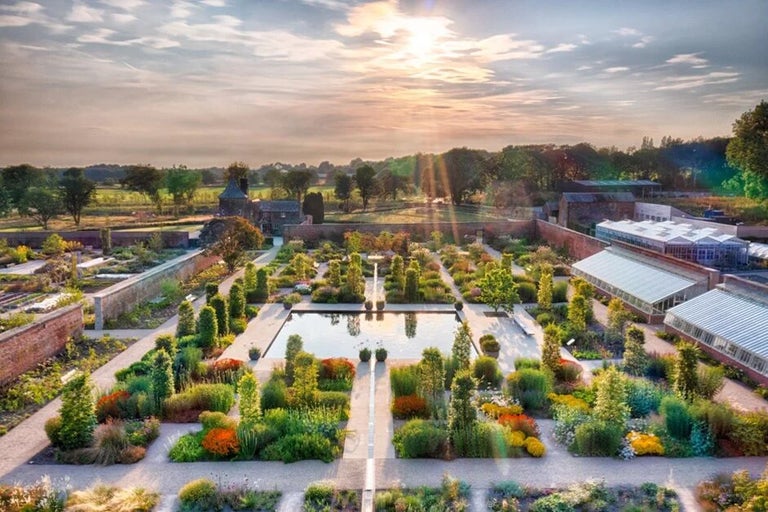
RHS Garden
Bridgewater
Symbolic Chinese trees take root at RHS Bridgewater
Planting starts around the Yangzhou Scholars’ Garden, a unique Chinese garden in Salford
As celebrations kick off for Chinese New Year, marking the start of the Year of the Horse in 2026, planting has begun in the Yangzhou Scholars’ Garden being constructed at RHS Garden Bridgewater in Salford. More than 200 trees and shrubs, from 56 different species and cultivars, have been chosen not only to delight visitors through the seasons, but also for their significance and symbolism in Chinese culture.
While Chinese New Year is rich in symbolic traditions – bringing prosperity, luck and happiness for the year ahead, so too is the art of classical Chinese garden design. Plants are selected for their symbolic meanings and to bestow messages of good luck, fortune, health, happiness and love.
Symbolic trees in the Scholars’ Garden
Pinus parviflora
Among the plants chosen for the Yangzhou Scholars’ Garden, pine trees such as Pinus parviflora are associated with strength and endurance in Chinese culture, remaining evergreen through the four seasons and often withstanding harsh growing environments.
Chinese philosopher Confucius is quoted as saying: “When the year grows cold, then we know the pine and cypress are the last to wither”, suggesting that in times of adversity, our true strength is revealed. Gnarled, twisted specimens are particularly prized, evoking the traditional scene of an ancient, weather-shaped pine clinging to a remote, rocky mountainside.
Rooted in the classical Chinese garden design principle of recreating the natural landscape in miniature, the pines at RHS Bridgewater will be cloud pruned in a traditional Chinese style, creating large bonsai that mirror the forms of mature trees in the wild.


Cloud-pruned Pinus parviflora in the Chinese Streamside Garden
Acer palmatum
Desired for their exceptional autumn foliage and beautiful forms, 13 different cultivars of Acer palmatum are included in the planting scheme. These trees all symbolise good fortune, happiness and longevity.
Although commonly known as Japanese maples, Acer palmatum has been used in Chinese gardens for centuries. Valued for their well-balanced, layered canopies and often twisted trunks, they mimic the look of much older and larger trees in nature.
Among those selected for the garden are many with the RHS Recommended: Award of Garden Merit, including Acer palmatum ‘Katsura’, Acer palmatum ‘Bloodgood’, Acer palmatum ‘Sango-kaku’and Acer palmatum ‘Ōsakazuki’.
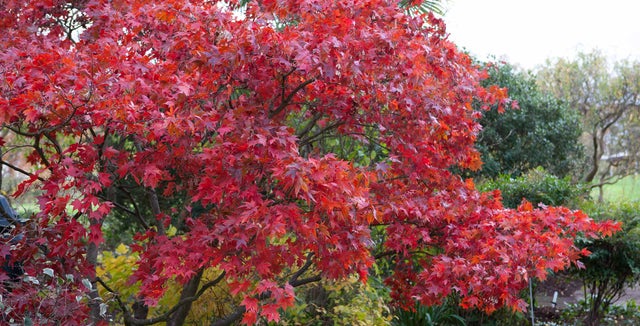

Acer palmatum ‘Ōsakazuki’, one of the chosen cultivars, prized for its intense red autumn foliage
Ginkgo biloba
One of the oldest surviving tree species, having changed very little in over 200 million years, and as one of the longest living trees, Ginkgo biloba represents longevity and resilience. to China, it is thought to have first been cultivated around temple gardens before gradually being spread through Asia and the rest of the world. With only a few wild populations remaining in China, its widespread cultivation has helped ensure the survival of this ‘living fossil’.
Today, Ginkgo biloba is a popular city tree that can withstand air pollution and poor soil conditions, bringing new significance to its traditional virtues. Its fan-shaped leaves turn a glorious buttery yellow in autumn. A striking six-metre-tall tree is being planted in the Yangzhou Scholars’ Garden, adding instant impact.

Ginkgo biloba in autumn shades of butter yellow
Zelkova serrata
Zelkova serrata, also known as Japanese zelkova, is said to bestow increasing success in Chinese culture. A wonderful tree for autumn colour, its slender, neatly toothed leaves take on vivid hues of red, orange and yellow. As the tree matures, its smooth grey trunk begins to flake, revealing a mosaic of colour.
Albizia julibrissin
A new tree species to RHS Bridgewater, the silk tree Albizia julibrissin is also known as the sleeping tree. Its leaves close at night and open in the day, symbolising the rhythm of marital harmony and a couple’s enduring affection for each other. Its large, mimosa-like leaves are composed of many small leaflets and it bears fragrant, bottlebrush pink flowers in summer. However, it’s yet to be seen how this typically heat-loving tree will perform in the garden’s Northwest climate.

Albizia julibrissin, the silk tree, coming into bloom
Lagerstroemia indica
Another experimental tree choice for RHS Bridgewater is Lagerstroemia indica, crape myrtle. Once regarded as tender in the UK, it now thrives in the sunny, free-draining Mixed Borders at RHS Garden Wisley in Surrey. With attractive peeling bark and festooned with clusters of pink, purple or white crinkly flowers in late summer and autumn, this tree represents auspiciousness, good health and wealth.
Josh Corbett, Team Leader of Arboriculture at RHS Bridgewater, said: “We’re always looking to increase plant diversity, and this is a great opportunity to try new things that not only provide a spectacular horticultural attraction, but let us see which plants do well in a changing British climate.”
Ever-changing seasonal beauty
Traditionally, a scholar’s garden is a place of retreat for reflection, creativity and connecting with nature. The Yangzhou Scholars’ Garden’s design emphasises the seasonal variation of the natural landscape, with plants carefully arranged to showcase the ever-changing beauty of the four seasons, one of the fundamental aspects of classical Chinese garden design.
Tracy Snell, Curator of RHS Bridgewater, said: “Visitors will be delighted in every season. Each garden entrance has a subtly different character, highlighting a specific season. In winter, the shadows of yellow-stemmed bamboo Phyllostachys aureosulcata f. aureocaulis will reflect off the courtyard walls, while cloud-pruned pines and Podocarpus provide a touch of theatre, alongside the delicate cherry blossom of Prunus × subhirtella ‘Autumnalis’.”


Magnolia × soulangeana delights in spring with large, pink-flushed goblet blooms
“Spring brings the zingy new growth of thirteen Acer palmatum cultivars, as well as the flowers of Magnolia × soulangeana, M. liliiflora ‘Nigra’ and the spectacular M. officinalis, with blooms as big as dinner plates, and the later-flowering cherry Prunus ‘Fugenzō’.”
“In summer, the garden will meld into restful hues of green, creating a peaceful woodland character. A pause before the cacophony of vibrant autumn colour from acers, ginkgos and euonymus.”

Artist impression of the Yangzhou Scholars’ Garden at RHS Garden Bridgewater
A unique showcase
Due to open in late September 2026, the Yangzhou Scholars’ Garden will form the spectacular centrepiece of the Chinese Streamside Garden at RHS Bridgewater.
Enclosing a courtyard and pool, its four interlinked pavilions celebrate the traditional scholarly pursuits of music, chess, calligraphy and painting. A striking showcase of authentic Chinese garden architecture, these buildings have been designed by Chinese architects who are experts in classical Chinese design and will be constructed by a team of craftspeople from China using traditional techniques.
The Chinese Streamside Garden is a remarkable fusion of Chinese and British horticulture, achieved thanks to the successful partnership between the local Chinese community, horticultural experts in China and the RHS. The Chinese Streamside Garden Founding Committee, comprised of members of the Chinese community in Manchester and the Northwest, was established in 2018 by philanthropist Dr Lee Kai Hung to help turn the vision for the garden into reality.
The Yangzhou Scholars’ Garden has been made possible thanks to the generosity of Dr and Mrs Lee Kai Hung, The Lee Kai Hung Foundation, China Flower Association and Yangzhou Slender Westlake Tourist Development Group Company Ltd. With support from the Yangzhou Classical Garden Construction Company and the Yangzhou Landscape Limited Liability Company.