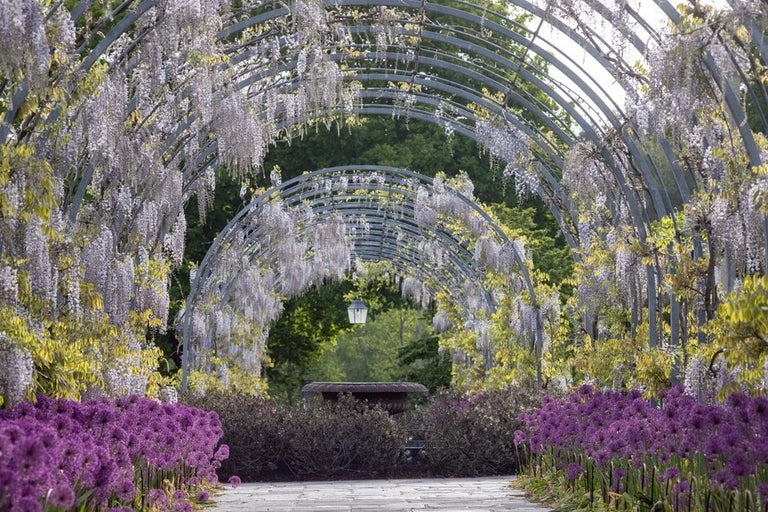
Many of our RHS Partner Gardens across the country feature beautiful and fragrant wisteria during spring
RHS Editorial Team
5-minute read
In full flower, wisteriais elegantly eye-catching. As vigorous climbers, they can clothe your house or garden walls or stand alone with cascading flowers.
Flower colours include white, lilac-blue, pink and a dramatic dark purple. The branches are covered with a mass of mid-green leaves which turn yellow in the autumn before they fall. A mature wisteria can reach around 10m (33ft) in height or spread up to 20m (66ft) against a wall.
Visit one of our mentioned RHS Partner Gardens this spring to see them in bloom for yourself.
Goldstone Hall Hotel & Gardens, Shropshire
Joe Wainwright
Wisteria at Goldstone Hall
The beautiful Wisteria at Goldstone Hall was already established when the owners arrived here in 1978, quietly tucked away against a bare south-east facing gable wall. In 1990, the wall was altered when a sash window was moved to make way for the new . During these works, the wisteria experienced a considerable upheaval, further affected by the raising and creation of the terrace below.
Rather than hinder the plant, these changes seemed to invigorate it. Since then, a simple routine of pruning in September followed by a light tidy in February has ensured reliable flowering year after year. By late April and early May, it comes into its own, filling the air with a delicate fragrance that drifts into the Green Drawing Room. For around 10 days, the racemes hang in glorious soft lilac clusters, a truly spectacular sight, before the falling petals scatter across the terrace like confetti.
Beneath it grow Clematis ‘Étoile Violette’ and ‘Princess Diana’, which happily weave their way through the wisteria and burst into flower during July and August, creating a second, equally delightful display on the wall later in the summer.
Free days out for RHS Members in 2026: 23 March–30 October, Monday–Thursday (excluding event days)
Exhibiting their National Collection of Wisteria at the RHS Chelsea Flower Show 2026, Brantwood is co-home to the Plant Heritage National Plant Collection of species and cultivars of Wisteria, which was started in 2022. Blooming typically between late spring until early June, there are four species, six hybrids and many different cultivars, including Wisteria floribunda ‘Mont Blanc’, Wisteria floribunda ‘Geisha’ and Wisteria x valderi ‘Lavender Lace’, which are represented in the collection of over forty wisteria that have been planted in the Trellis Walk and around the wider estate.
Free days out for RHS Members in 2026: Friday and Sunday when open
The Wisterias at Burrow Farm Gardens were planted in the year 2000 when the Millennium Garden was created and were planted to frame either side of the rill leading into the pond. This special garden was designed and planted by Mary Benger, the owner of Burrow Farm Gardens, who chose to use the variety Wisteria Prolific in this space.
The Wisterias at Burrow Farm are trained as standards rather than climbers, which makes them easier to prune and maintain but also offers a slightly different representation of a much-loved plant within the garden.
Free days out for RHS Members in 2026: April–October, Monday; September, daily
There is a White wisteria at East Lambrook Manor which grows over a support that bridges ‘The Lido’, part of an ancient farm at East Lambrook Manor. It was a farm for 600 years before being transformed into a Grade 1 listed garden by Margery Fish in the late 1930’s and 1940’s. A recent wedding of a previous gardener who used to help out at East Lambrook took place at the local church, and the couple asked whether they could have some of their photos taken amongst the floral displays in the garden. The white Wisteria looked perfect on the day and though it meant the bride and groom had to clamber into a ditch, they were able to get a beautiful photo of themselves amongst the flowers and a cutting from the Wisteria as well!
The new owners of East Lambrook Manor moved in last year, and now lovingly care for each of the Wisteria that grow in the garden, another of which runs along the front of the Medieval Manor house, once lived in by famous gardener Margery Fish. Walter Fish, Margery's husband, did not want a Wisteria, but when he died, Margery had her wish and planted the specimen which now surrounds the front door and grows along the front of the property. It was pruned in July last year and again in February of 2026 and the garden team now eagerly await the flowers to come.
Free days out for RHS Members in 2026: Wednesdays and Thursdays, April–September
Fullers Mill Garden was owned and lovingly developed by Bernard Tickner MBE from 1958, before being generously gifted to in 2013. Bernard dedicated decades to shaping the garden, introducing a wide variety of plants and features that reflected both his horticultural curiosity and his personal story.
One plant he was particularly keen to experiment with was Wisteria sinensis. He planted it in the Low Garden, just across the bridge from the house, choosing a spot where it could develop into a striking feature within the landscape. Around the base, he placed a mash tun plate, a nod to his earlier career as a master brewer at Greene King Brewery.
Now more than 30 years old, this wisteria has grown into something rather unusual. Instead of climbing, it has been carefully trained into a beautifully formed tree. With regular pruning, it continues to reward visitors with spectacular displays of flowers twice a year.
Free days out for RHS Members in 2026: April–October, Wednesday when open
The Spencer family owned York Gate Garden between 1951 and 1994, during which time they created the much-loved garden seen today. Following Sybil Spencer’s death in 1994, it was generously gifted to Perennial.
Sybil’s plant records show that five wisteria, of two varieties, alba and sinensis, were purchased in 1971 for between £1.90 and £3 per plant. These were originally planted around the . In her diary, Sybil writes: "We planted wisteria at the foot of each pillar, two white and two purple, but I'm afraid I've lost two. Only two survived and I'm still waiting for my white one to bloom."
The decision was then made to move the surviving purple one to the front of the house, where it has proved to be much more vigorous and spectacular. As anyone who grows wisteria will know, they are long-lived and extremely vigorous climbers, so the team at York Gate make sure to prune theirs regularly to prolong the flowering season and keep the wispy growth in check.
Free days out for RHS Members in 2026: Fridays only, April–October
Wisteria floribunda ‘Multijuga’ at Parham House & Gardens
Set in the heart of a medieval deer park at the foot of the South Downs, Parham’s award-winning four-acre Walled Garden is home to a stunning example of a Wisteria floribunda f. ‘Multijuga’, which displays wonderful long racemes that visitors walk under to reach the plant sales area. This is the oldest Wisteria in the garden and is estimated to be over 100 years old. The violet flowers with darker markings are sweetly scented and can grow to a mighty 1 metre in length, with the blooms lasting for around 2 to 3 weeks.
Free days out for RHS Members in 2026: April–May and September–11 October, when open
At Caerau Gardens, you can find whimsical Wisteria in the vegetable garden, where there is a mix of both sinensis and chinensis varieties. It is always fun for visitors to guess which is which!
The support arches here were used in the Twinings’ Tea Garden at the Hampton Court Flower Show in 2003 and the wisteria were featured in the 2002 Christie’s Against Cancer garden, The Road to Recovery, at Tatton Park. The two were put together in 2003 when the team here created the vegetable garden.
There is also a glorious Wisteria floribunda Lawrence nestled within the garden here. It is a standing joke between the owners and their son, who gave it to them after being a little bit difficult. It was an apology gift which they thought would have dark coloured flowers, as the owners enjoy a darker colour scheme. But when it finally flowered, they realised it was actually one of the palest varieties you can find. Each year when it blooms, the owners send their son a photo as a reminder; they are the best of friends now, so there is a happy ending.
Free days out for RHS Members in 2026: Thursdays and Fridays, April–May and September–October
There are two notable plantings of Wisteria to mention at Monteviot House & Gardens. The first grows on the 1830s Blore Wing of Monteviot House and although there is no formal record of its planting, it was most likely established under the instruction of the 13th Marquis of Lothian in the early 1980s. The variety is Wisteria sinensis, possibly planted as a tribute to Hampton Court, as another notable Hampton Court planting of a ‘Black Hamburg’ grape vine covers an adjacent wing here.
The second planting is on the Head Gardener’s pergola, which was installed in the early 2000s and is also the variety Wisteria sinensis.
Head Gardener, Jamie Stephenson, gives his top tips for growing wisteria:
Prune wisteria twice a year. A helpful way to remember is the “10 and 2” rule from driving lessons. As October approaches, cut back the long, whippy summer growth. Then, prune again in winter (February), reducing shoots to two short, plump, fuzzy flower buds on
When buying a wisteria, always choose one that is already in flower. Wisteria can take many years, sometimes decades, to bloom, so purchasing a flowering specimen gives reassurance that it will perform again in the future
If you are unsure which type of wisteria you have, there is a simple way to tell. Chinese wisteria (Wisteria sinensis) twines around its support in an anticlockwise direction, while Japanese wisteria (Wisteria floribunda) twists clockwise. These are the two principal species grown in the UK
Free days out for RHS Members in 2026: April–November, Thursday–Friday when open