Llanwrtyd celebrates centuries of heritage in an explosion of flowers
A first-time finalist in the 2026 Britain in Bloom UK Finals competition, this tiny Welsh town has decorated streets and public spaces with botanical arrangements that celebrate its history
For a town that claims to be the smallest in Britain, with a population of just 850, Llanwrtyd Wells is incredibly full of life. From its origins as a Victorian spa town to more recent and unusual traditions such as the World Bog Snorkelling Championship and the Man vs Horse race, its heritage is as rich as it is fascinating, attracting thousands of visitors each year from around the world.
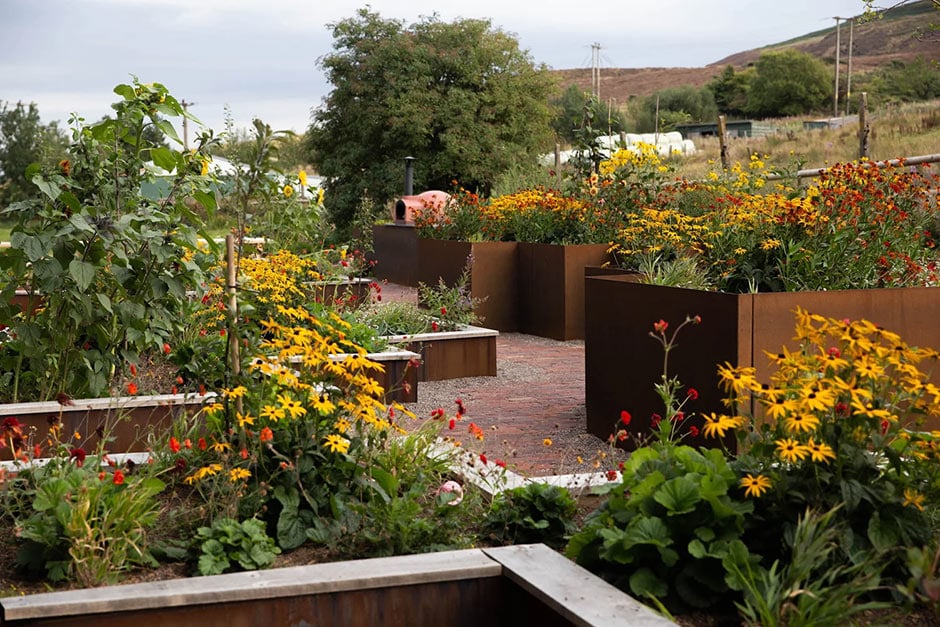
In 2026, Llanwrtyd in Bloom has been celebrating the legacy of this little corner of Wales by creating dazzling floral displays that recall its history. The group is a first-time finalist in the Britain in Bloom UK Finals, representing Wales in Bloom in the Village category.
A town that reinvented itself
Llanwrtyd Wells is nestled between the Cambrian Mountains to the west and the Brecon Beacons to the east.
During Victorian and Edwardian times, the area became renowned for the sulphurous water found in its wells. People would flock there by train to experience the supposed healing properties of the ‘stinking’ water, whose distinctive smell can still be detected today as you walk through the woods.
In the town square, a floral display of geraniums, sedum and fuchsias recalls Dolycoed Well, the only surviving spa well in Llanwrtyd, found in the grounds of the old Dolycoed Hotel
Thanks to its beautiful surroundings, in 1955 the town became the first official pony-trekking centre in Britain, attracting young women from all over the country – some of whom eventually married local farmers and settled in the town permanently.
During the 1960s and 1970s, Llanwrtyd was a renowned pony-trekking centre, with many young people visiting from the age of 14 and returning year after year
One of them was Val Hope, who created a celebratory display for Britain in Bloom outside her house using straw bales and a horse’s saddle with reins
“We grew wheat, barley and oats to represent the crops traditionally grown by our farmers, alongside pansies and other colourful
The farming display at the Llanwrtyd & District Heritage and Arts Centre
“During the Second World War, many Jewish children from what was then Czechoslovakia came to Llanwrtyd as part of the Kinder Transport organised by humanitarian Sir Nicholas Winton,” said Georgie and Lynn. “They arrived with only a small suitcase, hence the name of the ‘Suitcases of Memories’ flower beds we planted with red, white and blue flowers to reflect the country’s flag.” The town still has very strong links with Český Krumlov, where many of the children came from.
Back to more recent days, Llanwrtyd Wells has become a tourist destination for the weird and wacky events held annually in the town, attracting curious visitors from around the world. The so-called Green Events are the theme of the displays created at the local station.
Here, the Friends of Llanwrtyd Station have arranged a floral display around a bicycle to recall the Summer Cider Cycle, while the curiously funny World Bog Snorkelling Championship is represented through a box snorkelling display. “The volunteers made it look as though someone was snorkelling, with two legs sticking out and big black flippers on their feet, a head with a mask inside the box and a snow cloth and rucksack filled with plants,” said Georgie and Lynn.
A community that shows up
The polytunnel, in particular, has become a second home for Ukrainian couple Galina and Pasha Bagach, who relocated to Wales from Ukraine after Russia’s invasion. Missing their homeland and their large garden, they have started growing vegetables for the community.Georgie Perrett and Lynn Ball, Llanwrtyd in Bloom’s coordinators
Georgie and Lynn receiving a Gold award at the 2025 Wales in Bloom ceremony
“Suddenly, it was the talk of the town!” said the two group leaders. “For such a small population, the involvement and the enthusiasm have been amazing.”
Alongside the numerous and already active volunteer groups, many residents have stepped up and contributed in their own ways. To accompany each Britain in Bloom sign, local artist Rose McGrandle created a drawing of the red kite – an important symbol of Llanwrtyd, where one of the many kite-feeding stations was established at the end of the 20th century to help prevent the species from becoming extinct.
Another creative citizen, Allen Theseira, built a pushcart where people can leave surplus produce from their gardens for others to take and swap, which has become a very popular community exchange point.
The ‘Grow and Share’ cart has been very popular and a great way to share excess garden produce
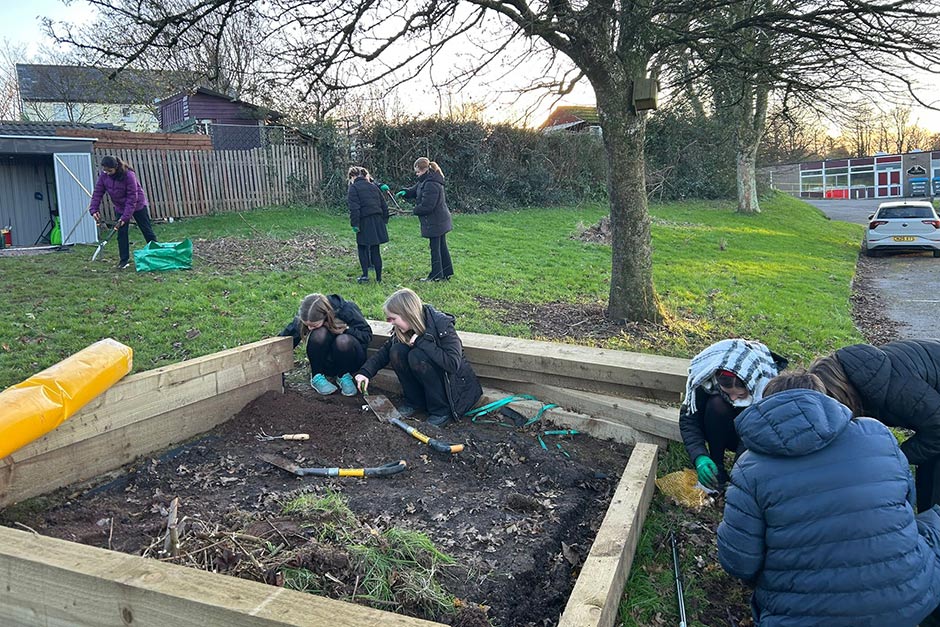
Volunteers at work during the ‘Sort It Saturdays’, making environmental improvements around the town
“This project has given everybody a sense of pride in the community and made an enormous difference to our streets,” said Lynn. “It’s been so successful that many people have asked us to keep it even after Britain in Bloom is over,” added Georgie.
Local businesses, members of the community, visitors to the town and even friends from overseas have also shown great generosity by raising funds for various environmental projects. One of them is Dolwen Field, a once-neglected and overgrown space that has been transformed into a community area with a sensory garden, a ‘Grow and Share’ garden, a
Ukrainian cucumber
“Galina and Pasha have introduced us to Ukrainian tomatoes and cucumbers, which look like gherkins because of their spiky skin but taste delicious. They also grow beans, courgettes, squash and much more. They’re very knowledgeable gardeners and are at the forefront of any volunteer call-outs.”
Many local children who attend schools outside the town have also contributed, creating a Welsh dragon from cotton wool, jute and natural wool felt.
A floral display inspired by the Welsh flag, created by Ysgol Dolafon’s schoolchildren
Beating the heatwave
“Watering has always been a major issue in Llanwrtyd Wells because we lack a reliable, accessible water supply system for public green spaces, but this year we’ve been even more desperate,” said Georgie and Lynn. “In springtime, we collected over 100 litres of rainwater from residents’ houses, but we ran out during the summer. We also applied to the River Authority to extract water from the river, but even though we got authorisation, we weren’t allowed to use electricity to power the pump. We have been really worried about how we were going to keep the plants alive.”
Volunteers worked tirelessly even when the heatwave made things challenging
The commitment has been wholehearted and the results are now there for everyone to see. “There’s a main road crossing the town and people have always gone straight through, but now more and more visitors are stopping to take photographs as they drive through. Taking part in Britain in Bloom has made a tremendous difference to Llanwrtyd and everyone who has contributed to the change feels proud to be part of it.”