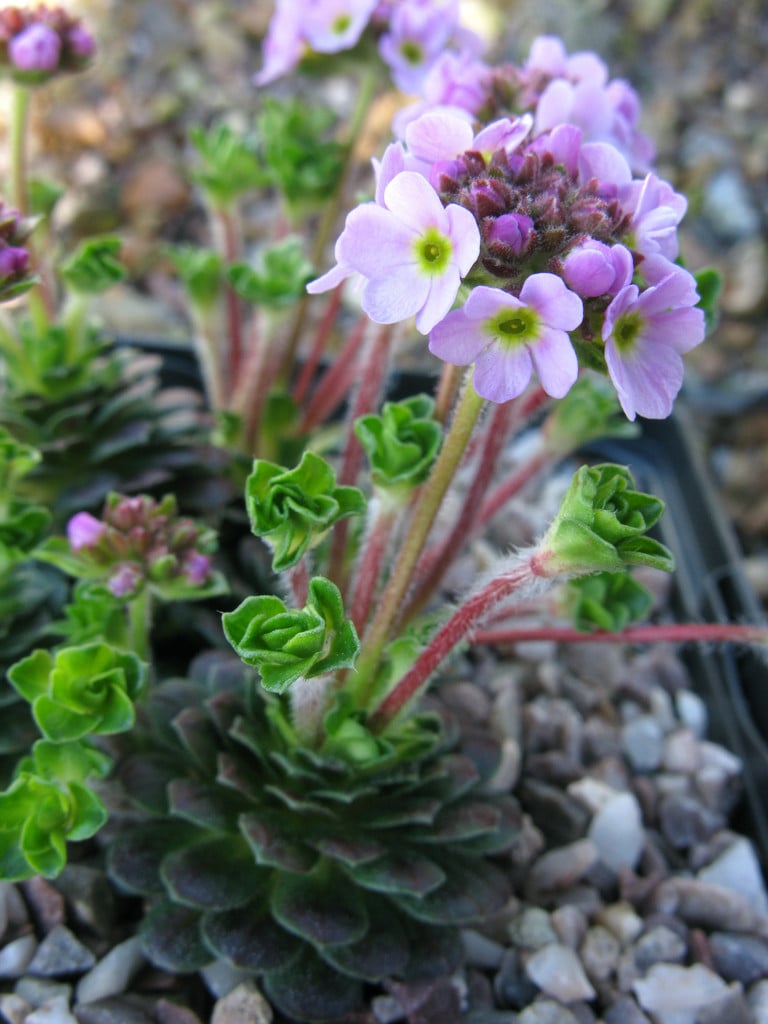
Androsace sempervivoides

RHS Plant Profile
sempervivum-leaved rock jasmine
sempervivum-leaved rock jasmine RHS

Synonyms

Androsace mucronifolia misapplied

Alpine Rockery

A mat-forming evergreen perennial, producing sprays of pink to mauve-pink, yellow-eyed, scented flowers 10mmacrossin spring. The eyes turn red with age, and the flower stems are also red

Position

Full sun

Soil Types

Chalk, Loam, Sand

Max Height

Up to 10 cm

Max Spread

0.1-0.5 metres

Size

Time to Maturity
2–5 years
Max Spread
0.1-0.5 metres
Max Height
Up to 10 cm

Growing Conditions

Chalk Loam Sand
Moisture
Well–drained
pH
Acid or Alkaline or Neutral

Position

Full sun
Aspect
West–facing or South–facing
Exposure
Exposed or Sheltered
Hardiness
H5

Colour & Scent

Fragrance Flower
Season Stem Flower Foliage Fruit
Spring
Summer
Autumn
Winter

Botanical Details

Family
Primulaceae
Native to GB/Ireland
No
Foliage
Evergreen
Habit
Matforming
Genus
Androsace can be annuals, biennials or evergreen perennials forming mats or compact cushions, with salver-shaped flowers which may be solitary or in umbels
Name Status
Correct
Plant Range
Kashmir, Tibet

How to Grow

Cultivation

Grow in a scree bed, in vertical crevices in rock or in moist but gritty, well-drained soil, or in containers

Propagation

Propagate by seed sown in containers in an open cold frame as soon as ripe or in autumn. Root single rosettes as cuttings in early to midsummer. Keep moist but water from below to avoid wetting the rosettes

Suggested planting locations and garden types

  • Patio and container plants
  • Rock garden
  • Gravel garden

Pruning

No pruning required

Pests

Generally pest-free. May be susceptible to aphids under glass

Diseases

Vulnerable to fungal diseases in damp conditions. Remove dead rosettes to reduce the risk of infection