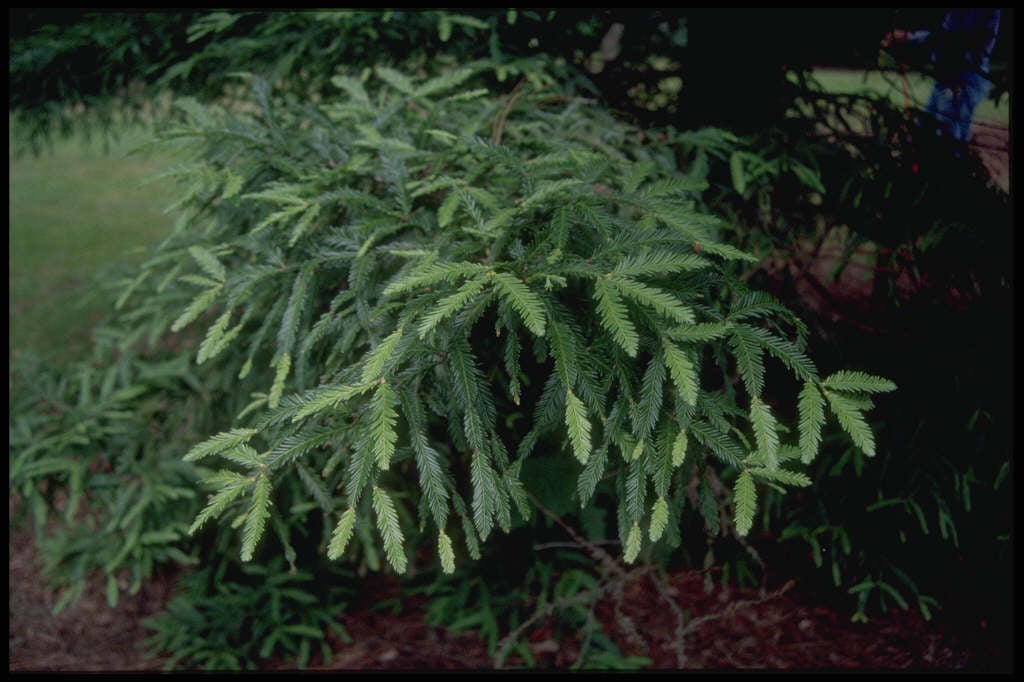
Sequoia sempervirens

RHS Plant Profile
coastal redwood
coastal redwood RHS

Other common names

Californian evergreen redwood, Californian redwood, redwood

Synonyms

Taxodium sempervirens

Award of Garden Merit
Conifers Trees

A fast-growing, very large and long-lived evergreen tree/conifer that can grow to 120 metres in its natural region of origin. It has striking thick, fibrous, soft and spongey reddish-brown bark and slightly drooping branches with dark green linear needle-like leaves that are arranged in two rows. Small hanging brown cones are produced after inconspicuous flowers. Ideally grown as a specimen in a large park or garden. Saplings are especially sensitive to frost.

Position

Full sun, Partial shade

Soil Types

Clay, Loam

Max Height

Higher than 12 metres

Max Spread

4-8 metres

Size

Time to Maturity
more than 50 years
Max Spread
4-8 metres
Max Height
Higher than 12 metres

Growing Conditions

Clay Loam
Moisture
Moist but well–drained
pH
Neutral

Position

Full sun Partial shade
Aspect
North–facing or West–facing or South–facing or East–facing
Exposure
Exposed or Sheltered
Hardiness
H6

Colour & Scent

Season Stem Flower Foliage Fruit
Spring
Summer
Autumn
Winter

Botanical Details

Family
Cupressaceae
Native to GB/Ireland
No
Foliage
Evergreen
Habit
Bushy
Genus
Sequoia is a tall and fast-growing evergreen tree with attractive, reddish-brown fibrous bark, and yew-like foliage arranged in two ranks on the shoots; cones are small, reddish-brown when mature
Name Status
Correct
Plant Range
W USA

How to Grow

Cultivation

Grow in moderately fertile, moist but well-drained soil in full sun to light dappled shade. See conifer cultivation

Propagation

Propagate by seed in containers in a cold frame in spring. Root softwood cuttings in summer or semi-ripe cuttings in late summer or autumn

Suggested planting locations and garden types

  • Architectural
  • Low Maintenance

Pruning

No pruning required, but it is one of the few conifers that is suitable for coppicing, or that will make new shoots from the base if cut down

Pests

Generally pest-free

Diseases

May be susceptible to honey fungus