Think climbers, and clematis, roses and sweet peas come to mind. But what about something more exotic? Find your favourite with this selection from plantsman Graham Rice
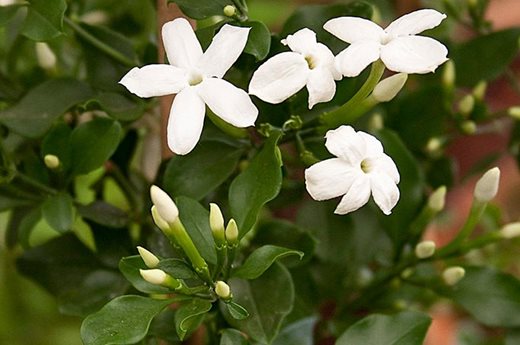 The sweet-scented white flowers of Jasminum angulare (pictured) have an even stronger scent than that of the more hardy jasmines, while the vigorous evergreen Mandevilla boliviensis is easily manageable outside in a container of peat-free compost that can be brought inside over winter. It has five-petalled, 7cm (3in) white flowers each with a rich orange throat.
Lapageria rosea, Chilean bellflower, twines to 2.5m (8ft) and its long, narrow, funnel-shaped flowers in deep rose pink hang in clusters. If you live in a mild area of the UK, you can grow in it a sheltered, lightly shaded site away from cold, drying winds. Otherwise, it makes a great conservatory plant.
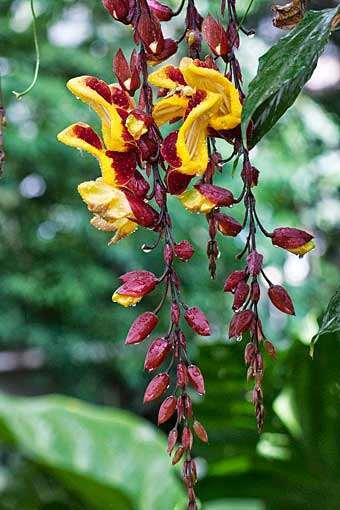 You may have grown old favourite black-eyed Susan, Thunbergia alata. Try its tropical relative T. mysorensis (pictured) with wisteria-like flowerheads, the red buds opening to red and yellow flowers. It’s ideal in the roof of a warm, humid conservatory, from where its glamorous flowers can swing.
Try these outside
Annuals can quickly create an exotic air. Cobaea scandens (cup and saucer vine), with large purple bell-shaped flowers, reaches 3m (10ft) thanks to its tendrils, which make it ideal for growing up a wigwam, obelisk or trellis. In sun and fertile soil it will produce hundreds of flowers by early autumn.
Morning glories have a similar effect, and while the familiar Ipomoea tricolor ‘Heavenly Blue’ always captivates, the less common Ipomoea nil ‘Chocolate’, with trumpet-shaped flowers the colour of milk chocolate, looks like something from another planet instead of another climate. Ipomoea lobata and Ipomoea coccinea both make fiery alternatives.
Though reasonably hardy in a sheltered, free-draining position, Mutisia ilicifolia looks exotic because of the unusual combination of lavender-pink daisy flowers set against holly-like leaves. The blue perennial pea, Lathyrus nervosus, also captures attention with its rounded, blue-green leaves and fragrant sweet pea flowers.
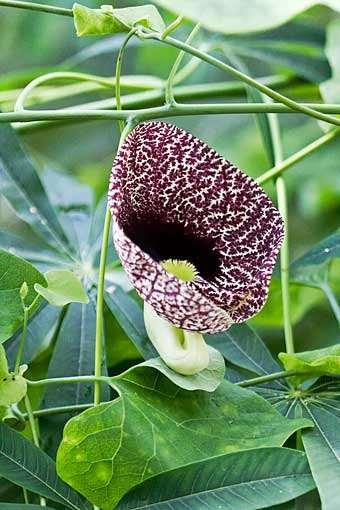 The big, bold heart-shaped leaves of Aristolochia macrophylla (pictured), up to 30cm (12in) long, are all you need for a subtropical look, yet the plant is very hardy in our coldest winters. The speckled flowers are attractive too.
Hardy perennial nasturtium, Tropaeolum tuberosum var. lineamaculatum ‘Ken Aslet’, is another climber with an exotic air. It produces fat edible tubers that are popular in South America and are found in world food stores in the UK.