The Japanese banana, Musa basjoo, is the most commonly grown banana in the UK. In autumn it’s important to keep an eye on the weather forecast, as you will need to have your banana plants wrapped before the first hard frosts set in. Bananas can tolerate a few minor frosts, but the weather can be unpredictable, and you might only have a short timeframe to protect them.
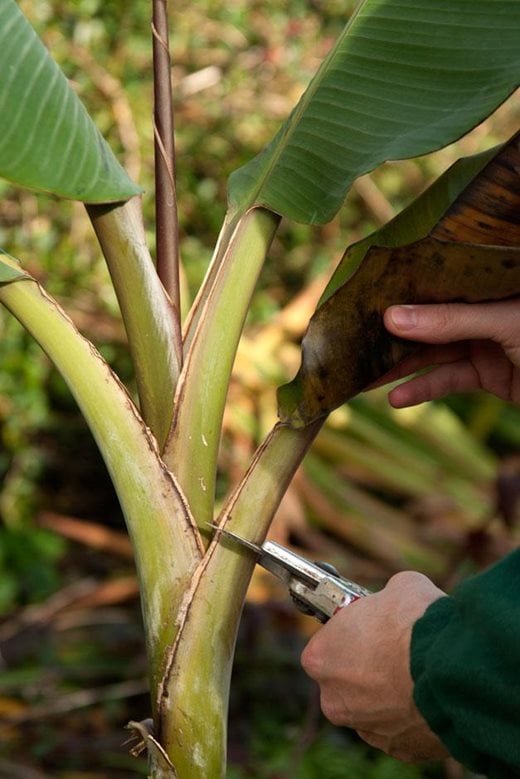
Step 1 – Remove the leaves
After the first light frosts, you may notice that some of the foliage has blackened, but don’t worry – you now cut off all the leaves just above the top of the stem.
Use a sharp pair of secateurs and make a sloping cut away from the centre of the stem. This will prevent moisture from channelling into the stem and causing it to rot.
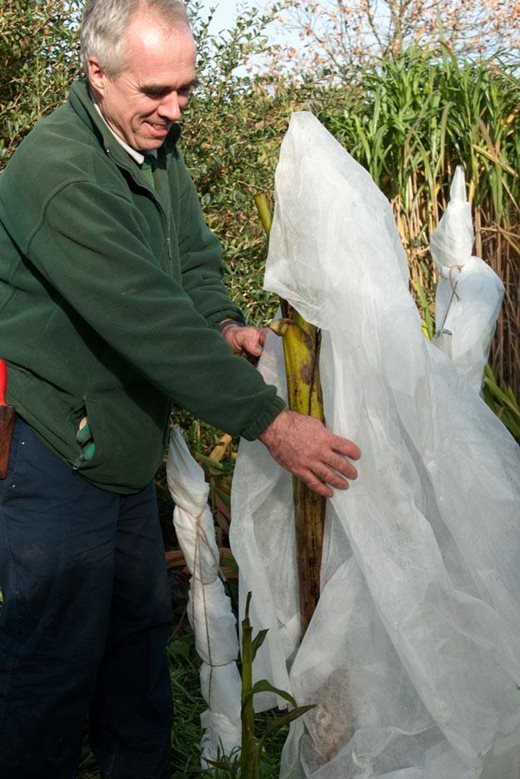 Step 2 – Wrap the plant
Wrap the whole plant with re-used or biodegradable fleece, ensuring that there are no gaps.
Use garden twine to secure the fleece, tightly enough that the fleece stays in place, but not so tight as to dig into the stem and damage the trunk.
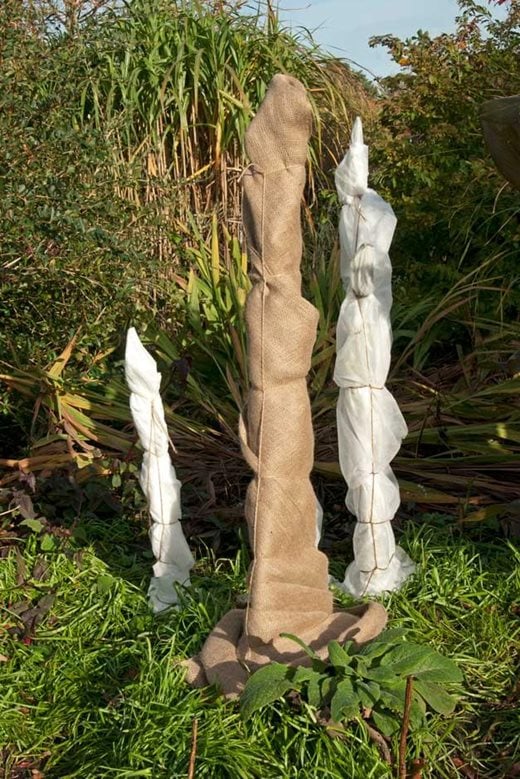 Step 3 – Wrap hessian around the fleece
Wrap a layer of hessian around the fleece and tie it securely; this will offer even more protection. Having someone else to help makes the wrapping easier.
Fleece and hessian may be all that’s needed if the plant is in a sheltered spot.
Extra protection for cold areas
Step 4 – Construct a wire frame around the plant
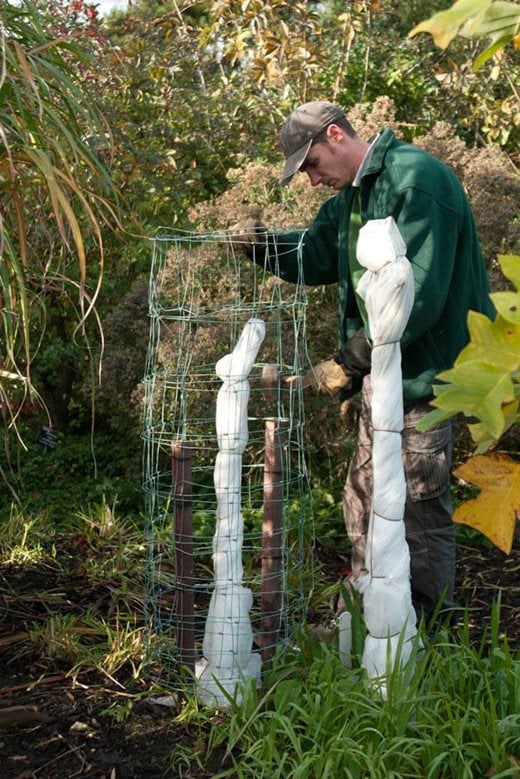 In cold areas away from cities and the coast, additional protection will help the plant to survive. Wear a thick pair of gloves and eye protection for this stage.
Make a cylindrical frame around the trunk, using wire such as chicken wire or stock fencing. Secure this with two stakes hammered in on either side of the plant, taking care not to disturb the roots. Ideally you should have a gap of around 15cm (6in) from the circumference of the wire to the tree trunk.
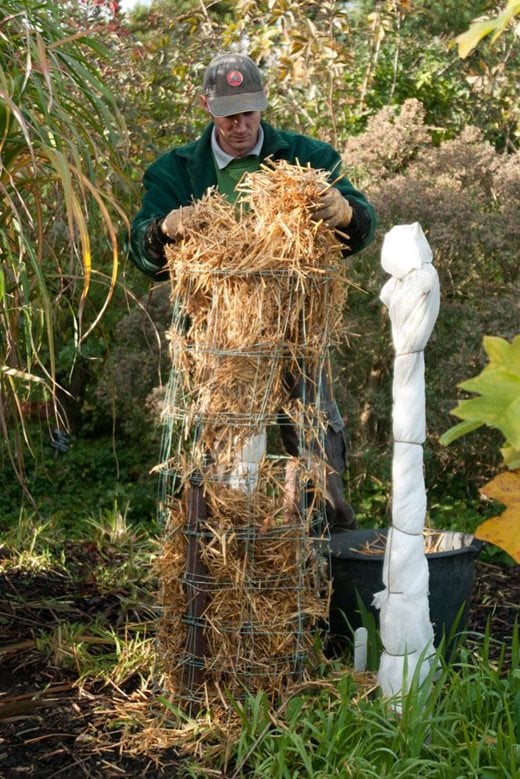 Step 5 – Pack the cage with straw
Fill the wire cage up with straw or dry bracken, packing it in quite tightly to surround the trunks completely.
The purpose of this is to create a thick enough insulating layer to prevent the cold from reaching the stem.
Step 6 – Fix a cover over the top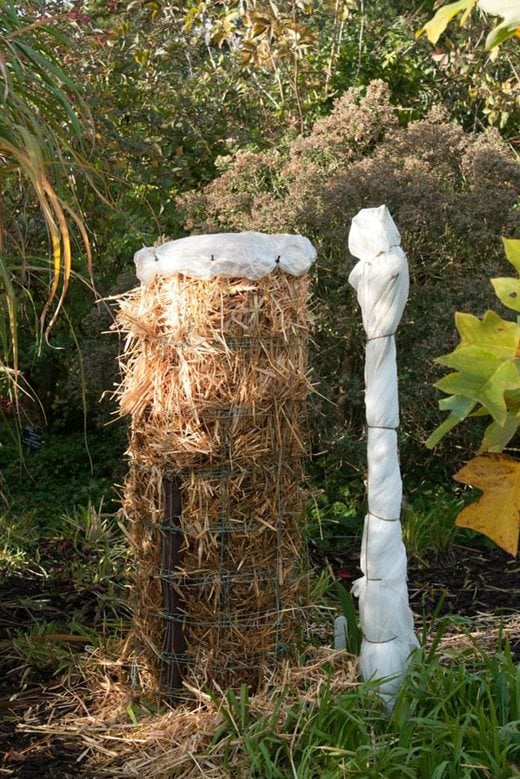
The last step of the process is to attach a reused polythene sheet over the top of the banana. Secure the sheet using twine so that it does not blow away in the wind.
Although we try not to use plastic in the garden, the purpose here is to provide waterproofing to prevent rain, snow and ice from getting into the middle of the plant.
What are we doing at RHS Gardens?
Russell Watkins, Team Leader at
RHS Garden Harlow Carr in Yorkshire, has tried simplifying the number of steps – removing foliage, then creating a frame around the edge of the plant with chicken wire, filling it with straw, and wrapping the whole thing with hessian or reused/biodegradable fleece.
“However, one year, we had early snow and missed the boat for doing this,” Russell says. He decided to see what would happen if he left the bananas to their own devices, and the results were interesting.
“The clumps that were left alone, with their old foliage, survived completely unharmed, although they looked a bit messy. We tidied up a clump near the path and even though frost killed it back to ground level, it’s almost the same size as the others again now.”
So, now Russell waits until the foliage drops and then wraps the stems with the foliage neatly tied in. This is a much easier way to manage large clumps and has the benefit of not requiring plastic.
Useful links