Metasequoia – from near extinction to National Plant Collection
The discovery of Metasequoia in the early 1940s is one of chance, miraculous coincidence and perseverance. The amazing story of this tree captured the imagination of Peter Jones, former Garden Manager, encouraging him to look into the history of RHS Wisley’s dawn redwoods and the many surprisingly distinct cultivars this grand tree has to offer
Peter Jones
Former Garden Manager, RHS Wisley
7-minute read
Introduction
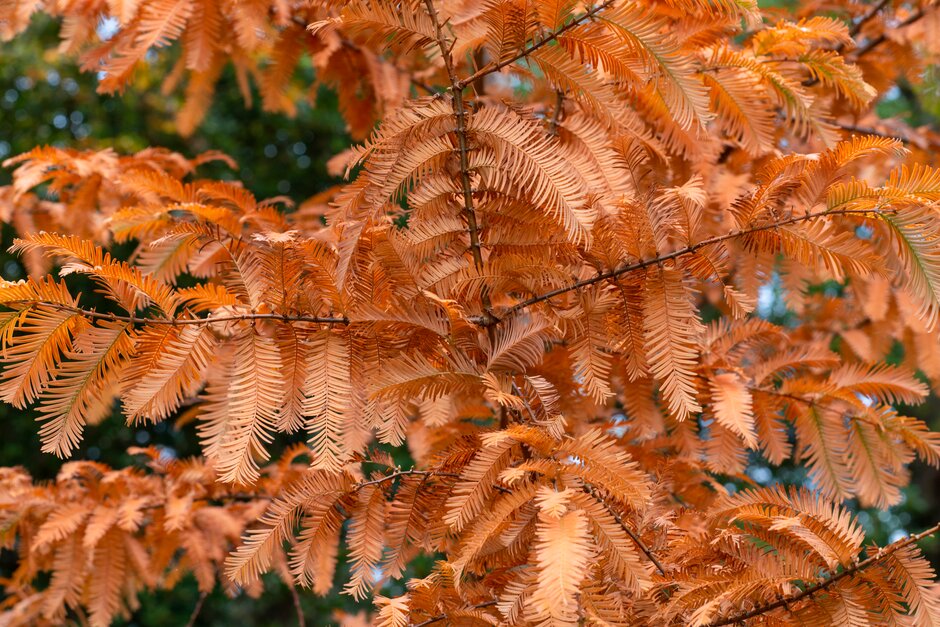
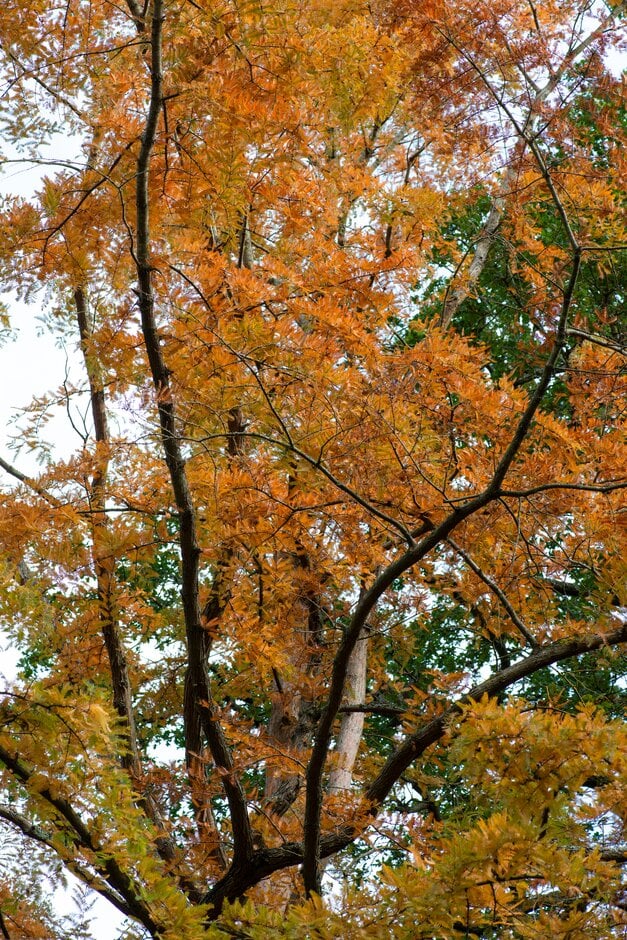
RHS Wisley achieved National Plant Collection status in 2019 and grows 22 different taxa (one species and 21 cultivars) of Metasequoia. The best time to view them is in April for foliage and in October for autumn colour.
The genus Metasequoia was first described by the Japanese botanist Shigero Miki in 1941, from fossils newly discovered in Japan in Lower Pliocene strata. Miki noticed several distinct differences separating the sample from the giant redwood, notably the opposite, not alternate or spiral arrangement of the leaves, buds and branchlets. This also separates Metasequoia from two of its winter- cousins, Glyptostrobus and Taxodium.
Coincidental discoveries
Now comes the miraculous coincidence: only a few months after Miki had identified and named this newly discovered but apparently extinct genus, living trees of Metasequoia were discovered in China. A Chinese forester named Toh Kan encountered an unfamiliar tree in remote Lichuan County, in Hubei. He took sample specimens of the bare winter twigs but being unaware of the tree’s significance did not attempt to identify it. However, it may be from this encounter that the rumours of an unusual, unknown tree arose, that encouraged a forester called Zhan Wang to investigate the area in 1943. Wang found the tree but mistook it for Glyptostrobus pensilis, a deciduous conifer widespread in southern China. He collected specimens but as the Second World War raged across continents, these remained without a proper identification until, in 1948, botanists Xiansu Hu and Wan-Chun Cheng published the name Metasequoia glyptostroboides, finally making the link to Miki’s fossil genus.
The first seed collections of M. glyptostroboides were made in 1947. The common misconception is that all this seed went to the Arnold Arboretum from where it was further distributed. In fact, much seed was sent direct from China to other botanical institutions around the world including Kew and Edinburgh. However, the consignment of seed that Wisley received, which records state was “collected 2nd Feb 1948 China: Szechuan and Hupeh Province, Shui-sa-pa valley. 1000 m” did come from the Arnold Arboretum via Lord Aberconway of Bodnant Gardens (former President of the RHS). Twelve trees from this original introduction continue to grow happily at Wisley today.
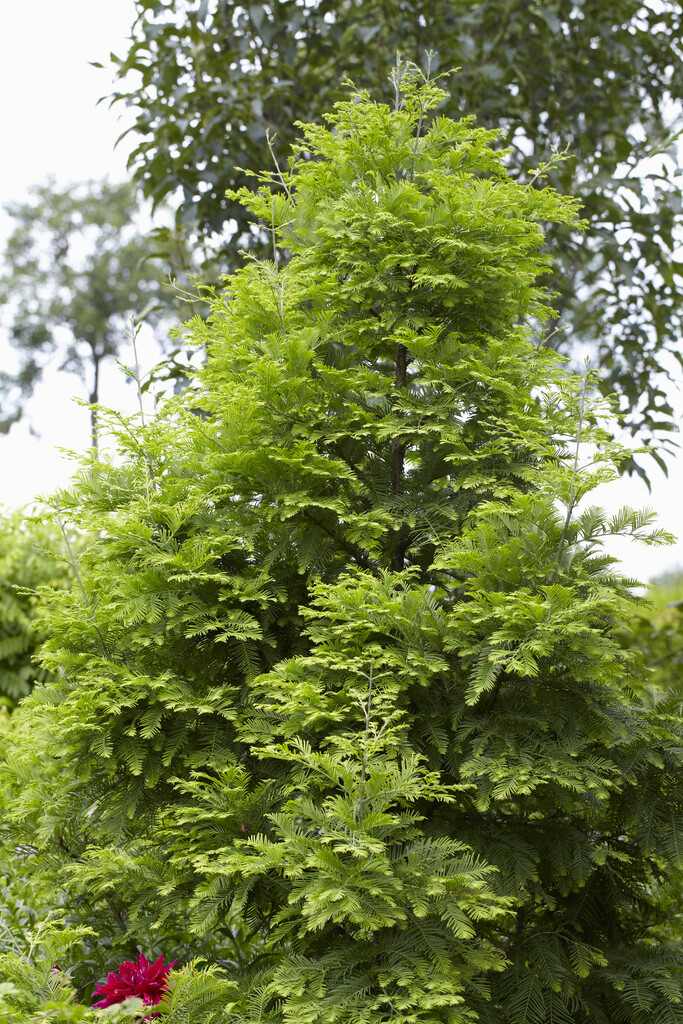
Metasequoia glyptostroboides 'Emerald Feathers'
Understanding the beast
Dawn redwoods can grow to 50m tall, with trunks as wide as 3m in diameter. Young trees have a conical-pyramidal habit becoming elongated with maturity. It produces soft needle-like leaflets in late April and the emerging foliage can be particularly vibrant in colour (notably in the cultivars), varying from bluish to lime-green, yellowish green or bronze, turning bronzy yellow or more often orange or rust-red in autumn.
Widely acknowledged as moisture-loving trees, they are often planted near riverbanks and on edges of ponds, much in the way people like to position Taxodium, the swamp cypress, which can look similar. This is exactly what has happened at Wisley with several of our best specimens being planted around the ponds on Seven Acres, where the trees now form tall sugar cone-like sentinels, standing watch over the ducks and herons.
The oldest Wisley trees from that initial introduction vary greatly in form and habit. The majority are now towering specimens approximately 15-18m in height, some have relatively plain trunks but others have beautiful, deeply fluted flared bases, like something from a Brothers Grimm fairy tale. One particular tree which has been christened the “Wisley Witch” stands no taller than 5-6m in a quiet corner of Battleston Hill, never pushing a strong leader, sitting squat with a particularly angry trunk, gnarled and fissured.
Given the amount of variation in these dozen or so trees, it’s easy to see how so many distinct and interesting cultivars have been selected in recent years. Intrigued by these characteristics, I built the National Collection at Wisley, achieving the status in 2019, now numbering 21 different taxa (one species and 20 cultivars). For me it’s fascinating how distinct these different cultivars can be, and such a shame more aren’t widely grown.
In recent years, RHS gardeners have been planting and trialling cultivars in other parts of the garden. Oakwood was an obvious location, being the lowest lying part of the garden and regularly sitting wet during winter and on into later spring. This is where I witnessed some truly astonishing growth.
In 2017, I planted one truly pot bound, weak and feeble specimen of the ‘Waasland’ no more than 1.2 metres in height, I was not hopeful of its survival, as I had to remove most of the roots due to spiralling in the pot. This tree is a picture of health and vitality, now 8-9 metres high and over taking the many struggling Quercus robus nearby, showing this genus can adapt to the changing climate which some of our trees are struggling with.
Elegant, with multiple seasons of interest – emerging foliage in spring, vibrant autumn colour, or the wonderful skeleton branch silhouette in winter – Metasequoia fits into my favourite plant category, one that is good value! Tolerant of climatic extremes with excellent pest and disease resistance, it is certainly a tree which has great potential in UK horticulture and amenity landscape, especially where there's room to let the large cultivars flourish.
‘Amber Glow’ A fairly new cultivar to the UK, the foliage emerges in spring with a touch of burgundy that is quickly replaced by yellow leaflets, in autumn these fade to the typical rusty orange. Selected as a seedling of ‘Gold Rush’, it is fast growing but maintains a compact look.
'All Bronze' A recently planted cultivar at Wisley, raised by Dutch nurseryman Nelis Kools Nursery c. 2000, ‘All Bronze’ has young foliage that flushes with a metallic bronze hue, and intense orange-bronze autumn colour, with a reportedly upright habit and vigour, Wisley's plant is still very young so I can’t confirm that characteristic, but it does show great promise.
‘Blue-ish’ Aptly named, as it is indeed “Blue-ish” the initial spring growth has a striking metallic quality, which does make this variety stand out. For the moment this is the only particularly distinct characteristic I’ve noted, but I think that is definitely good enough a reason to grow it.
'Daweswood Tawny ' A selection found at The Dawes Arboretum, Ohio, as a witches'-broom on one of their wild-origin specimens, it has a rounded to slightly conical habit with bronze leaflets with an initial striking metallic quality. Definitely a slower growing cultivar 1.5-2 metres in 8 years, making it useful for a domestic sized garden.
'Emerald Feathers' Is perhaps more widely known in the US, selected prior to 1972 at the US National Arboretum in Washington DC. Selected for its slender conical habit, more radiant green leaves, and its extraordinary vigour, being capable of achieving 7 m in ten years though 4–6 m is more usual (Auders & Spicer 2012). The tree in Oakwood does produce elegant luscious foliage and is putting on substantial height now its roots have established.
'Golden Dawn' A miniature selection of much reduced vigour, forming a rather squat globose plant to c. 1.5 m in ten years. The foliage is described as smaller than typical, creamy-yellow at first, darkening to golden yellow as it matures. It was raised from seed by K.W. Murray in Delaware, c. 1986, and seems still to be restricted to cultivation in North America (Auders & Spicer 2012).
'Golden Oji' Synonyms [GOLD RUSH] Probably the most popular of the Metasequoia cultivars would undoubtedly be 'Golden Oji'. Commonly known by its trade designation, GOLD RUSH. It was raised from irradiated seed sown at the Kameyama Breeding Station in Mie, Japan, in 1974. The Wisley specimen on Seven Acres happens to be the National champion, and is flanked by three handsome brothers from the original 1948 seed consignment. With its bright sulphur yellow emerging foliage, which persists with vibrancy throughout the , then fading to bright orangey brown in autumn, it is a striking tree that can light up a dark treescape. But does need some thought of placement when considering the long term visual effect.
'Hamlet's Broom' One of very few true extreme dwarfs of this species, ‘Hamlet’s Broom’ was propagated from a witches’ broom found in Denmark prior to 2005. Its foliage is feathery and lighter in green colour through the growing season and has superb autumn vibrancy.
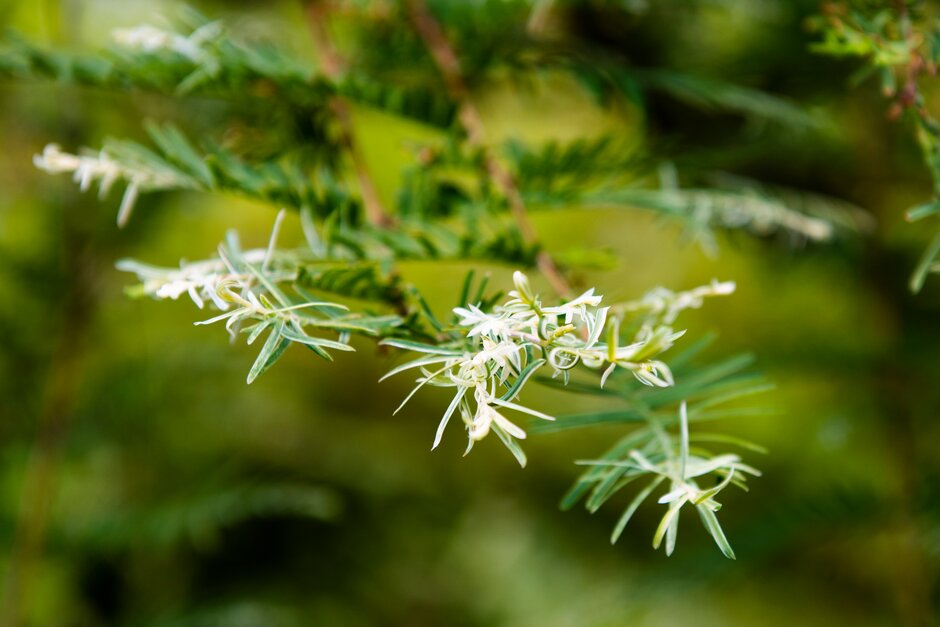
'Little Creamy' Found in the Netherlands in 2001, it is a rather curious selection, it has a tight upright habit, quite fastigiate. Producing shorter needles which appear with a creamy-white , and the upright early extension growth is blue green in colour initially before fading to a lighter green. A slightly slower growing tree I’ve found, but I think this variety still has the potential to make some height over time.
'Matthaei' A dwarfing form, which has foliage that retains a bronzy hue throughout the growing season.
'Miss Grace' A wonderful weeping selection, propagated from a witches broom. Mature plants form wonderful jelly mould like domes of grey-green foliage that turn that signature orange in autumn. It’s important to stake young plants to get some height before allowing them to cascade down, or you’ll end up with a flat sprawling low hummock rather than an elegant plant.
'Royal Air' A characterful cultivar, having a pyramidal habit, and very ascending branches. Young branches exfoliate black flaky as the branches thicken quickly. We have a good specimen in the Pinetum easily growing 40-60cms since planting in 2017.
'Schirrmann's Nordlicht' A witches’ broom from a plant of ‘White Spot’ growing in Germany, sometime prior to 2005. The foliage emerges creamy-white with blue-ish tips to the stems in the spring; as it matures it turns green with a bronze variegation. Always seen as top worked grafts as there produce no strong leader making small mounds. A great plant for a smaller garden.
'Sheridan Spire' A selection from Sheridan Nursery, Canada, in 1960 picked for it’s narrow habit. This variety has only recently been added to Wisley’s collection but there is a fine grove planting of this cultivar at Savill Gardens, Windsor, that look like tall green organ pipes on the landscape.
'Snow Flurry' or 'Pat McCracken' or 'McCracken's White' The names all appear to be muddled in the trade. Introduced to cultivation by Pat McCracken from North Carolina in 2005, ‘Snow Flurry’ forms an upright tree whose foliage is cream-white . This variegation is most pronounced on the tips and fades as the foliage matures.
'Waasland' Selected at the eponymous Belgian arboretum in the late 1970s, this cultivar has a very upright growth habit, and I’ve found it to be incredibly vigorous, with astonishing growth. Producing soft lush grass green foliage, and good autumn colour. Similar to ‘Royal Air’ the bark flakes but with a brown-bronzy indumentum, on the younger branches as they quickly thicken.
'White Spot' The most variegated cultivar in our collection with the leaflets having a narrow margin of variegation around the perimeter. Our tree in Oakwood, adds a useful light colour to a dark green backdrop. While our tree shows good vigour, it has decided to stop producing a leader now it’s 5-6 metres tall, which I imagine will form a very interesting and characterful dumpy tree as it matures.
‘Chubby’ A useful compact form of Metasequoia. Producing a shorter, squat tree, forming a pyramid, and typically a very fluted trunk when mature. The adult foliage is bright green while the young and new shoots have a striking blue glow.
‘Feather Duster’ A selection raised Tom Cox of the Cox Arboretum in Canton, GA, from wild collected Chinese seed. 'Feather duster' has distinct pale green, feathery leaves, that are notably longer than the general straight specie. The foliage turns to vivid yellow tones in autumn rather than the classic amber-copper colours of most clones. As this is a relatively new introduction to the UK its ultimate height potential is unknown, but early indications show it to be a very vigorous cultivar.
'Moerheim' This is a new cultivar to the collection that I stumbled across at Endsleigh garden centre, Plymouth, the only information I’ve found is on Trees and Shrubsonline, Auders & Spicer (2012), describe ‘Moerheim’ as a columnar tree with upright branches, but they stop short of referring to it as fastigiate. It was selected in the Netherlands from an original tree – grown from seed received from the Arnold Arboretum in 1948 – growing at the Belmonte Arboretum. At Wisley our young plant appears to be a good strong cultivar, with foliage similar to ‘Emerald feather’.