Camassia (quamash) trial 2024–2026
Objectives and purpose of the trial
Soft subtle colours of camassias shine in the sun in May 2024
Upright spikes of camassias draw attention in trial bed
Plants and location
What was planted?
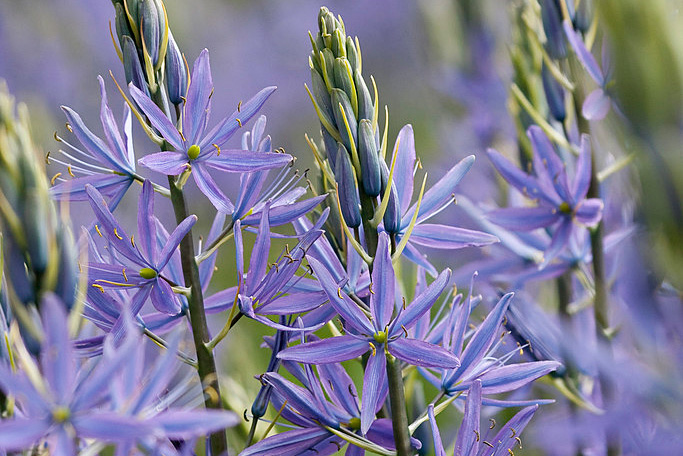
Native to North America, Camassia produce striking upright spires of star-shaped flowers in shades of white, blue, purple, and pink. Flowering in late spring to early summer, they are hardy, low-maintenance plants well suited to borders or naturalistic planting in wildflower meadows.
As part of the trial, photographs will be taken of each entry to document both the overall habit and detailed flower close-ups. The RHS Trials team will also record key growth stages, including what height the flower spikes reach. In addition, the RHS Herbarium may collect a specimen of each entry to preserve in its permanent collection.
Where was it planted?
The spring bulbs were planted into the ground in the The Old Frameyard area at RHS Bridgewater, ready to brighten the coming seasons. Here are some considerations for planting out camassias:
- Camassia like moist soil in full sun or light shade
- It is best to plant them between September and November at a depth 2 or 3 times the size of the bulb
- The leaves usually start to appear in January, followed by the flower stems in April
- When flowering has finished, remove the stems but leave the foliage to die back naturally as it feeds the bulb for the following year
- Camassia will grow in containers but flowering diminishes after a couple of years and they dislike
being disturbed by being repotted
Judges and criteria
Judges of the trial
The 2024–2026 Camassia (quamash) trial judges are: Sue Wood (Chair, Harrogate Council Horticulturist), Teresa Clements (RHS Bulb Expert Group member), Stella Exley (Camassia National Collection Holder, Hare Spring Cottage Plants), Muhammad Hafiz Ullah (Bulb expert), Peter Williams (Former lecturer), Madeleine Calder (National Trust, Attingham Park), Nigel Hutchinson (The Hedgerow, Threshfield), Carolyn Collins (RHS Plant Records Officer), Vicky Fox (Co-owner of Plantagogo).
Judging criteria
The following factors are all taken into consideration as part of the judging of the trial:
- Overall appearance (proportions, sturdiness, foliage)
- Flower impact: colour, size, shape and number of florets per spike
- Length of flowering
- Pest, disease and weather resistance
- Uniformity of height and colour
Vibrant camassias make a bold statement in the trial bed
Camassias growing strong at RHS Bridgewater in May 2025
Cultivation
Planting process
Improved weather in November 2023 allowed the RHS Trials team, supported by volunteers, to proceed. By the third week of the month, the team was able to prepare the site and plant the bulbs as planned.
Each trial entry consisted of 27 bulbs, arranged in nine plots of three bulbs each. Within each plot, bulbs were planted in a triangular formation, at a depth of twice their height. A spacing of 50cm was maintained between entries to ensure optimal growing conditions. To prevent disturbance by wildlife, the trial bed was covered with chicken wire.
The site was selected for its full sun exposure, though Camassia will tolerate partial shade. The soil is moisture-retentive, and watering will be provided in spring if necessary, during the active growth and flowering period. The bed will be kept dry during the bulbs’ dormant phase. Flower stems will be removed after blooming, while the foliage will be left to die back naturally to replenish the bulbs.
Following the natural die-back period in summer 2025, the bulbs will be lifted and redistributed to other areas of the Outer Walled Garden. A number of the blue-flowered varieties are expected to be replanted in the Blue Peter Garden.
How we’re managing plant health
How to grow camassias
Explore all the information you need to know to grow and care for camassia in your garden
Discoveries
First emerging flowers | April 2025
The first plants to flower in 2025 were Camassia leichtlinii ‘Pink Star’, blooming between 16–23 April 2025, and Camassia ‘Blue Candle’, which opened on 23 April 2025. Their early blooms marked a vibrant start to the season.
Suppliers to the trial
List of plants in the trial

Handy tools and information
- Full article - Filter RHS Recommended: AGM plants by colour, height and season
Find a plant online
Filter RHS Recommended: AGM plants by colour, height and season - Full article - Explore advice and helpful tips from our resident experts
Gardening advice
Explore advice and helpful tips from our resident experts - Full article - Check how hardy plants are using the RHS hardiness ratings system
Hardiness ratings
Check how hardy plants are using the RHS hardiness ratings system - Full article - A trusted gardening app packed with expert know‑how
RHS Grow app
A trusted gardening app packed with expert know‑how
Get in touch
For more information on our RHS Plant Trials or to access older trial reports, please get in touch with our team via email at [email protected].
Get involved
The RHS is the UK’s gardening charity, helping people and plants to grow - nurturing a healthier, happier world, one person and one plant at a time.