Begonia Fleuroselect trial results 2025
Objectives and purpose of the trial
Begonias flowering throughout the summer trial in Floral Fantasia
Begonia I’CONIA PORTOFINO DARK ORANGE impressed the judges
What is an RHS Recommended: Award of Garden Merit?
The RHS Recommended: Award of Garden Merit is intended to help gardeners choose reliable plants and is only awarded to plants that are:
- Healthy, with good overall growth and appearance
- Excellent performers, resilient in the right conditions
- Available to buy in garden centres or online
- Reasonably resistant to common pests and diseases
- True to type, keeping a consistent colour and form
Judging criteria
The following factors were all taken into consideration as part of the judging of the trial:
- Flower performance
- Habit
- Colour and appeal
- Pest and disease resistance
- Longevity
Begonias – RHS Recommended: AGM winners
See a selection of the winners in the plant carousel below, more will be added as they become available.
Begonia I'conia Portofino Orange ('Dobegicpororan') (I'conia Portofino Series) (T/d)
Begonia I'conia Portofino Citrix ('Dobegicpocit') (I'conia Portofino Series) (T/d)
Begonia I'conia Portofino Orange ('Dobegicpororan') (I'conia Portofino Series) (T/d)
Begonia I'conia Portofino Citrix ('Dobegicpocit') (I'conia Portofino Series) (T/d)
Some begonias are currently being bred to be more drought tolerant, such as Begonia BRAVEHEART (‘Berose’), which featured in the trial and received an RHS Recommended: Award of Garden Merit. This Begonia also coped very well in the trial’s very sunny and exposed location.

Why the RHS Recommended: AGM was awarded
Judges casting their votes during a July 2025 visit to RHS Hyde Hall
Begonia BRAVEHEART (‘Berose’) showed vigour and floriferousness
RHS Recommended: AGMs rescinded
Plants and location
What was planted?
This trial featured 142 Begonia selections, with 87 entries planted in the ground and 55 grown in containers. Together they represented a diverse mix of colours and growth habits, including several scented varieties. The focus was on tuberous and interspecific Begonia:
- Tuberous Begonia are grown from underground tubers and are valued for their large, often showy flowers and long flowering season
- Interspecific Begonia are hybrids created from crosses between different Begonia species, bred to combine desirable traits such as improved vigour, resilience or novel flower forms
All entries were sourced and submitted by breeders and growers from the UK, the Netherlands, Germany, Switzerland, the USA and the Czech Republic.
Throughout the trial, each entry was photographed to record plant habit, consistency and key details. The RHS Trials team monitored plants through every stage of development, from the emergence of the first shoots through to flowering, enabling performance and ornamental value to be assessed over time.
Where was it planted?
Begonia entries were planted directly into the open ground in the Floral Fantasia area at RHS Hyde Hall, Essex, where they were set to deliver bold colour and lush foliage through the summer season. Further cultivars were grown in pots around the edge of the trial garden, adding depth, contrast and softer touches of colour to the display. Here are some considerations for planting out begonias:
- Begonias are tender so must be protected from frosts
- Tuberous begonias grown in the ground should be lifted before the first hard frosts and left to die back before being stored in a well-ventilated, dry and frost-free place over the winter. The dry tubers should be stored in barely moist soil or sand in a frost-free shed, ideally at 7°C (45°F), and watered occasionally to prevent shrivelling
- Tuberous begonias thrive in light shade and sheltered spots
- Tuberous begonias are ideally suited for growing in containers and hanging baskets
- They thrive in moist, but well drained soils and composts. They do not like overly wet or waterlogged soils or composts
- During the growing season they can be fed with a balanced liquid fertiliser
- Container-grown begonias should be brought under cover during winter and potted on into a slightly larger container each year in spring
Cultivation
Planting process
Preparations for planting began earlier in the year. In early March 2025, soil analysis was carried out to assess the condition of the trial beds and confirm their suitability. The results showed that the soil structure and overall nutrient profile were appropriate. However, following a winter of heavy rainfall, the RHS Chief Horticulturist advised that nitrogen levels may have been reduced through leaching. To counter this, a nutrient-rich feed was incorporated into the soil at a rate of 50g per sqm2 in early spring, ahead of planting.
The soil analysis also highlighted very high levels of nutrients and organic matter already present within the trial beds. This finding shaped subsequent decisions, particularly around mulching. To avoid adding further fertility that could affect plant performance, a low-nutrient mulch was required. Strulch (straw-based mulch) was selected and applied to help retain moisture and suppress weed growth, while minimising any influence on plant growth.
All begonia entries, whether destined for ground planting or container display, were supplied in 10.5cm pots. Planting took place on 12 and 13 June 2025. Ground-grown entries were planted in groups of five, arranged in rows, while containerised entries consisted of three plants grown together in a single 10L pot.
Two trial beds were used, each with slightly different planting densities. In the first bed, ground-grown entries were spaced 50cm apart, with 40cm between individual plants within each row. In the second bed, the spacing between entries was increased to 60cm, while the spacing within each group remained the same. This approach allowed performance to be compared under slightly different spacing conditions.
How plant health was managed
Challenges
Although begonias can be susceptible to garden problems such as caterpillars, mealybugs, powdery mildew and fungal leaf spot, no pests or diseases were observed on any entries during the trial. As a result, no chemical controls were required.
Pruning and deadheading
To allow the judging panel to assess each entry’s natural flowering habit and overall performance, it was agreed that no deadheading would take place during the trial. This enabled a clearer assessment of how the plants performed under minimal intervention.
However, flower heads that fell naturally were removed from the trial beds and containers. This helped to keep the displays looking tidy for visitors and reduced the risk of disease developing from decaying plant material.
Watering
Consistent soil moisture was maintained throughout the trial period. Ground-grown begonias were watered regularly using a seeping hose, with occasional additional watering provided using a lance during drier periods. Containerised begonias were watered by hand using a lance. Watering was always carried out in the morning to minimise plant stress and reduce water loss during the warmer parts of the day.
Nutrition and feeding
From July 2025, both ground-grown and containerised begonias were fed twice weekly at half strength using a liquid feed to support steady growth during the main flowering period. At the second judges’ meeting in early August 2025, the containerised entries were noted as underperforming in comparison with those grown in the ground.
On the advice of the RHS Chief Horticulturist, the feeding regime was revised to a more balanced fertiliser applied more frequently. From August 2025, feed was applied at half strength three to four times per week, depending on weather conditions, using a dosatron (dosing pump). By the third judges’ meeting in late August 2025, plant quality had improved and the judges were satisfied with the revised approach, although milder and wetter conditions may also have contributed to improved plant health.
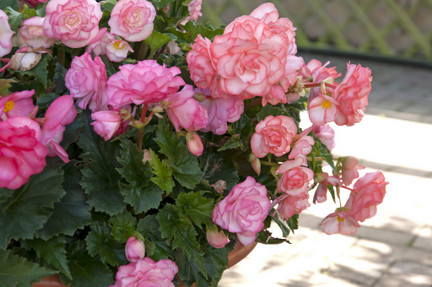
How to grow begonias
Explore all the information you need to know to grow and care for begonias in your garden
Discoveries
Testing against the elements | July–September 2025
The trial took place in a very sunny, exposed location, providing a strong test against the elements. While begonias typically prefer more sheltered, shadier conditions, they performed surprisingly well in this sunny and windy setting.
Hair-like projections | July–September 2025
A notable feature observed during the trial was the presence of small white, hair-like projections on the underside of the leaves of Begonia BRAVEHEART (‘Berose’). These are thought to help reduce transpiration and reflect sunlight.
Pollinator activity | July–September 2025
Some begonias were observed attracting pollinators during the trial, notably Begonia ‘Tophat Pink’ (Tophat Series) and Begonia BOWLER HAT BRONZE WHITE.
Who was involved?
Judges of the trial
The 2025 Fleuroselect Begonia judges included: Mike Smith (Chair, and Owner of WD Smith & Son Nurseries), Stuart Lowen (former marketing manager at Ball Colegrave); David Creese (RHS Tender Ornamental Expert Group Member), Paul Hansord (former managing director at Thompson and Morgan) Phil Johnson (RHS Herbaceous Plant Expert Group Member and Director of Lion Seeds), Adele Dyer (Principal Researcher and Writer at Which?), Andy Bunker (Sales Director at Alton’s Garden Centre), Chris Finlay (Sales Director at Volmary), Michael Perry (Presenter and Influencer, Mr Plant Geek) and Molli Christman (Horticulturist).
Suppliers to the trial
List of plants in the trial

Handy tools and information
- Full article - Filter RHS Recommended: AGM plants by colour, height and season
Find a plant online
Filter RHS Recommended: AGM plants by colour, height and season - Full article - Explore advice and helpful tips from our resident experts
Gardening advice
Explore advice and helpful tips from our resident experts - Full article - Check how hardy plants are using the RHS hardiness ratings system
Hardiness ratings
Check how hardy plants are using the RHS hardiness ratings system - Full article - A trusted gardening app packed with expert know-how
RHS Grow app
A trusted gardening app packed with expert know-how
Get in touch
For more information on our RHS Plant Trials or to access older trial reports, please get in touch with our team via email at [email protected].
Get involved
The RHS is the UK’s gardening charity, helping people and plants to grow - nurturing a healthier, happier world, one person and one plant at a time.