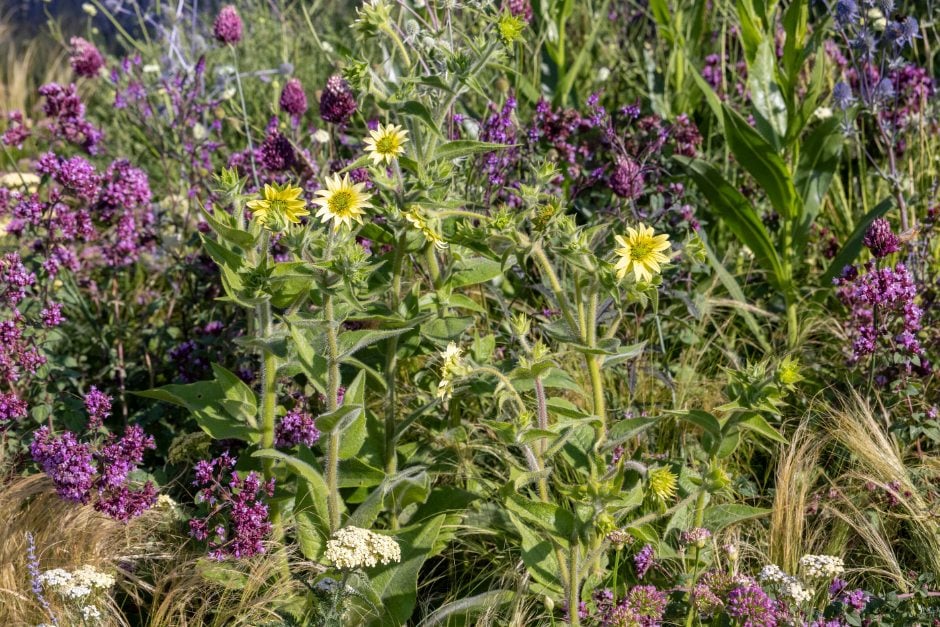
5 perfect plant combos from RHS Badminton 2026
Fresh from the newest RHS show, here are five designer planting schemes and iconic trios to try at home
Putting the right plants together not only makes your borders or container displays look amazing – it also creates plant communities that are more resilient to challenges like heat and drought.
Inspired by the brand new flower show at RHS Badminton, here are five pre-made designer plant combinations to choose from.
1. Perfect prairie planting
- Stipa tenuissima (Mexican feather grass)
- Salvia ‘Nachtvlinder’ (sage ‘Nachtvlinder’)
- Salvia yangii ‘Prime Time’ (perovskia ‘Prime Time’)
- Crambe maritima (sea kale)
- Seseli elatum subsp. osseum
Highlighting the cow-parsley-like dainty white heads of Seseli elatum subsp. osseum, designer Tom Stuart-Smith says: “This is a very unusual
2. Beat the heat in style
- Agastache ‘Peachie Keen’
- Achillea ‘Terracotta’ (yarrow ‘Terracotta’)
- Centranthus ruber (red valerian)
While the Achillea and Centranthus are both robust hardy perennials, the Agastache is half-hardy, so may need some protection during cold spells in winter. Alternatively, it can be grown as an annual and
3. Luscious looks for shade
- Campanula lactiflora ‘Loddon Anna’ (milky bellflower)
- Geranium ‘Dreamland’
- Astrantia major ‘Buckland’ (masterwort)
- Hakonechloa macra (Japanese forest grass)
- Cyrtomium fortunei (Fortune’s cyrtomium fern)
- Dryopteris filix-mas (male fern)
At a practical level, covering ground with low-growing plants is the best way to retain moisture and suppress weeds. A calming blend of textural greens with just the right pops of colour, this ground-covering plant combination for shade nails the perfect balance of aesthetics and practicality, packing a punch with minimal maintenance.
Evergreen cyrtomium fern and Hakonechloa grass provide year-round interest, while long-flowering Geranium ‘Dreamland’ – my personal favourite hardy geranium for its exquisite striped pale pink blooms and attractive foliage – spangles pops of light into the shade, and award-winning Campanula ‘Loddon Anna’ becomes the focal point with its mounding froth of sumptious lilac blooms. A stalwart for shade, the astrantia will provide earlier colour from late spring to early summer.
4. Pretty in purple
- Verbena bonariensis (purple top vervain)
- Tulbaghia violacea (society garlic)
- Liatris spicata (button snakewort)
As used in: The Split Hazel Basketry Garden by Henry T. Pope
“Keeping a restricted colour palette really helps, as it means things tie in together without being overwhelming,” says designer Henry T. Pope. “It doesn’t mean fewer plants, but keeping things simple and repeating plants is surprisingly effective.”
Try playing with plants in a similar colour palette but with contrasting flower forms – such as the spikes of the Liatris with the rounded heads of Tulbaghia and tall, airy sprays of Verbena bonariensis – to create a simple yet effective display.
5. Pollinator paradise
- Verbena officinalis ‘Bampton’
- Oreganum vulgare (oregano)
- Scabiosa columbaria subsp. ochroleuca (pale yellow scabious)
- Oryzopsis miliacea (smilo grass)
- Sambucus nigra f. porphyrophylla ‘Eva’ (black-leafed elder)
As used in: Silo: All that comes in remains by Abigail Stoyle
This opulent blend of purples and bronzes is not only drought-tolerant and looks fabulous; it also provides a varied buffet for pollinators. The verbena and scabious are loved by butterflies, while the oregano supports moths and the flat heads of the black elder are perfect for hoverflies.
The rarely used Mediterranean smilo grass, Oryzopsis miliacea, ties it all together with airy bronze flowerheads that give the planting a textural lift. This underused grass was also one of our 8 star plants from RHS Badminton 2026.