Getting Started
A member of the onion family, this staple of Mediterranean cooking is simple to grow in a warm sunny site with well-drained soil. It’s grown from cloves, which are best planted in autumn, and is ready to harvest the following year, in late spring and summer.
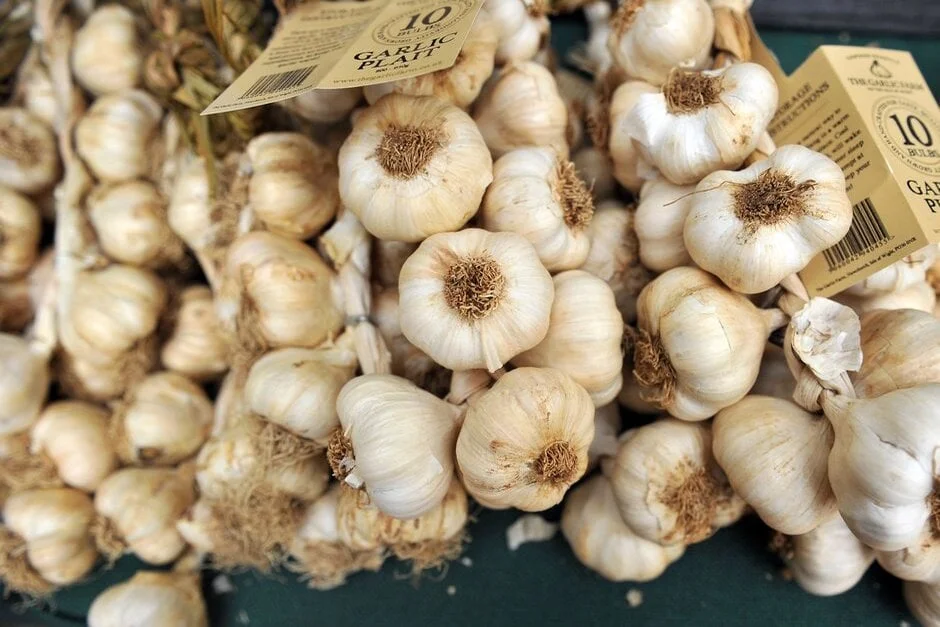
Hardy, sun-loving garlic is an increasingly popular crop, as it needs minimal maintenance, takes up relatively little space and produces reliable harvests. Started off from cloves rather than seed, it needs no cosseting. It usually requires a spell of cold to form a good bulb, so is generally planted in autumn to overwinter outdoors.
Simply keep weeds at bay and water during prolonged dry spells, and you’ll be harvesting your own garlic from late spring onwards, depending on the variety. Garlic stores well for several months, so you can grow plenty to use as needed, and benefit from garlic’s many health-boosting properties.
Jobs to do now
Prepare ground
Month by Month
Plant
Harvest


Choosing What To Grow
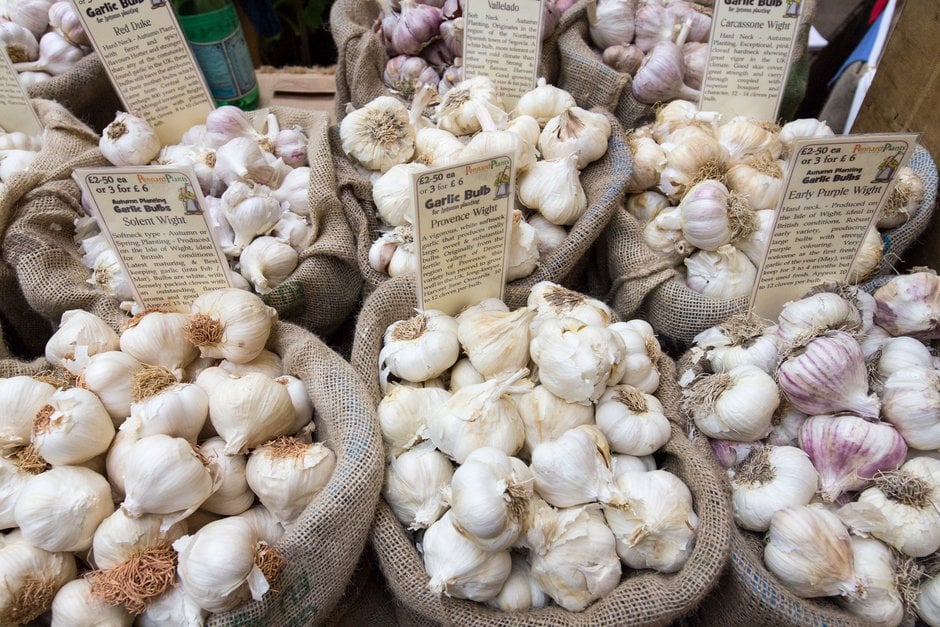
Garlic is grown from cloves – the small individual segments in a bulb of garlic. These should be named varieties bought from a garden centre or mail-order supplier. It is not recommended to plant garlic bought from the supermarket as it may be unsuitable for the British climate, giving disappointing results. There are also risks (such as introducing diseases) associated with planting supermarket-bought garlic .
There are two main types of garlic – hardneck and softneck.
Hardneck garlic:
- Produces bulbs with fewer, larger cloves
- Has a stronger flavour
- Stores well for about four to six months
- More prone to (flowering), which can lead to a smaller bulb that won’t store
Softneck garlic:
- Produces smaller, more tightly packed cloves
- Stores for longer – if planted in autumn it will keep well into the following winter, if planted in spring it will keep until the middle of the following spring
- Unlikely to bolt, except in poor growing conditions
Within these two categories, there are many varieties to choose from, with different harvesting times, storage lengths, bulb sizes and flavours. Look in particular for varieties with an RHS Recommended: Award of Garden Merit (AGM), which shows they performed well in RHS trials – see our list of AGM fruit and veg (135kB pdf) and our Recommended Varieties below.
Elephant garlic (Allium ampeloprasum) is often sold as garlic, but is actually more closely related to leeks. It produces a big bulb with a small number of very large cloves, which have a mild flavour. It needs a long, warm to produce a good crop and is best planted in October.
Elephant garlic sometimes doesn't divide into cloves, producing just a large single-clove (solo) bulb. Early planting often reduces the occurrence of solo bulbs. You can either eat solo bulbs or re-plant them the following autumn – they will usually go on to produce a multi-clove bulb.
What and where to buy
Named garlic varieties are widely available in autumn and spring, in garden centres and online, with several specialist suppliers offering a particularly wide choice.
Recommended Varieties


Preparing The Ground
Garlic likes a sunny site with free-draining soil. Wet soil can make garlic more prone to disease, particularly if planted in autumn. If your soil is heavy and wet over winter, it’s better to start garlic off in before planting out in spring – see Planting in modules below. Garlic doesn’t like very (below 6), but you can reduce acidity by applying lime in autumn or winter – you can carry out a simple pH test to check if this is necessary.
Prior to planting, remove any weeds, then improve the soil’s structure, moisture retention and nutrient levels by digging in organic matter. Apply about two bucketfuls of well-rotted (not fresh) manure or homemade garden compost every square metre/yard. Alternatively, if you're practicing no-dig, the soil with organic matter ahead of planting directly into the mulch.
To reduce the need for weeding later, you could cover the soil with weed-suppressing membrane, then plant the cloves through slits.
Planting
Planting in the ground
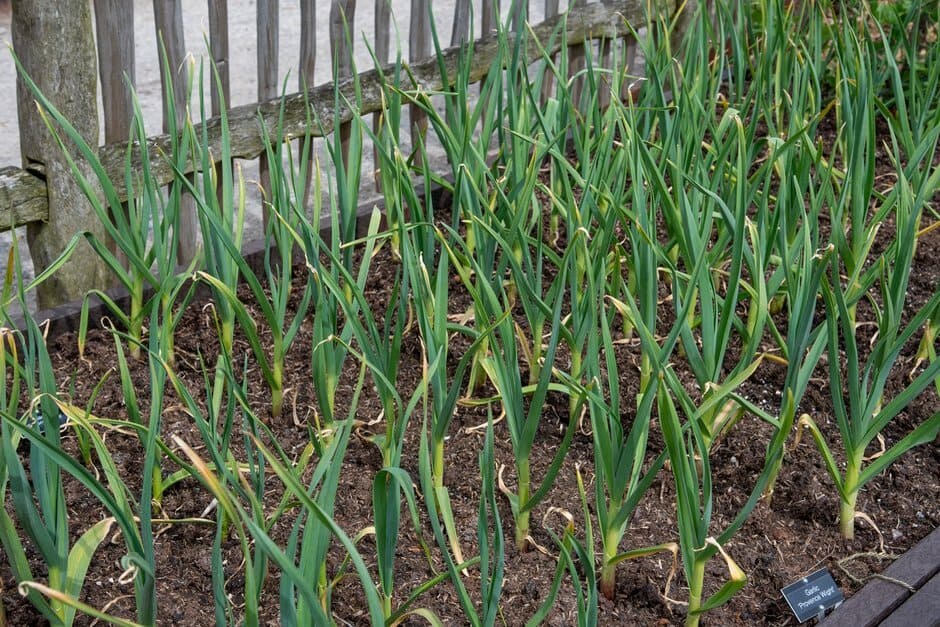
Garlic is usually planted from mid-autumn to early winter, as it needs a period of cold – most varieties need one to two months at 0–10°C (32–50°F) for good bulb development. However, some varieties are suitable for planting in late winter and early spring.
Once you’ve prepared your planting site (see above), carefully split your garlic into individual cloves. Be sure to plant them the right way up, with the flat end downwards and the pointed end upwards. Space the cloves 15cm (6in) apart, with the tip 2.5cm (1in) below the soil surface. In light soil, deeper planting can produce larger bulbs, but don’t plant deeply in . Space rows 30cm (1ft) apart.
Birds sometimes pull up newly planted cloves, so cover with platic-free netting or horticultural until well rooted in.
Planting in modules
If your soil is heavy and/or wet over winter, start garlic off in in autumn. Keep them in an unheated greenhouse, or a sheltered outdoor location over winter, then plant them out in spring.
- Partly fill a modular tray with peat-free multi-purpose or
- Insert one clove into each module, so the tip of the clove is covered by about 2.5cm (1in) of
- Place in a cool location protected from excess rain and the harshest winter weather – a well-ventilated cold frame is ideal
- Keep the compost slightly moist but not wet
- Plant out in spring, into prepared ground (see above), 15cm (6in) apart
Planting in containers
If you have soil that doesn't drain well or you're limited for soil space, it's possible to grow garlic in a container using a peat-free multi-purpose . Pots should be at least 25cm (10in) deep, their width and length will determine how many cloves you can plant – aim for the same spacing and depth used when planting in the ground (see above). Compost in containers can dry out quickly, so be prepared to regularly check if you need to water.
Plant Care
Garlic needs little maintenance, apart from watering during prolonged dry spells and weeding to prevent overcrowding. Also snip off any flower stems that start to form.
Watering
To improve bulb size, water garlic during dry spells in spring and early summer. However, don’t water once the are large and well formed, as this could encourage rotting – yellowing foliage is a sign that the bulbs are reaching this stage of maturity. Try to avoid wetting the leaves when watering, as this can encourage fungal problems.
Weeding
Garlic needs full sun, so weed regularly to ensure plants don’t get shaded. This is best done by hand, as risks damaging the developing . Alternatively, to reduce the need for weeding, consider planting through a weed-suppressing membrane or lay a , such as cardboard, between rows.
Removing flowers
Remove any flower stems as soon as they start to form, otherwise the plant’s energy will go into producing the flower rather than swelling the bulb. It also means the bulb won’t store well. If picked young, while the flower is still in , the flower stalks (scapes) are delicious sautéed, barbecued or roasted.
Harvesting
While the are still growing, you can harvest a few of the green leaves to use as a garnish or in salads. You may sometimes find cloves form on the stalk (known as ‘top sets’) due to changeable weather in spring – these can be used as you would normal garlic cloves. If a flower stem starts to form, this can be cooked and eaten too.
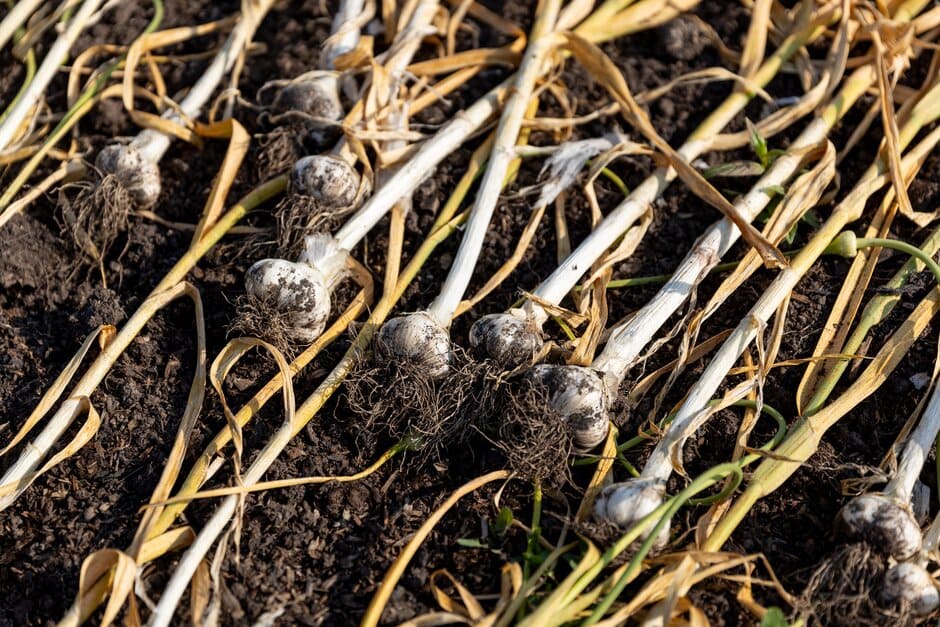
Garlic bulbs are ready to harvest once the leaves have turned yellow. Autumn-planted garlic is ready from late spring to early summer and spring-planted garlic is ready from mid-summer to early autumn. Try not to delay harvesting, as bulbs that are lifted late tend to open up and have a shorter storage life. Carefully dig up the bulbs with a fork. Handle them gently, as bruising also reduces their storage potential.
Storing
To prepare garlic for storing, dry them off thoroughly in a single layer in the sun – a well ventilated greenhouse is ideal, but avoid excessive heat (above 30°C/86°F). Alternatively, place them in a dry, well-ventilated shed.
Initial drying takes two to four weeks, depending on the weather. Once the foliage is dry and rustling, cut it off and store the bulbs in a cool, dry place at 5–10°C (41–50°F), where further drying will take place. Garlic can usually be stored for several months. Hardneck varieities can store well for four to six months. Softneck varieties store for longer, potentially up to a year.
Problem Solving
Garlic is usually trouble-free in good growing conditions. However, it can potentially be affected by similar problems to onions and leeks (see Common problems, below). The following issues, related to growing conditions or harvesting, could also arise:
- Cloves forming on the stem – this is usually due to adverse weather, such as fluctuating temperatures in spring. Called ‘top sets’, the cloves can be used in the normal way
- not dividing into cloves – this is usually the result of insufficient cold weather over winter
- Flowering ( ) – hardneck garlic readily produces flower stems, which should be removed as soon as they appear and can be used in stir-fries. Softneck garlic occasionally produces flower stems due to poor growing conditions, such as high temperatures or drought
- Split bulbs – this can happen if the crop was harvested late
- Green cloves – usually due to shallow planting. They can be used as normal, but are unlikely to store well
Common Problems

Allium leaf miner
Allium leaf mining fly was first detected in Britain in 2002, it has become widespread in England and parts of Wales. The larvae bore into the stems a...


Onion downy mildew
Onion downy mildew is a disease of onions and related crops that damages foliage and bulbs, resulting in loss of yield or even a complete failure of w...


