Apples: choosing cultivars
Apples are the easiest fruit to grow and by choosing the right one, you’ll have a regular, abundant crop of tasty fruits, no matter how large or small your garden.

From strawberry-scented fruit to rich, nutty russets, these eight heritage apples combine centuries of history with distinctive flavours and practical qualities for today's gardens
Choosing an apple tree is a long-term investment, so it pays to look beyond flavour alone. Reliable cropping, natural disease resistance and flowering time can all influence how well a variety performs as growing conditions change. Those that flower over a longer period, or whose flowering times have remained relatively stable despite warmer springs, may be better placed to cope with unpredictable weather and late frosts.
These eight heritage varieties offer a range of distinctive flavours and practical qualities, from compact trees suited to smaller gardens to late-season apples that can be enjoyed well into winter. Their reliability, disease resistance and flowering characteristics make them interesting choices for gardens facing a changing climate.
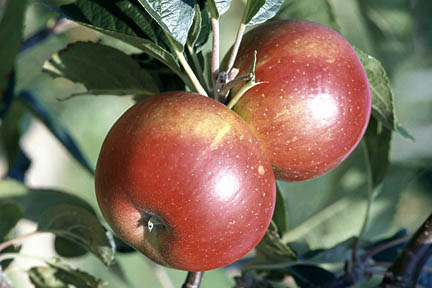
‘Worcester Pearmain’ is a reliable, heavy cropping dessert apple was once a major commercial . Introduced in 1874 by Richard Smith of Saint John’s Nursery, the fruit is bright red with a strawberry flavour when fully ripe and firm juicy flesh. A partial tip-bearer, it has shown relatively little change in flowering time despite warmer, earlier springs. This could make it less vulnerable to late frosts than varieties whose flowering has advanced. It's also not particularly disease-prone.

Recorded in 1862, 'Lord Derby' (C) was raised by BW Witham of Stockport, Cheshire. Possibly a seedling of ‘Catshead’ , this is a reliable, well-favoured and heavy cropping apple, that produces well-flavoured cooking apples and has good natural disease resistance. It's spur bearing and flowers in mid to late spring, making it neither particularly early nor late in the season.

A cross between ‘Cox’s Orange Pippin’ and ‘Cellini’ apple 'Ellison's Orange' (D) was raised by Reverend CC Ellison and Mr Wipf, head gardener to the Reverend’s brother in law at Hartsholme Hall, Lincolnshire. It was recorded in 1904 and introduced in 1911, it's one of the best-known dessert apples, prized for its distinctive aniseed flavour. The tree is hardy with good disease resistance and flowers in mid to late spring.

Probably a seedling of ‘Nonpareil’ , 'Ashmead's Kernel' (D) dessert apple is said to have been raised by Dr Ashmead of Gloucester. Its partly russeted fruit, with an intense flavour and good sugar/acid balance, this reliable apple exhibits good disease resistance. It flowers well each year in mid to late spring, and its fruit has a particularly late season of use.

Raised by Thomas Squire, Berkhamsted, Hertfordshire, before 1841, 'Lane's Prince Albert' (C) cooking apple was introduced in 1850 by John Lane, Berkhamsted. Good quality, slightly acidic fruits are produced on a compact spur bearing tree suitable for gardens. Its extended flowering period could be particularly advantageous in unpredictable spring weather, helping to reduce the risk of a poor fruit set if conditions are unfavourable during part of the flowering season. It also has good natural disease resistance.

'Egremont Russet' (D) is the most popular russet dessert apple with a rich nutty flavour, this was probably raised at Petworth in the early 19th century and introduced by John Scott of Merriott, Somerset in 1872. A reliable, heavy-cropping, spur-bearing variety, it produces distinctive russeted fruit with a rich, nutty flavour. Its russet skin makes the fruit resistant to scab, although the leaves remain susceptible.

Laxton’s Brothers of Bedford raised 'Lord Lambourne' (D) , a sweet, juicy dessert apple in 1907 from ‘James Grieve’ × ‘Worcester Pearmain’ , this sweet, juicy dessert apple was introduced in 1923 and named after the then RHS president. The tree is compact and has good disease resistance. Although its flowering time has changed relatively little compared with some other apple varieties, it flowers over an extended period which may help it cope with unpredictable spring weather. It's best by varieties that flower in group 3.

Popular in Victorian and Edwardian times, 'Adams's Pearmain' (D) dessert apple with a rich aromatic flavour came from Herefordshire or Norfolk. Introduced in 1826 by Robert Adams of Norfolk, it’s a partial tip bearer that’s reliable and disease resistant.

Enjoyed this article?
This piece comes from The Garden, the monthly magazine sent to RHS members. Filled with expert advice, planting inspiration and seasonal ideas, it’s one of the many benefits of RHS membership. Become a member to receive your copy each month.