
Why hazel is the small tree that has it all
From wildlife provision to year-round interest and value for garden crafts, hazel is a tree that delivers in every way. Which one will you choose?
Hazels are instantly recognisable for their bright, pollen-clad catkins dangling from bare stems, which light up countryside and gardens alike amid the late winter gloom. Also known as Corylus, hazel is the RHS Wildlife Wonder Plant of the Month for February, meaning our wildlife experts have chosen it as a top plant we can all grow to support wildlife as part of our Bringing Nature Home campaign.
All hazels are , but within that, they’re incredibly versatile. Many have a graceful arching form from coppicing, while some have unique corkscrew stems, and others have striking purple foliage. Providing year-round interest, a larder for winter wildlife and valuable materials for gardeners, a hazel tree is a must-have – and with a range of award-winning types, there’s one for every space.
Now is the perfect time to plant, so here’s why hazel deserves a spot in your garden – whether it’s a standalone tree, part of a hedge, in a pot, adding structure to a border, or enriching a wildlife or woodland area.
What makes hazel great for wildlife?
Late winter is when hazels really shine. Bare stems are hung with golden yellow or even pink catkins – and beneath, you might find signs of last year’s nuts, a boon for winter wildlife. While mammals such as shrews and hedgehogs are mostly insect-eaters, many others – including squirrels, voles and mice – rely on seeds, berries and nuts such as these hazelnuts.
What are catkins?
While most flowering plants have male and female parts on the same flower, hazel trees have separate male and female flowers. Catkins are the long male flowers, which hang in clusters and produce pollen, so are often yellow. The tiny, star-like female flowers are harder to spot.
The catkins are wind‑ , and on mild days you can even see a light puff of pollen drifting away to the tiny red female flowers on nearby hazel trees. Though bees don’t get from catkins, they do collect some of the pollen – a valuable early protein top‑up for brood‑rearing.
Come late summer, hazelnuts ripen and provide a fuel that carries wildlife through the cold months of winter. Small mammals nibble or cache them for later, while birds such as woodpeckers and nuthatches crack the nuts by jamming them into cracks in tree and hammering them with their beaks.
What is coppicing?
A woodland management or pruning technique in which all of a tree’s growth is regularly cut down to the ground, leading to lots of straight, upright stems being produced.
As well as laying on a larder, coppiced hazel provides the perfect habitat for the rare hazel dormouse, which spends much of its time among the branches.
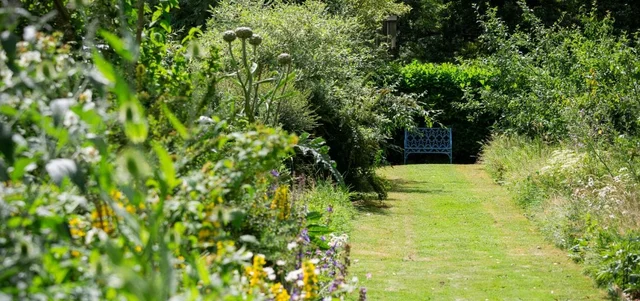


Olivia Drake
Hazels, such as this mature Corylus avellana in the Lake District, support wildlife such as the rare native red squirrel
Six award-winning hazel trees to grow
From the compact Corylus avellana ‘Contorta’ to the majestic Corylus colurna and the classic heavy-cropping cobnut Corylus maxima ‘Kentish Cob’, there’s a hazel for every space. It’s worth remembering too that many can be kept smaller by pruning or coppicing.
These six choices have all earned an RHS Award of Garden Merit, reflecting outstanding all-round performance in the garden.
1. Corylusavellana ‘Contorta’
Great for: small gardens, large containers, decorative stems for floral displays
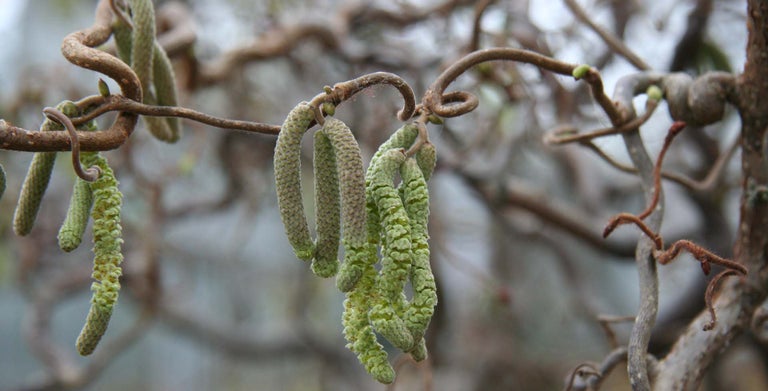
This compact hazel is instantly recognisable for its extraordinary twisted, curling stems that make a bizarre and eyecatching winter feature, especially when spangled with small yellow catkins towards the end of winter and early spring. If it’s nuts you’re after, the bounty from straight-stemmed forms will be much heavier, but ‘Contorta’ certainly earns its keep for novelty factor.
Eventual height and spread: 2.5-4m. More info >| Buy it now >

Frosted stems of Corylus avellana ‘Contorta’ at RHS Rosemoor
2. Corylusavellana ‘Red Majestic’PBR
Great for: borders, colourful foliage, winter interest
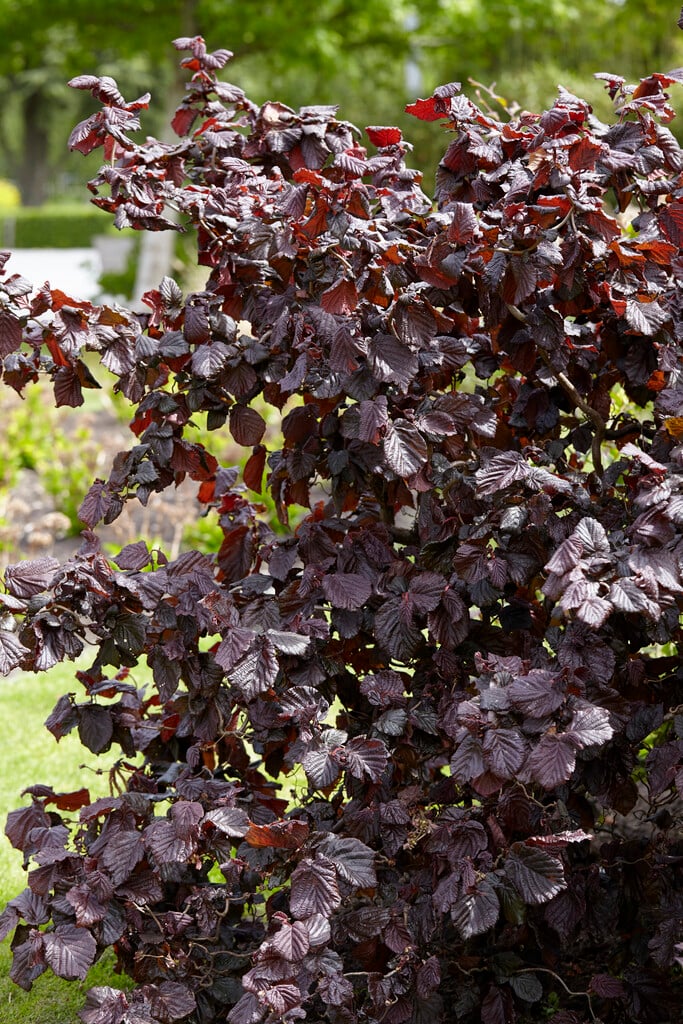
Take all the weird and wonderful features of ‘Contorta’, add dramatic foliage and you have ‘Red Majestic’PBR – a compact, spreading or semi-weeping little tree whose twisted branches are clothed in dark purple leaves that become flushed with green as the season progresses. Purplish-pink catkins are a stunning feature in late winter.
Eventual height and spread: 2.5-4m. More info >| Buy it now >

Corylus avellana ‘Red Majestic’ is a contorted hazel boasting striking wine-coloured foliage
3. Corylusavellana ‘Rotblättrige Zellernuss’
Great for: coppicing, hedging, colourful foliage and catkins, filling a space quickly
This straight-stemmed is a fast-growing, arching large shrub or small tree with foliage that emerges reddish brown and matures to brownish green. Reddish brown spring catkins in spring and summer are followed by brown nuts in autumn.
Eventual height and spread: 3-4m. More info >| Buy it now >
4. Corylusmaxima ‘Gunslebert’
Great for: coppicing, hedging, an abundance of edible nuts
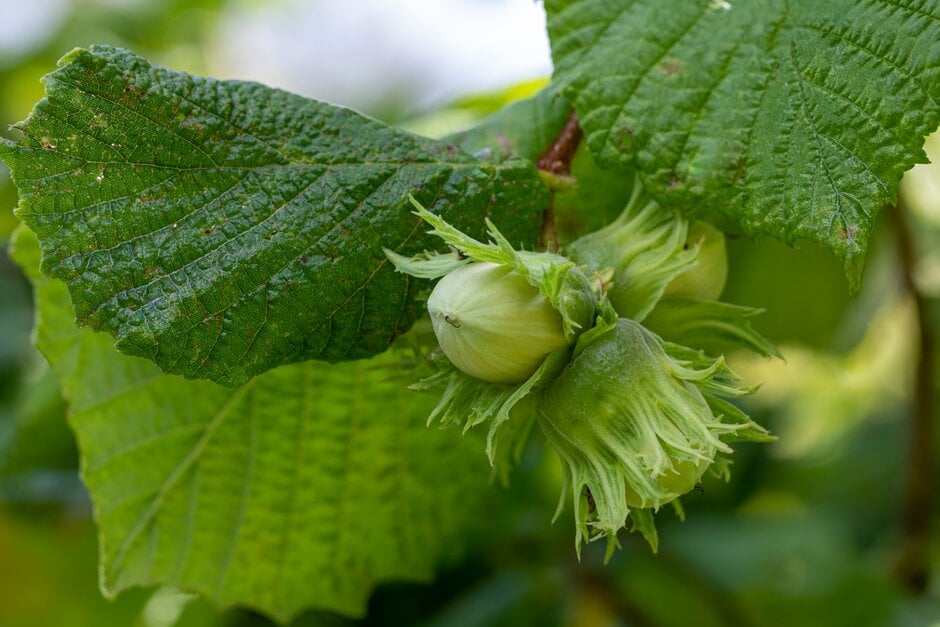
This slightly larger hazel – growing up to 6m if unpruned – has broad, rough leaves and yellow-brown catkins in late winter or early spring, followed by clusters of nuts in pale green husks in early to mid-autumn. An abundance of large, well-flavoured nuts is produced from an early age, though cropping is even better if the tree is pollinated by a different variety, such as ‘Kentish Cob’ below.
Eventual height and spread: 4-6m. More info >

The nuts of Coryllus maxima ‘Gunslebert’ can provide a feast for wildlife and people alike
5. Corylusmaxima ‘Kentish Cob’
Great for: coppicing, hedging, an abundance of edible nuts
This popular, easy-to-grow cultivar is another larger hazel with broad green leaves and flavoursome nuts, but with a paler yellow catkin. Though it’s self-fertile to some extent, try growing with ‘Gunslebert’ for the best crop of nuts.
Eventual height and spread: 4-8m. More info >| Buy it now >
6. Coryluscolurna
Great for: a focal tree in larger gardens
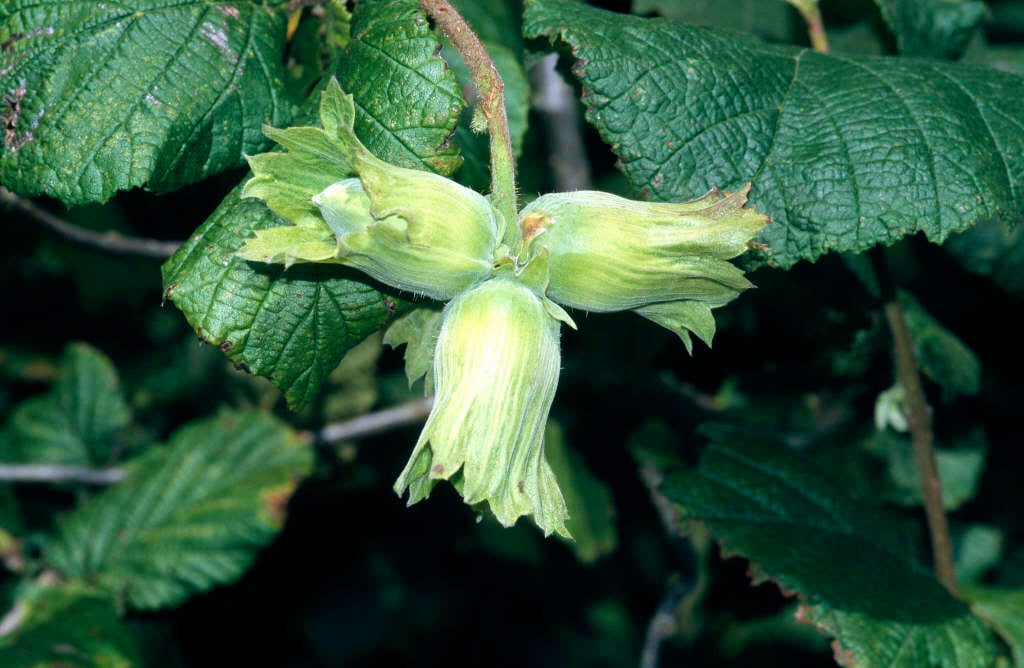
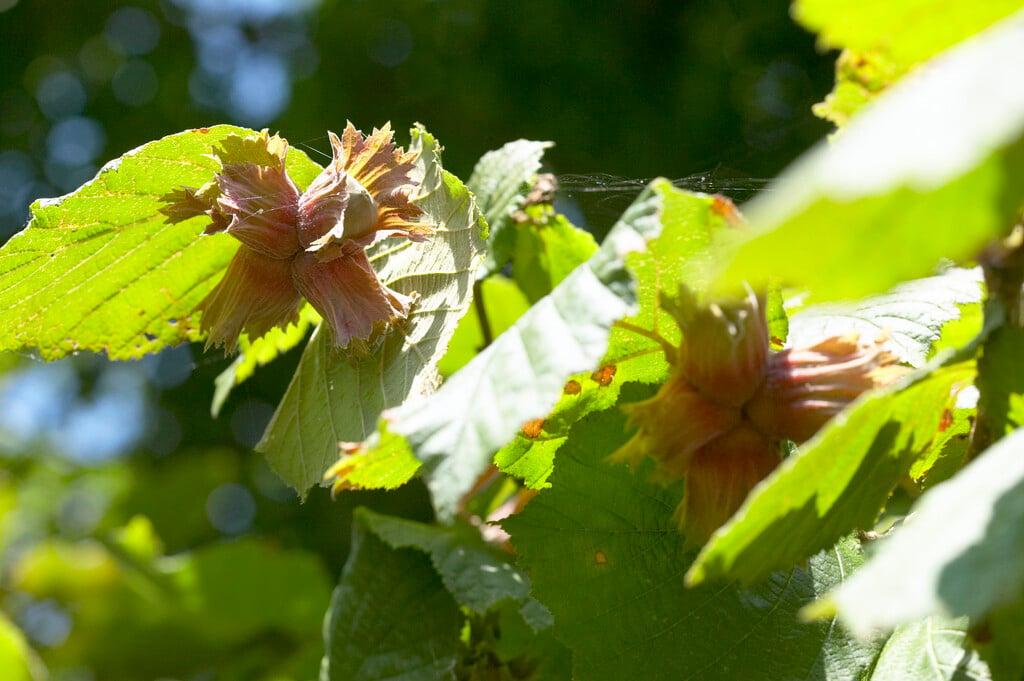
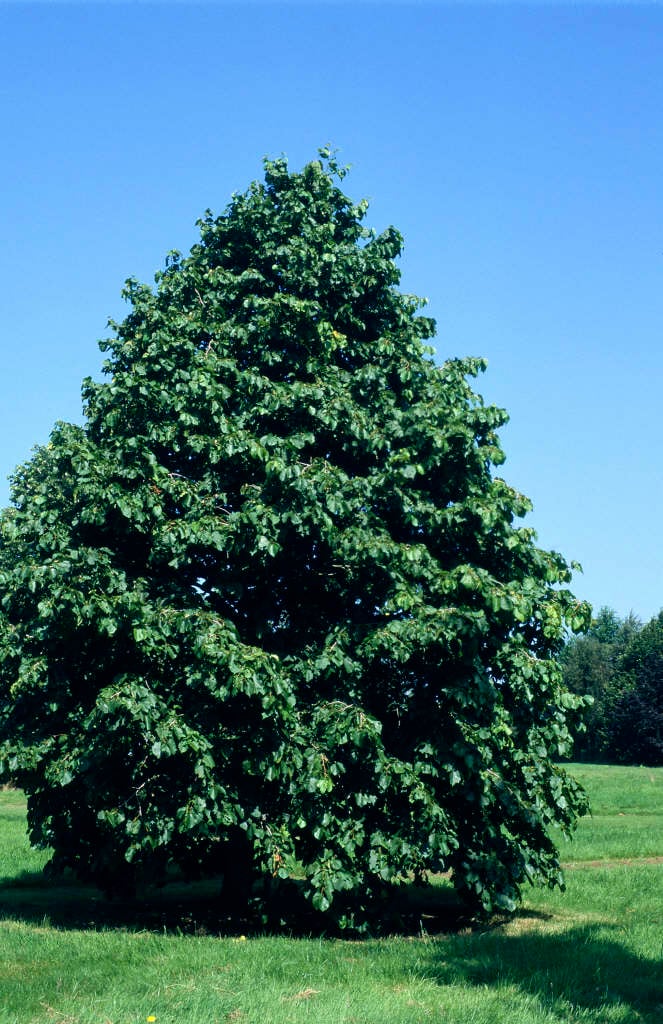
If you have space, this is the largest award-winning hazel, growing into a distinctive conical-shaped tree that’s festooned with long yellow catkins in spring and nuts cuddled by frilly husks in autumn.
Eventual height: 12m or more, eventual spread: 8m or more. More info >
Hazel as your new favourite garden resource

At Faringford, an RHS Partner Garden on the Isle of Wight, hazel stems are used to make arches, fruit cages, fencing and more
If you plant a hazel tree, it will quickly become your garden’s most useful natural material. Non-contorted types can be coppiced to encourage the growth of tall, straight stems that provide a beautifully rustic, no-travel-miles alternative to bamboo canes, and lend themselves perfectly to making wigwams, arches, obelisks, domes, tunnels and whatever else you can imagine.
The finer twigs at the tips of the stems – known as pea sticks – are the go-to material for natural staking, thanks to their flexibility and highly branched structure. This makes them ideal for supporting a wide range of plants, from peas to herbaceous perennials.

Olivia Drake
Hazel ‘pea sticks’ are ideal for weaving into functional yet decorative structures to support emerging herbaceous perennials
Traditionally, coppiced hazel trees are cut down to the ground on a 5-7 year rotation, but even if you only have one plant, you can get everything you need by selectively harvesting stems that are the right size for your intended use. This ensures there’s always enough to support wildlife, too.
Once you have a coppiced hazel in your garden, your options for creativity are boundless – check out the inspiration below for more ideas to elevate your gardening.

1
of
6
In the Kitchen Garden at RHS Bridgewater, hazel teepees are stuffed with material from cutting back perennials to create hedgehog shelters...


How to grow hazel
Hazel is easy to grow, coping with most soil types, but thriving best in well-drained, fertile soil in sun or part shade. They’re less good with waterlogged clay soils, very dry soils or very windy, exposed sites. For the best chance of nuts, plant two or more – preferably two different cultivars – to flower at the same time and pollinate each other, and prune or coppice as desired in late winter.
Other wildlife trees to plant
Our Wildlife Wonders supporting cast for February are yew, pyracantha, berrying ivy and hawthorn, so don’t forget to sneak some of those into the garden too. Here are a few ideas:
- Yew: evergreen hedging, clipped balls or topiary
- Pyracantha: trained against a wall or as an
- Ivy: scrambling up an old wall, fence or tree
- Hawthorn: a deciduous hedge, part of a mixed hedge or a standalone feature tree

1
of
2

About the author – Olivia Drake
With a background in biology, Olivia is passionate about biodiversity, sustainable horticulture and the role gardening can play in conservation. She is trained as a botanical horticulturist and previously worked in public gardens around the UK and abroad.

You may also like
-
 Category: Inspiration
 -
Hazel
Hazels are a versatile group of deciduous trees and large shrubs. They are probably best known for their yellow, dangling catkins on bare branches in early spring, followed by edible nuts in autumn. The common hazel (Corylus avellana) is excellent for wildlife gardens, hedgerows and woodland settings.