Clever water-management ideas for community gardeners
Many traditional growing practices may become less effective as temperatures rise. Water-saving and storage expert Janet Manning shares practical tips for managing water on community gardens and allotments, and explains how these sites could help reduce flood risk
RHS Editorial Team
5-minute read
Managing water successfully in a garden is not just about capturing rainwater. As periods of drought become more frequent and intense across the UK, rethinking how we grow is one of the main challenges gardeners need to face.
Water-saving and storage expert Janet Manning believes that productive food growing can thrive with minimal reliance on mains water. She has spent years working in water management and was involved in developing the Mains 2 Rains campaign.
As a director of the community food-growing project Edible Bristol, Janet shares practical ideas for making better use of rainwater and reducing water use wherever possible on allotments and in community gardens.
Don’t waste a single drop
Volunteers at Edible Bristol manage three sites across the city, including three allotment plots in Speedwell, five beds in Millennium Square and a large bed in Castle Park.
Since 2023, when a network of IBC containers was installed with funding from Waterwise, the main production site in Speedwell has been able to store more than 8,000 litres of water.
Water is collected from sheds, polytunnels and a green roof, then channelled through a guttering system into IBCs and water butts. Siphons connect the various areas of the site, so water can easily reach the plots without the need for pumps or carrying it.
Janet explained: “As long as the two containers are at roughly the same height, connecting them with a pipe that reaches the bottom of each means they work like one large tank. You can add or take water from either container and the water level will adjust in both. This keeps the water moving and fresher, rather than having to wait for one container to fill up and overflow into the other.”
Edible Bristol volunteers collect more than 8,000 litres of rainwater every year
Edible Bristol volunteers have been recording how many watering cans they use across Speedwell. “In 2025, which was one of the hottest years on record, we used 5,000 litres, which means that we didn’t need to use a single drop of mains water to grow our crops.
“In 2026, despite the heat, we had a very successful , harvesting tomatoes , beans, beetroot and a wide range of other vegetables that were then distributed through a local food club.” A smart water meter records how much water is used across the site every hour.
However, for Janet, “it’s not all about water butts.” In Castle Park, for example, there is no direct access to water, so the volunteers need to put in place a different strategy. “You ideally need water storage to get through a drought, but to manage without mains water, it depends just as much on how you grow.”
Clay, the super soil
Much of Edible Bristol’s success comes from building healthy, moisture-retentive soils through no-dig methods, regular application and extensive mulching.
The group’s allotments sit on clay soil, which Janet sees as an advantage rather than a challenge. “People moan about clay soil, but I’m a big fan of it!” she said.
Clay soils hold water well and are generally less affected by drought than lighter soils, as long as they are covered with a good layer of organic . Their tiny particles have a large collective surface area, allowing them to retain moisture for longer. When topped with compost and other organic matter, clay can act as a valuable water reservoir, storing moisture that plants can access during dry periods. A layer of compost or woodchip mulch also helps reduce evaporation and conserve moisture at the soil surface.
“Heavy rain can quickly run off clay soils, but adding organic mulch allows more time for the water to soak in. Once roots reach the clay, they can access that stored moisture during drier periods.”
Rather than digging and disturbing the soil, Edible Bristol volunteers continually add compost, woodchip and other organic matter to the surface. The result is a healthy, moisture-retentive soil that supports strong plant growth without breaking the soil structure.
Large clumps of clay-based soil
The importance of shade
“When I walk around some of the allotment sites and see Bristol’s clay soil left bare, with every weed scraped away, I think, no wonder you’re using so much water! Without any shade, the soil heats up and loses more moisture through surface evaporation than it should,” said Janet.
To create cooler, more resilient growing environments, shade is something gardeners need to think more about. “Keeping roots cool is really important, but overwatering in a heatwave is the worst thing you could do,” she added. “While traditionally a propagation area would be in full sun, our propagation polytunnel is now in partial shade as high temperatures are more of a concern that seeds will dry out rather than having enough warmth for .”
Shade can be created through trees, climbing fruit and living boundaries such as hedges, helping to protect crops and soils from excessive heat.
At Edible Bristol’s Speedwell site, for example, a pear tree growing over one of the sheds provides fruit while reducing temperatures around the building and nearby growing space. At Castle Park, Janet is also experimenting with low woven barriers made from pruned buddleja stems. Similar to a dead hedge, it makes use of materials that might otherwise be composted or removed, while helping to shade vulnerable root zones and reduce soil temperatures.
Buddleja hedge on Janet’s patio table, just after she made it
“As volunteers, it’s hard to find the time to water every day, but fortunately there’s no need,” said Janet.
To get around frequent watering, they have started using sand-covered benches to keep hydrated for longer. “We sow our seeds in and then place them on a wet sand bench, making sure the sand is as wet as possible. The sand underneath provides enough capillary action and to help the plants happily last a week without being watered. They struggled a bit during the heatwave, but they do actually survive.”
Trays of seedlings growing on a sand covered bench in one of Edible Bristol’s polytunnels
Community gardens as water infrastructure
Janet is currently exploring the development of a water management playbook for allotments and community gardens. The ambition is to help councils better understand water use on growing sites, reduce unnecessary mains water costs and support plot holders in adopting water-efficient practices.
For her, community gardens could also play a much bigger role in managing rainfall and reducing flood risk.
“Any rainwater that’s collected and reused means it’s not going down the drain,” she explained. “By channelling rainwater from neighbouring buildings into allotment sites, we can use it to grow healthy, sustainable food rather than sending it straight to a drain. If the drains are connected to foul sewers, this also helps lower the risk of overflows that can result in raw sewage being discharged into watercourses.”
Treating allotments and community gardens as sustainable drainage systems would give developers an added incentive to include them in new projects, creating a win-win situation for communities and water management.
Janet Manning watering pumpkins, sweetcorn and climbing beans
More water management tips from community gardeners
“Take the lids off your water butts, turn them upside down and remove the rubber bungs, so they can catch extra rainwater and collect it in the butts.” – Justine Dixon, Rosemary Cottage Hook Garden
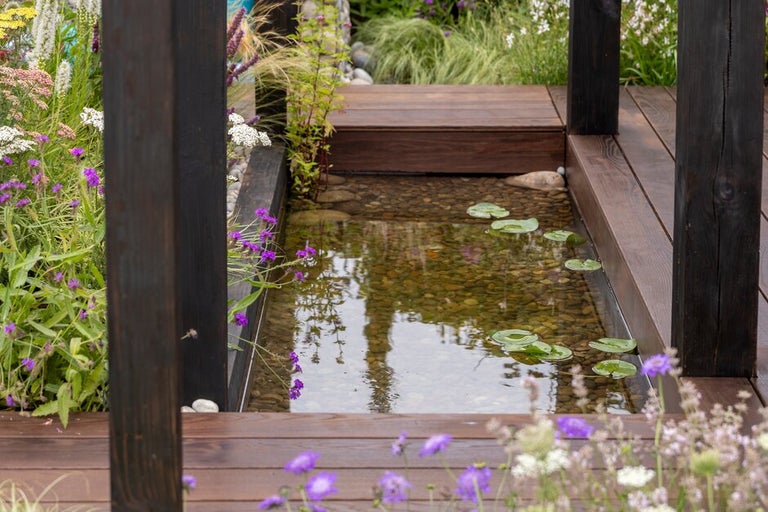
“When building a pond, divert a gutter downpipe into a rill so that your pond gets refilled every time it rains. You can also create a bog garden to take the overflow by making holes in the pond liner, adding a layer of gravel at the bottom and filling it with the soil you dug out of the hole.” – Veronika Rogers, Bexhill Gardening Club
“Harvest rainwater from the roof. We are about to set up two 4,000-litre tanks!” –The Wonky Garden
“We collect all the water used indoors – for example, for rinsing salad or washing our hands – in a jug left under the tap. We also save leftover tea from the teapot. It all goes on the herbs and bedding plants.” – Roxane Care
“Save rain from the drain by creating a rain garden planter. Connected to a roof downpipe, it captures and slows rainwater that would otherwise flow into drains, helping to reduce surface water runoff while creating an attractive planted feature.” – The Garden Gate Project