Hamamelis × intermedia 'Livia'
witch hazel 'Livia'
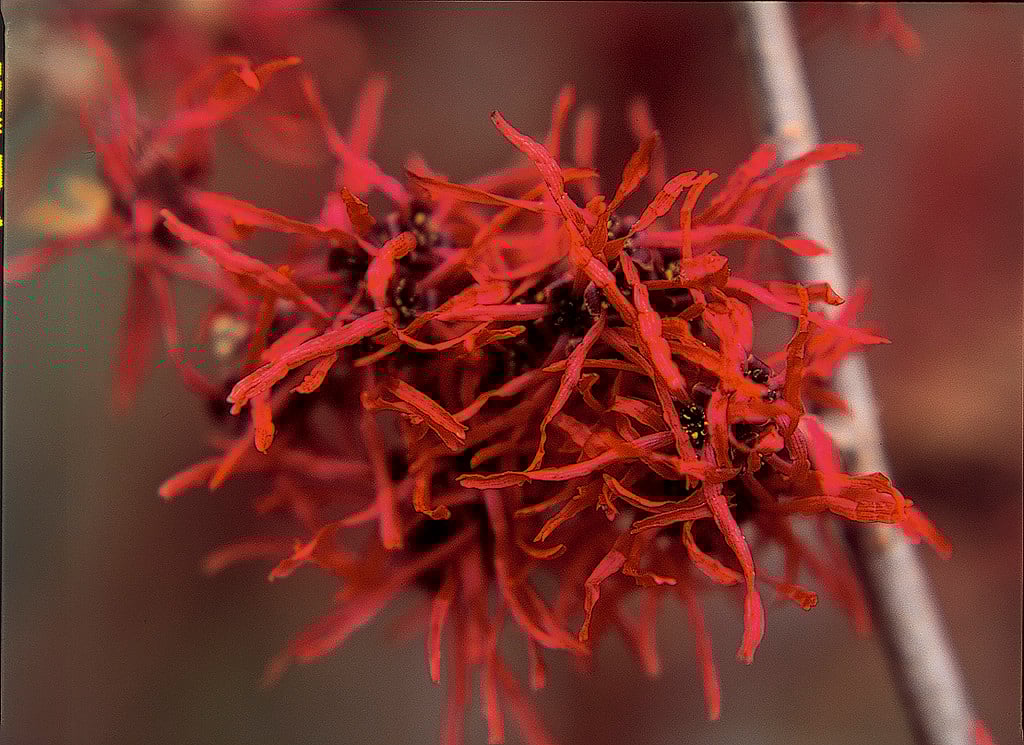
'Livia' is a spreading shrub up to 2.5m high and 3m wide with twiggy branches, broadly elliptic leaves 11cm long and 6.5cm wide which are a medium yellowish green heavily flushed with maroon-purple in spring, become dark green, and develop faint orange-red tints in autumn; lightly scented flowers with purplish red calyces and deep red petals over 2cm long appear from late autumn to late winter, over a very long flowering period, and unlike some other red cultivars they do not change colour as they fade
Size
Ultimate height
1.5–2.5 metresTime to ultimate height
10–20 yearsUltimate spread
2.5–4 metresGrowing conditions
Moisture
Moist but well–drainedpH
Acid, NeutralColour & scent
| Stem | Flower | Foliage | Fruit | |
| Spring | Red Green | |||
|---|---|---|---|---|
| Summer | Green | |||
| Autumn | Orange Red | |||
| Winter | Red |
Position
- Full sun
- Partial shade
Aspect
South–facing or North–facing or West–facing or East–facing
Exposure
Sheltered Hardiness
H5Botanical details
- Family
- Hamamelidaceae
- Native to GB / Ireland
- No
- Foliage
- Deciduous
- Habit
- Spreading branched
- Genus
Hamamelis are deciduous shrubs with broadly ovate or rounded leaves, sometimes colouring well in autumn, and fragrant yellow to red flowers with 4 narrow petals, borne on the leafless branches in late winter and early spring, or in autumn
- Name status
Accepted
How to grow
Cultivation
Grow in moderately fertile, neutral or preferably slightly acidic soil which is well-drained but humus-rich and moisture-retentive in summer, in full sun or partial shade, in an open position with shelter from cold drying winds, and add mulch to conserve moisture; will also tolerate soils over chalk if they are deep and humus-rich; for more advice, see witch hazel cultivation
Propagation
Propagate by layering in autumn, by grafting in late winter or early spring onto H. virginiana rootstocks, by budding in late summer, or by softwood cuttings in mid-spring in very free-draining compost with bottom heat and humid conditions (under mist or in a closed case) and not potted on until the following year
Suggested planting locations and garden types
- City and courtyard gardens
- Cottage and informal garden
- Low Maintenance
- Hedging and screens
- Banks and slopes
- Flower borders and beds
Pruning
Pests
Generally pest-free
Diseases
May be susceptible to coral spot, honey fungus, phytophthora root rot and powdery mildews
Get involved
The Royal Horticultural Society is the UK’s leading gardening charity. We aim to enrich everyone’s life through plants, and make the UK a greener and more beautiful place.