10 award-winning starter ferns
Hardy ferns bring understated beauty and graceful texture to the garden, thriving in shade while adding year-round interest with minimal effort
Often thought of as delicate or demanding, many ferns are surprisingly hardy and easy to grow. They thrive in shady spots with soil that stays reasonably moist, bringing subtle charm and movement to borders, woodland gardens, and containers, while their delicate forms add a sense of lightness amid denser planting.
Recognised with the RHS Recommended: Award of Garden Merit for their reliability, these ferns perform across a wide range of garden situations, helping gardeners create lasting displays with minimal maintenance.
The maidenhair fern is a favourite and familiar houseplant – this is the tough-as-nails outdoor version, and it features unique and distinctive fronds. Each wiry black stem of Adiantum aleuticum is topped by a swirl of fronds, each lined with pairs of small leaflets, and arching like a frilly umbrella. Ideal in moist but well-drained soil at the foot of a north wall. Height 30–60cm (11–23in). Hardiness rating H6.
One of those intriguing ferns with two completely different kinds of growth, the evergreen fronds of the British
The Japanese lace fern, Polystichum polyblepharum, is an evergreen fern forming a neat shuttlecock of spreading, glossy dark green fronds. The young fronds emerge upright, yellowish-green and covered with fine, golden hair-like scales. With its striking form and long-lasting foliage, it makes a great addition to shady borders or woodland-style planting. Height 80cm (31in). Hardiness rating H7.
The common name for Dryopteris erythrosora is the autumn fern – oddly, because although the evergreen fronds are the colour of autumn foliage they develop their pink or red colouring as they emerge in spring then mature to dark glossy green. Each frond is prettily divided two or three times into opposite pairs of leaflets and the spring colour of Dryopteris erythrosora ‘Brilliance’ is especially bright. Happy in moist shade. Height 60cm (23in). Hardiness rating H4.
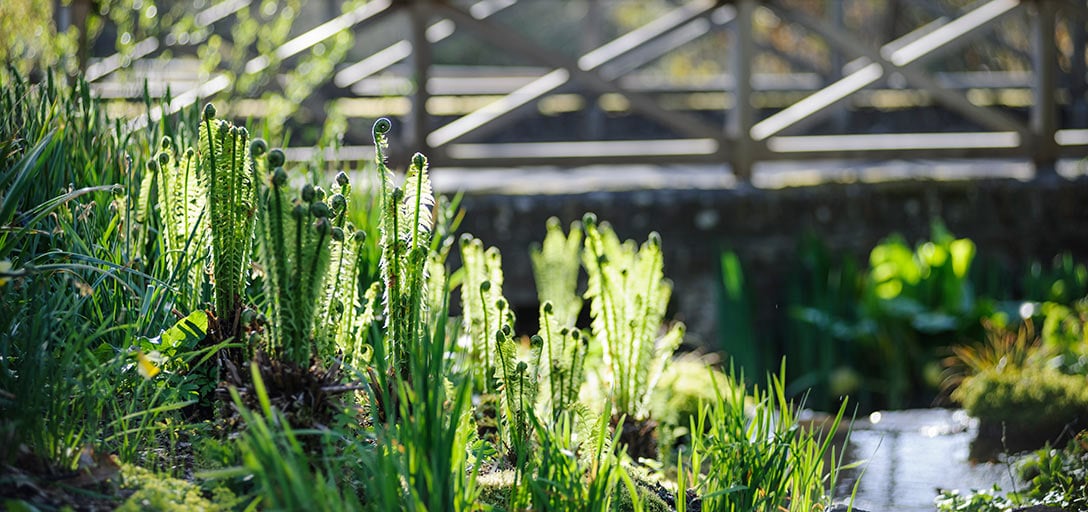
The shuttlecock fern, Matteuccia struthiopteris, is an impressive plant. Individual crowns develop tall, fresh green, parallel sided fronds in an imposing shuttlecock shape and send out leafless runners to produce new crowns, sometimes 30–45cm away. Over time, it forms a spreading, increasingly lush clump that thrives best in larger gardens, where it can really show off its grandeur. In summer, much reduced green fronds develop vertically from each crown and soon turn black as the spores develop. Insists on moisture. Height 1.2m (4ft). Hardines rating H5.
Called the sensitive fern, a name that reflects its response to the changing seasons rather than touch, as the first autumn frost causes the leaves to die back. Establishing quickly in wet conditions, sun or shade, the egg-shaped fronds of Onoclea sensibilis are often tinted pink as they emerge before maturing to a slightly bluish green. Invaluable on pond margins, its network of
The cinnamon fern, Osmunda cinnamomea, forms tight clumps of upright shuttlecocks made up of fresh green fronds, and in spring the plant is transformed. At the centre of each shuttlecock, cinnamon-brown, spore-bearing fronds emerge, almost like flowers. The crowns develop almost on top of each other, creating a display packed with interest and colour. Height 90cm (35in). Hardiness rating H6.
First described in 1668, this is a strange but wonderful little fern, happily creeping over limy rocks with a network of slender yet strong brown rhizomes that cling tightly. Thriving in full sun or light shade, the thin, somewhat papery, sharply divided fronds of Polypodium cambricum ‘Cambricum’ emerge in July and August and remain attractive through to spring before resting. Plant it carefully between stones in a wall and watch it start to spread. Height 40cm (16in). Hardiness rating H7.
One of the most attractive native ferns and ideal for small spaces, the hard shield fern, Polystichum aculeatum, rarely spreads, with each plant usually producing just a single crown. In a shade garden, it matures with arching elegance, its neatly divided dark green fronds remaining evergreen. The fronds may droop by early spring, but they pair well with bergenia foliage. Height 40–60cm (16–24in). Hardiness rating H7.
The male fern, Dryopteris filix-mas ‘Cristata’, is a striking