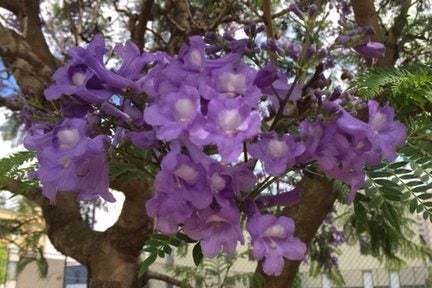
Often seen on exotic holidays in tropical or subtropical areas of the world, jacaranda can be grown in temperate regions as a foliage plant; outside in summer and overwintered in greenhouses and conservatories.
By The RHS Advice Team
Quick facts
Common name - Green ebony tree, jacaranda
1
Botanical name - Jacaranda mimosifolia
2
Group - Conservatory or greenhouse plant (trees, shrubs and woody climbers)
3
Flowering time - Mid spring, rarely in the UK
4
Planting time - Spring
5
Height and spread - 15m (50ft) by 7-10m (22-30ft)
6
Aspect - Bright light under glass, full sun outside
Although jacaranda will outgrow their space relatively quickly, they make great foliage plants until then. Sometimes flowers form on potted specimens when they reach the 1.8m (6ft) mark, but in the UK, this is rare.
Grow outside in summer or in a greenhouse or conservatory. Not being hardy, the winter minimum night temperature needs to be at least 5°C (40°F). They will lose their leaves at this temperatures, but it is best to let them become dormant. Warm conditions with low light levels would encourage legginess. They are not good houseplants .
In winter, only water when the plant has become bone dry
Even in summer, allow pots to dry between waterings
the shoot tips when are 20-30cm (8in-1ft) high to encourage bushiness. Alternatively, let the shoot grow up to develop a short trunk and then pinch out at around 1.2-1.5m (4-5ft)
More established jacarandas are tolerant of being pruned, making it easier to keep them for longer before they outgrow their allocated space
Take semi-ripe cuttings of young growths in early summer and insert the into pots of peat-free cuttings and into a with bottom heat of 20–24°C (68–75°F).
Seeds
Jacarandas can be raised easily from seed each year for use as foliage plants.
Sow seeds in January/February in a temperature of 20–24°C (68–75°F)
In warmth and good light, grow fast and can reach 60-90cm (2–3ft) by the end of summer
Cultivar Selection
It is unusual to get cultivated forms of jacaranda but the species Jacaranda mimosifolia - widely grown in warmer regions and familiar to many from holidays to such parts - is available in the UK.