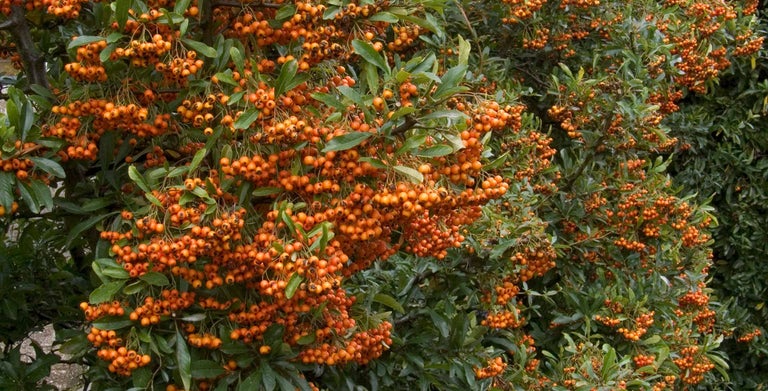
Quick Facts
Group: Shrubs, hedges
1
Flowering time: Spring to mid-summer
2
Planting time: Anytime, but ideally autumn or winter
3
Height and spread: 4m by 4m (12ft by 12ft)
4
Aspect: Full sun or partial shade
5
Hardiness: Most are fully hardy
6


Before you get started
Site and soil conditions
Pyracantha is suitable for any moderately fertile garden soil in sun or partial shade, including very dry, free-draining soils, and heavy clays, as long as they are not prone to waterlogging. Berrying can be reduced in shady sites, including against north-facing walls.
Pyracantha can be grown as a free-standing shrub (or hedge), or trained against a wall or fence.
Planting
If training Pyracantha along a wall or fence, plant at least 50cm (20in) out from the wall to avoid the dry area at the base.
Allow 1.5–3m (5-10ft) between specimen plants, but 50cm (20in) is fine between hedging plants.
After planting, apply a thick of organic matter such as well-rotted manure or garden .
Ongoing Care
Watering, feeding and mulching
Watering is required to help plants establish in the first couple of years after planting. After this establishment period, watering is very seldom required. Wall-trained specimens may need watering every 10 days in dry spells.
Pyracantha don't need regular feeding.
Annual mulching is very beneficial, helping to improve the soil, retain moisture and smother weed growth. Spread a 5-7.5cm (2-3in) layer of organic matter, like leaf mould, garden or well-rotted manure, around the base of your shrub each spring, being careful not to bank it up against stems to prevent rotting.
Pruning and Training
Pyracantha flowers mainly on shoots produced the previous year, so when pruning try to retain as much two-year-old wood as possible.
Wear thick gloves when pruning; as its common name (Firethorn) suggests, Pyracantha bears long and very sharp thorns.
Prune out shoots badly affected by pyracantha scab. These are easy to spot as the leaves (and often the berries too) will be covered in unsightly black scabs.
Pyracantha usually responds reliably to very heavy pruning when overgrown plants need to be renovated.
Free-standing shrubs
Free-standing shrubs merely need unwanted, damaged or diseased shoots removed in mid-spring.
Wall–trained shrubs
Pyracantha can be trained against a wall. See our advice on pruning climbers and wall shrubs on first planting for more information on how to establish a wall-trained plant.
Pyracantha can also be trained as an . See more details on this technique on our espalier pruning and training page.
In general, prune to make the berries more visible and to keep the plants in shape. In spring, cut back outward-growing shoots, and shorten other growth as needed. Waiting until after flowering will help to limit loss of berrying wood.
In late summer, shorten all sideshoots that arise from the main framework branches, stopping just short of the clusters of berries (usually about two to three leaves from the base of the side shoot).
If you need to extend the plants, tie new, leafy shoots into wires or trellis. While the shoots are still flexible, they can be trained to frame doors or windows.
Hedges
Trim Pyracantha hedges two or three times between spring and the end of summer. Aim to retain as many berries as possible but some will no doubt be lost as you strive to keep the outline.
Propagating
Pyracantha can be easily propagated from semi-ripe or hardwood cuttings, or alternatively from seed. Pyracantha seed requires three months of cold stratification in order to germinate. Cultivars won't usually come true from seed.
Problems
Pyracantha can suffer from the diseases pyracantha scab and fireblight. It can also be attacked by pyracantha leaf-mining moth and woolly aphid pests.
Lack of berries can be caused by:
- Pruning too much: Wall-trained plants need an annual haircut with shears to be kept neat. However, this can slice off the flowers and hence berries. If berries are needed, don’t clip the entire plant - just shorten back the sideshoots in mid-summer as described above
- Poor : This can occur in cold spring weather, particularly where plants are being grown in open situations exposed to strong winds, which can deter insects. It can also occur if plants flower during a wet period, when pollinating insects such as bees are not active
- Drought: This often occurs against a sunny wall in a dry border, and can result in premature berry-drop even though pollination has been successful. Water thoroughly at 10-day intervals in dry conditions until the berries colour-up in late summer
- Lack of feeding: Potassium (potash) encourages flowering and fruiting. Apply sulphate of potash at 30g per sq m (1oz per sq yd), tomato fertiliser, or comfrey pellets in early spring to an area extending at least 1m (3ft) beyond the branch spread
- Lack of vigour: Plants making only thin, weak annual growth may remain without berries. Check that the growing conditions are suitable and the plant is not suffering from a pest or disease
- Frost: Late spring frosts can damage flowers, destroying the plant’s ability to produce berries. Flowers may appear undamaged until examined closely