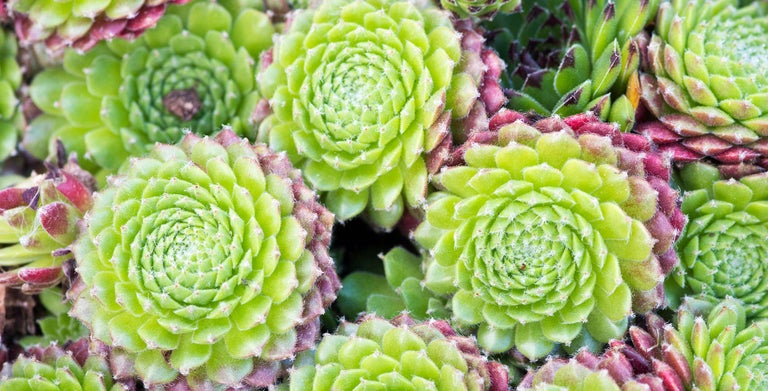
Quick Facts
Easy to grow and low maintenance
1
Evergreen foliage plants
2
Grow in an open, sunny site
3
They need well-draining soil or potting compost
4
Little feeding or watering required
5
Plants flower every few years in summer
6
Repot rosettes in spring or fill any gaps in your display with offsets
7


Before you get started
What are sempervivums?
Sempervivums are mostly hardy, evergreen , originating from mountainous regions of Europe and Asia. Their common name, houseleek, refers to their traditional useage of house roofs.
Choosing sempervivums
Most houseleeks are easy to grow and form dense ground-hugging mats. There are quite a few to choose from though so let's take a look at what to consider before you make your purchase;
- Your main deciding factor is most likely foliage colour and how they contrast with other houseleeks or alpine companions. Colour is quite fluid in houseleeks. Foliage can change colour - often from green to red - depending on the time of year and temperature. Some have contrasting leaf tip colour to the rest of the plant. Others have a more dominant leaf colour whether green, red or grey, or blue-green.
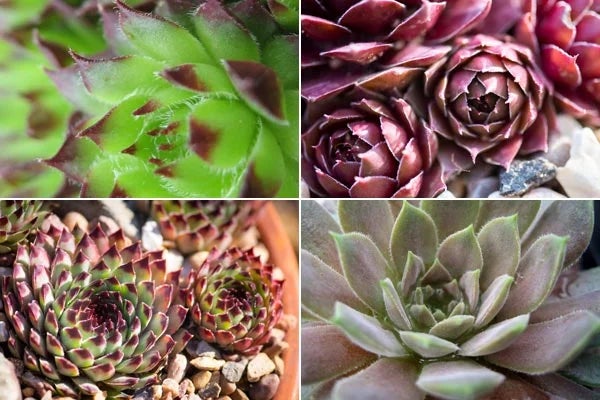
- Leaf texture is another element of choice. A few houseleeks have a 'cobweb' of white hairs over them such as Sempervivum ciliosum.
- Go to RHS Find a Plant and search by your preferred foliage colour.
- Although foliage is the most important feature of a houseleek, mature will flower in summer. Flower clusters may be green such as Sempervivum calcareum 'Guillaumes', pink, as with S. 'Hayling' or purple, e.g. S. tectorum.
- Most sempervivum are fully hardy. However a few (check label before buying), especially the grey or hairy ones, dislike winter wet so may need bringing under cover or protecting from the worst of the wet.
If you select plants with an AGM award (Award of Garden Merit) they have been trialled by the RHS for attractiveness and reliability, so they're recommended to perform well in your garden.
Top Tip
Other hardy succulents similar to sempervivums include Rosularia, Jovibarba and Sedum, good alternatives to more tender succulents such as Echevaria and Aeoniums.
Flowers
Houseleeks flower in summer after 2-3 growing seasons. While flowers add interest, the foliage is the main attraction. A flower stalk is sent up from the middle of the rosette to a height of around 15-20cm (7-9in). After flowering this central rosette dies, but there should be plenty of mini plants by then to replace it. These are produced by the rosette sending out a spray of horizontal stems (stolons) with mini rosettes attached to the ends. These then root. 'Hen and chickens' is one of sempervivum's common names, referring to this growth pattern.
Buying sempervivums
Although houseleeks can be bought at any time of year. They are usually sold in small pots (about 9cm) in garden centres, from specialist alpine nurseries and by mail order.
Fernwood Nursery holds the National Collection of species and cultivars and is a good place to go for more unusual varieties.

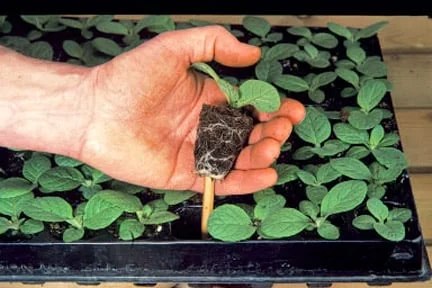
Planting
When to plant sempervivums
While they can be planted at any time of year, spring is ideal to get them nicely established during the warmer growing months.
Where to plant sempervivums
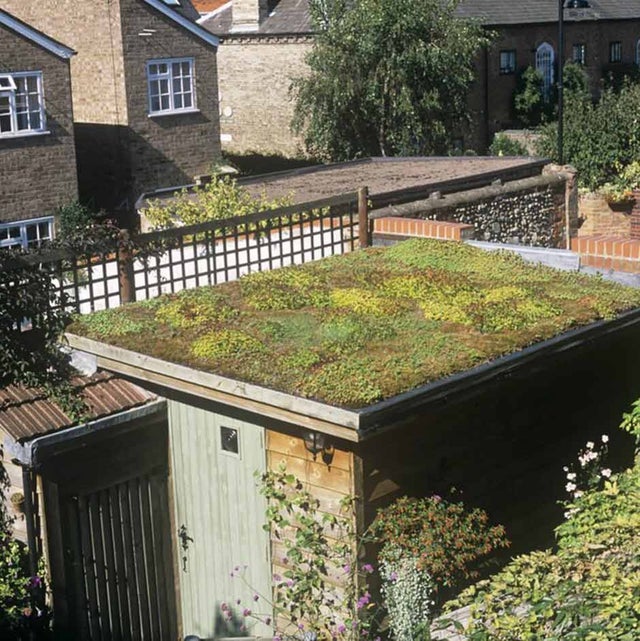
You'll need a well-drained site such as a rock, scree or gravel garden. Alternatively, grow sempervivums in containers whether shallow alpine pans, old bricks, troughs, gutters or sinks. They can also plug holes in dry stone walls! Or pop them into living walls and green roofs.
They are not fussy as to soil type in terms of but avoid heavy soils like clay that drain poorly.
Also when positioning houseleeks, have a think about their eventual size. Plants rarely get more than 15cm (6in) tall but will spread to at least 30cm (1ft) by stolons and rooting . In good conditions, vigorous plants may outgrow their space and need splitting up in spring. Others will need repotting or infilling with young offsets every few years if flowered patches have died out.
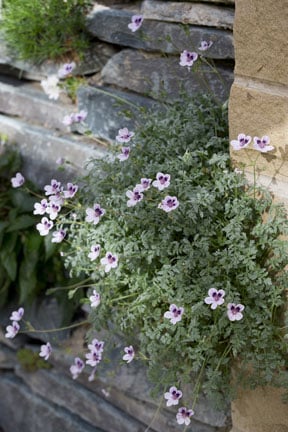


How to plant sempervivums
Plant out at the same level as the rosettes are in their pots, firming in gently. Dress the surface of your soil or pot with grit, slate or some small aggregate. This helps keep soil off the leaves, but also acts as a foil, showing the rosettes off to perfection.
If you are planting in containers, prepare a free-draining growing medium. Here's how;
- 1 parts soil-less (for example a peat-free potting compost), one part loam-based compost such as John Innes No.1 or No.2 and one part .
- A basic alpine trough mix of half sharp grit and half John Innes No. 2 will also offer enough drainage. You can add a slow release feed. Check the product label for the application rate.
- If you aren't able to mix your own, buy a ready made alpine or cacti potting compost.
Ongoing Care
Watering
While sempervivum appreciate being watered in dry in spring or summer weather, they can survive happily without.
Plants out of doors will not need watering in winter.
Feeding
While any slow release feed you've included in the potting medium will last several months, once that has been used up, you can supplement with a monthly general liquid feed in the . Plants growing in the ground are unlikely to need fertiliser.
Overwintering
Houseleeks are generally very hardy, needing little attention in winter. Some will prefer sheltered conditions out of excessive winter wet (check the label when buying) so move containers into a or place a sheet of perspex over a plant if you live in a wet region.
Ongoing care
To keep your container collection of sempervivum in tip-top conditions, separate and repot plants every 2-3 years in spring. This will let you clear out any dead material and fill gaps left by flowered plants (although you can just gently prize up an offset and pop it with a little more into the gap and it will root away).
Displays in the open ground can also be split and replanted in spring when they start to look tired or gappy.
Pruning and Training
If you don't want plants to self-seed, trim off flowered stalks after they've flowered and before they set seed.
Ensure that over time, or at the height of the , other plants don't overshade your sempervivums. Cut them back if you need.
Propagating
Offsets
Propagating by offsets is a sure fire way to get plants the same as your favourite cultivars.
- Pot up offsets (mini ) in spring into a free-draining, gritty . You can make your own using half and half sharp grit and John Innes No.2 or buy a ready-made cacti compost. Plantlets may already have roots, so tease rosettes apart carefully. Keep moist and out of direct sun and they should establish in 4-6 weeks.
- If the mini rosettes don't yet have roots, snip off the connecting stolon close to the rosette to encourage rooting. Press the rosette lightly into the surface of a pot of gritty compost. Place somewhere out of direct sun and keep moist until rooted and showing active growth – a process which will take a few weeks.
Seed
If you have a species sempervivium which will come true from seed if not cross or if you want to experiment, you can grow plants from seed. Named varieties are unlikely to produce offspring that are true to type (i.e. like the parent).
- If you are experimenting with hybridising, pollinate the summer borne flowers by hand using a paintbrush using pollen from cultivars you'd like to try as parents.
- When seed pods brown, crush to extract the tiny seed.
- Sow in potting compost between spring and autumn.
- Place in a sheltered and frost-free spot, such as a , to germinate.
- Pot on into a free-draining gritty compost when little plants are large enought to handle.
Problems
Sempervivum are generally trouble-free little plants.
One problem which may arise is birds trying to uproot newly planted speciemens. If so, temporarily string arcoss some taut thread to keep them off. Like other containerised plants, they can suffer from soil-dwelling pests like vine weevil. And they can get sempervivum leaf miner, a relatively new pest to the UK.
If plants look peaky, give them a gentle tug to check the root system is strong and if not, tip them out of the container to see if there is an underlying root problem. Excessive moisture will cause roots to rot, so ensure drainage is sharp by having a well-draining or soil. Rust is occasionally a problem.
If you're a member of the RHS, you can use our online Gardening Advice Service, via MyRHS, for any gardening queries and problems.