Gladiolus (gladioli) trial results 2024–2025
Objectives and purpose of the trial
Gladioli standing tall within the Trials Garden at RHS Wisley
A vibrant cast of gladioli in full bloom fills the trial beds in July 2025
What is an RHS Recommended: Award of Garden Merit?
The RHS Recommended: Award of Garden Merit is intended to help gardeners choose reliable plants and is only awarded to plants that are:
- Healthy, with good overall growth and appearance
- Excellent performers, resilient in the right conditions
- Available to buy in garden centres or online
- Reasonably resistant to common pests and diseases
- True to type, keeping a consistent colour and form
Judging criteria
The following factors were all taken into consideration as part of the judging of the trial:
- Overall appearance – proportions, sturdiness and foliage
- Flower impact – colour, size and shape
- Length of flowering period
- Weather and pest resistance
- Uniformity of height and colour
Gladiolus – RHS Recommended: AGM winners
We’re now looking at companion planting in a different light and researching all the options before a trial is planted.
Why the RHS Recommended: AGM was awarded
Forum assess the Gladilous trial in July 2025 at RHS Wisley
The judging forum assessing the trial at RHS Wisley in August 2025
RHS Recommended: AGMs rescinded
Plants and location
What was planted?
Over the course of the trial, the project lead documented each entry through photography, capturing overall plant habit as well as finer details such as colour, form and stem strength. In parallel, the RHS Trials team closely observed all key stages of development, from the first flowers opening to the final flowers fading, while the RHS Herbarium collected representative plant material to add to its archives.
Where was it planted?
The gladioli corms were planted directly into the open ground across two trial beds in the Trials Garden at RHS Wisley, forming the basis of a colourful summer display and providing optimal conditions for assessment. Here are some considerations for planting out gladioli:
- Plant gladioli in full sun, choose an open, sunny site with shelter from strong winds
- Use fertile, free‑draining soil. Good drainage is essential to prevent corm rot and promote strong growth
- Planting at the right depth is important. Set corms 10–15cm deep to improve stability and flowering quality
- Water during dry periods. Keep soil evenly moist while plants are actively growing
- Feed gladiloi when flower spikes form. Apply a potassium‑rich feed as flowering stems start to emerge
- Make sure to lift tender types in autumn. Most garden hybrids should be lifted and stored frost‑free over winter
Cultivation
Planting process
After planting, the beds were covered with a layer of strulch (straw-based mulch) to suppress weed growth.
During planting, the curatorial team identified some corms with aphid infestation at the base. These were treated by soaking in a soapy solution, before planting. To support spike stability during the first flowering season, each trench was staked using four bamboo canes and twine. The trial was not staked in 2025.
Following flowering, fertiliser was applied in October 2024. In November 2024, the remaining flower spikes and foliage were cut back to 5cm, and a further layer of strulch was applied to protect the beds over winter. Any remaining stalks were removed by December 2024.
In April 2025, 17 entries that had been severely affected by thrips in their first year were removed and replaced with new corms, or with suitable alternatives where original stock was unavailable. Corm availability was limited following prolonged wet conditions in the Netherlands during 2023 and 2024, which affected supply.
At the end of the trial, entries were left in the ground over winter and covered with strulch to assess which cultivars would flower again the following year.
How plant health was managed
Challenges
During the first year of the trial, gladiolus thrips had a significant impact. Damage included streaking and mottling of florets, discolouration of foliage and, in severe cases, flower buds on the spikes failing to open.
In response, the beds were treated three times between August and September 2024 with a soapy solution, followed by a final spray aimed at controlling adult insects, larvae and eggs. Despite repeated applications, this approach proved ineffective and was not considered a reliable or preventative control method.
In the second year of the trial, the focus shifted from attempted eradication to management, recognising that thrips is a persistent pest. In 2025, an Integrated Pest Management (IPM) strategy was introduced to reduce damage. Key actions included:
- Mid-April: Direct sowing of alyssum (Lobularia maritima) across the gladiolus beds
- Early May: First application of a Steinernema feltiae nematode drench
- Early June: Second application of a Steinernema feltiae nematode drench
This approach aimed to encourage a more balanced ecosystem by providing alternative feeding sites for thrips. Early observations in June and July suggested a reduction in thrip damage, with flowering spikes opening more fully and showing less distortion.
However, in June and July 2025, three closely spaced heatwaves affected the trial. Despite regular hand watering, signs of heavy thrip infestation re-emerged by late July. Two additional biological controls were considered as part of the IPM approach:
- Amblyseius cucumeris, a predatory mite that feeds on thrips
- Orius laevigatus, whose nymphs primarily consume thrip larvae
These were not introduced, as it was felt they would be ineffective so late in the season. By this stage, most flower spikes had already passed their peak due to the prolonged hot and dry conditions.
Alongside the Trials Garden, the Gladiolus Trials Forum also observed three cultivars planted within a mixed border in the RHS Wisley Garden. In this setting, the gladiolus performed well and showed minimal thrip damage. This comparison suggested that while thrips presented a significant challenge in the trial environment, they may be less problematic in garden settings where gladiolus are grown within mixed herbaceous planting.
Weather and watering
Spring and summer 2025 were notably warmer and drier than average at RHS Wisley, creating challenging growing conditions for the trial.
Rainfall: Spring rainfall totalled 45.9mm, making it the fourth driest spring on record at RHS Wisley. May received just 55% of the 1990 to 2019 average rainfall, while June was also drier than usual. Although July rainfall reached 92% of the long-term mean, much of the South East was already experiencing drought conditions by this point.
Temperature: Three heatwaves were recorded across June and July. In June, temperatures exceeded 27°C for three consecutive days, with a maximum of 32.4°C recorded on 30 June. Peak temperatures reached 33°C in July. The Gladiolus beds were not fitted with drip irrigation, so watering was carried out manually twice a week throughout the growing season.
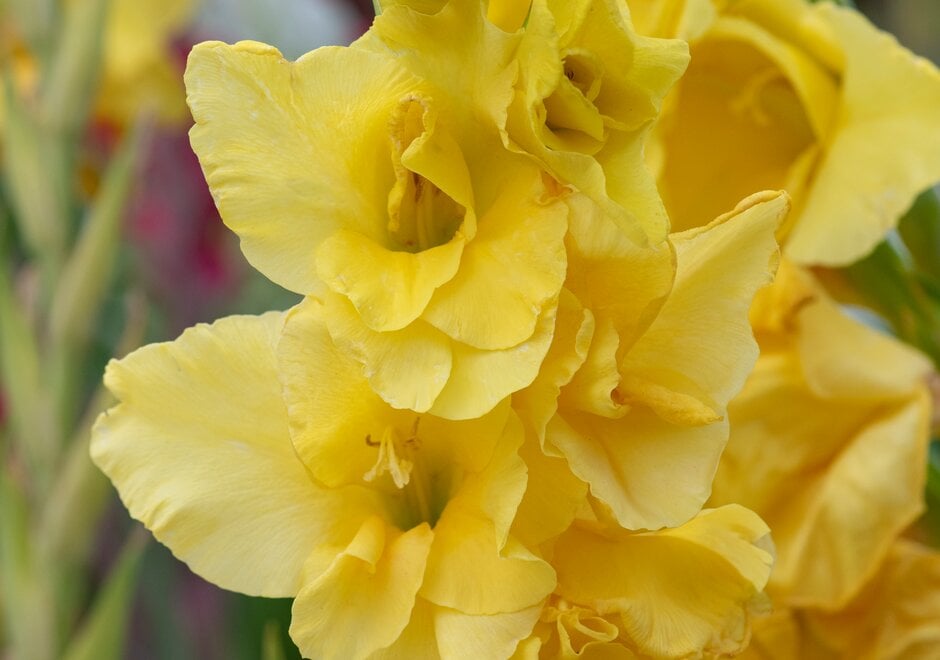
How to grow gladioli
Explore all the information you need to know to grow and care for gladioli in your garden
Discoveries
Perfect companion planting
Want to try companion planting at home? Lobularia maritima ‘Carpet of Snow’ was used in the trial and is easy to grow in your own garden.
Mixed border planting | July 2025
Gladiolus ‘Cobain’, ‘Cream Perfection’ and ‘Lennon’, all RHS Recommended: AGM winners, displayed in the RHS Wisley long borders in the summer of 2025. Photo credit: Michael Pitcher.
Thrips | 2024–2025
Thrips damage as seen on flowers and leaves during the trial. Thrips cause streaking and mottling on florets and discolouration on foliage.
Aphids | November 2024
Aphids were discovered at the base of a small number of corms during planting in November 2024. These were treated with a soapy solution before planting.
Who was involved?
Judges of the trial
The 2025 Gladiolus judges comprised: Rob Evans (Pheasant Acre Plants), Michael Pitcher (Garden enthusiast), Pip Bensley (Florist and RHS Judge), Coralie Thomas (Assistant Head Gardener, Great Dixter), Cathy Osselton (Gladiolus Breeder), Jonathan Moseley (Floral Designer), Muhammad Hafiz Ullah (RHS Bulb Expert Group), Peter Wilkins (Garden Enthusiast), Verity Battyll (RHS Curatorial, Year 1) and Nick Petters (RHS Curatorial, Year 2).
Suppliers to the trial
- Nijenhuis
- Prisma Gladiolus
- Pheasant Acre Plants
List of plants in the trial

Handy tools and information
- Full article - Filter RHS Recommended: AGM plants by colour, height and season
Find a plant online
Filter RHS Recommended: AGM plants by colour, height and season - Full article - Explore advice and helpful tips from our resident experts
Gardening advice
Explore advice and helpful tips from our resident experts - Full article - Check how hardy plants are using the RHS hardiness ratings system
Hardiness ratings
Check how hardy plants are using the RHS hardiness ratings system - Full article - A trusted gardening app packed with expert know-how
RHS Grow app
A trusted gardening app packed with expert know-how
Get in touch
For more information on our RHS Plant Trials or to access older trial reports, please get in touch with our team via email at [email protected].
Get involved
The RHS is the UK’s gardening charity, helping people and plants to grow - nurturing a healthier, happier world, one person and one plant at a time.