8 plants you weren’t expecting to see at RHS Chelsea 2026
The weeds, the wacky and the weird from this year’s RHS Chelsea Flower Show


RHS Chelsea
Flower Show
Meet some of the floral stars of the show and discover inspiring plant ideas to take home from this year’s RHS Chelsea Flower Show

The Tate Britain Gardenis a garden designed around foliage power – and the effect is jaw-dropping. The most eyecatching plants of all are perhaps the incredible cycads scattered through the garden; prehistoric plants very rarely seen at RHS Chelsea.
“I’d seen cycads in so many gardens in the South of France and the mountains of Majorca,” says designer Tom Stuart-Smith. “But we don’t really use them in the UK because of perceptions of tenderness. Just plant them carefully – for example at the Tate, where this garden is going after the show, they’ll be in a spot that stays quite dry in winter. They won’t take below -10C, but will cope with a light frost.
“These plants are 40–50 years old, but cycads as a group are ancient, Jurassic plants – they could have been a dinosaur’s favourite after-dinner snack.”
RHS Wisley Curator Rob Brett says: “I can see this is a plant for the future in the South East of England. Its architectural form is such a draw. The jaggedness of the leaves makes a striking contrast with the softness of the other foliage around them.
“It’s my top plant at the show, because I’m trying to push the boundaries of horticulture – and this is doing that.”

This luxurious crimson peony has become centre of attention on The Boodles Garden.
“The peony ‘Buckeye Belle’ is the plant everyone’s talking about on this garden,” says designer Catherine MacDonald. “It’s probably my favourite red peony. I love the colour – it’s a deep, rich, royal red, which is well suited to a garden themed around the Royal Palaces.”
Catherine has paired the peony with Aquilegia ‘Ruby Port’ and purple-leafed cowparsley Anthriscus sylvestris ‘Ravenswing’ for an opulent display of harmonising burgundy tones, which is lifted and softened by the delicate frothy white flowerheads of the cowparsley.

This eyecatching shrub is quite literally stopping visitors in their tracks on the Trussell’s Together Garden.
“No one is getting past the Cornus VENUS,” says designer Rob Hardy. “The ‘flowers’, which are actually bracts, are just huge. When I went to the nursery a couple of weeks ago, the bracts were tiny and I couldn’t believe they would open to the massive size I’d been promised – but now they’re the size of my hand.
“I wanted something tolerant of light shade to become a focal point at the back of the garden, creating height at the back of the structure. It will eventually grow to five metres tall, but can be kept smaller by pruning. I’ve put Viburnum KILIMANJARO next to it on the right, weaving through the structure – which I think is lovely.”

It might not be the first thing you spot on The Lady Garden Foundation ‘Silent No More’ Garden, but the intense blood-red bloomsof Rosa ‘Geranium’ are breathtaking against the backdrop of the terracotta-coloured wall it nestles against.
Bred at RHS Wisley in the 1930s, ‘Geranium’ is one of the more compact and bushy hybrids of Rosa moyesii – and if you can only have one, this is the one to go for. The simple, open blooms are a draw for pollinators, while autumn brings beautiful bottle-shaped red hips and the foliage is so delicate as to be a worthy feature in its own right.
Despite its delicate looks, this is a truly tough, low-maintenance rose that thrives in challenging and drought-prone situations on a wide range of soils, and thanks to its deep roots, shouldn’t even need watering once established.

Two magnificent multi-trunked Scots pine trees frame The Asthma and Lung UK Breathing Space Garden.
“The garden was inspired by a drawing of a pine tree with an empty backdrop,” says designer Angus Thompson. “The garden is designed to showcase the beauty of empty space – we thought, can we go to RHS Chelsea and be quite bold and not cram the garden with flowers?
“We only wanted two trees, so they had to be good trees. We went to a nursery in Belgium and found these two pine trees – ‘the brothers’ – that had been rescued from an area with a rising water table that would eventually have killed them.
“The stress of that situation is what caused them to grow into these wonderful shapes – they were shallow-rooted as they’d lifted their feet up to escape the ground.”

A hardy with all the whimsical charm of a self-sown meadow annual, golden alexanders injects a vibrant pop of acid yellow-green into the resilient planting scheme in The Children’s Society Garden and Arit Anderson’s Parkinson’s UK – A Garden for Every Parkinson’s Journey.
The delicate flat-topped flowerheads (umbels) rise above glossy green foliage, bringing energy and movement to the planting. In The Children’s Society Garden, they contrast beautifully with the dark foliage of a purple-leafed elder, the blue-grey foliage of Rosa glauca and the hot pink flowerheads of an RHS Chelsea classic, Cirsium rivulare ‘Atropurpureum’.

The unmistakeably exuberant grey-green foliage and tall rust-red flower spikes of Melianthus major make a stunning focal point on The Lady Garden Foundation ‘Silent No More’ Garden, creating a dialogue with the jagged grey leaves of Cynara cardunculus set against the terracotta-coloured wall behind.
In The Tate Britain Garden next door, Tom Stuart-Smith uses the same plant in combination with cycads and Salvia confertiflora – which, not yet being in flower, is featured for its furry red stems– for a breathtaking, foliage-focused tropical look.

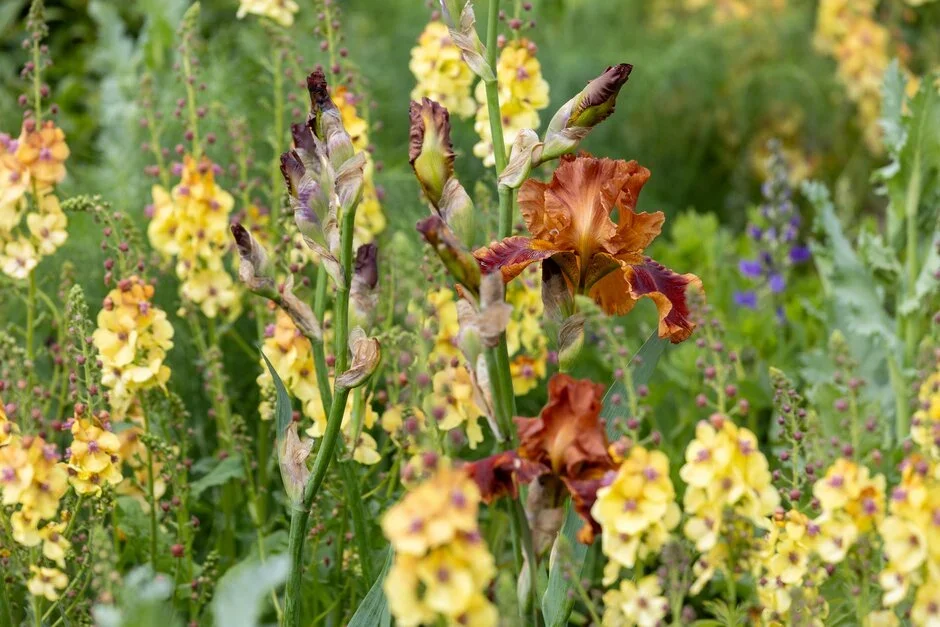
Bearded irises were a key plant at RHS Chelsea in 2025, and have certainly made a comeback in 2026. The trend this year is to pair them with other flowers that have contrasting, spire-shaped forms but harmonising colour tones. In The Trussells Together Garden, Rob Hardy pairs ‘Carnival Time’ – a rusty iris with yellow stamens – with Verbascum ‘Clementine’, which itself has yellow flowers with rusty centres.
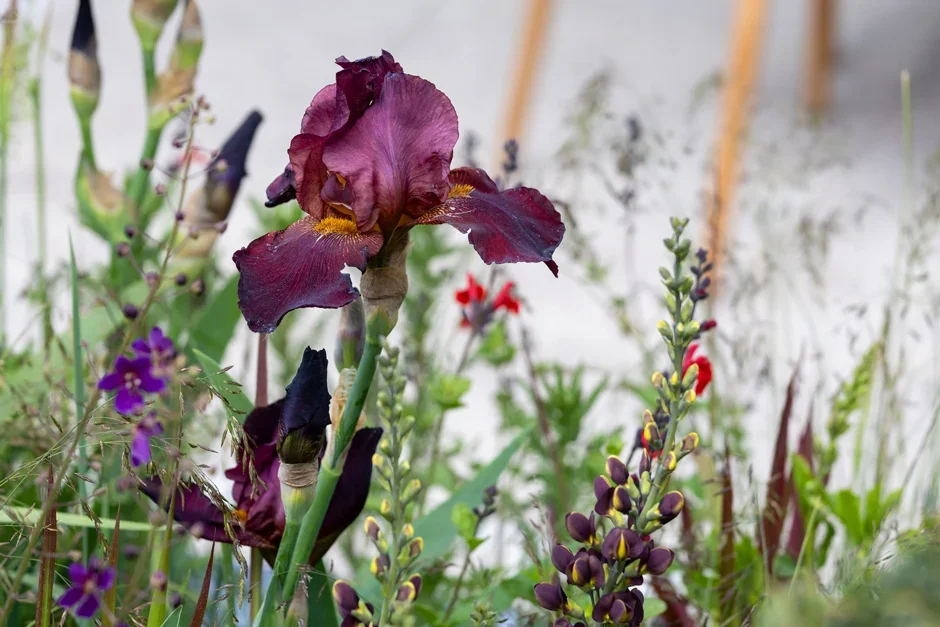
Similarly, on The Boodles Garden, Catherine MacDonald pairs plum-and-yellow Iris ‘Benton Caramel’ with plum-and-yellow Baptisia ‘Dark Chocolate’. Elsewhere, she creates a purple haze with Iris ‘Superstition’ and Iris ‘Deep Black’ interwoven with Salvia nemorosa ‘Caradonna’ and Verbascum ‘Violetta’.
If you have a sunny, reasonably dry spot where bearded iris tubers can bake in the sun, why not have a go at recreating a colour-matching iris-verbascum combination at home?
Get the look: Shop the Show Garden plants from RHS Chelsea 2026 here >
About the author – Olivia Drake
With a background in biology, Olivia is passionate about sustainable horticulture, biodiversity and the role gardening can play in conservation. She is trained as a botanical horticulturist and previously worked in public gardens around the UK and abroad.