Quick Facts
A genus of around 80 species of perennial corms that come up every year
1
Flowers are funnel shaped and a few inches tall, blooming mainly in spring, but some species flower in autumn
2
Colours range through white, yellow, lilacs and purples
3
Crocus generally prefer sunny and well-drained sites
4
They're happy on a range of soils including chalk
5
Different selections will grow in a wide choice of settings: containers, turf, under deciduous trees or in borders
6
For species that need specialist cultivation a coldframe, plunge bed or alpine house is required
7


Before you get started
What are crocuses?
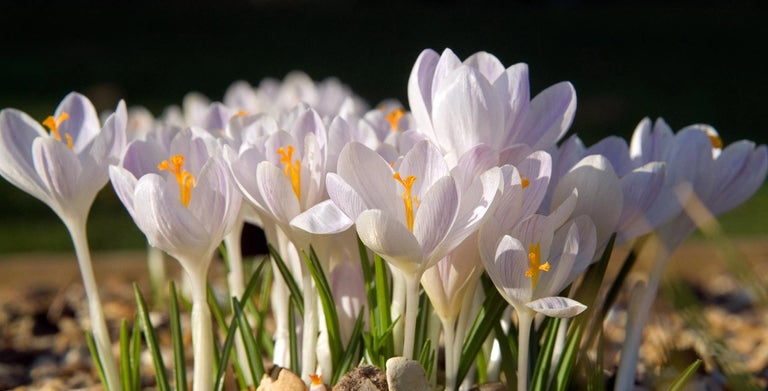
Crocus are very dwarf perennials growing from an underground . Their , linear leaves usually have a silvery central stripe. The goblet-shaped, sometimes fragrant, flowers bloom in early spring or autumn.
Choosing crocuses for your garden
Decide what season you want crocuses for and where you want to grow them. Here are some ideas:
Crocuses for spring
For naturalising in sparse grass and under deciduous trees: Try the slender pale lilac C. tommasinianus cultivars. They offer early flowers in February to March.
For rock gardens and soils that are dry in summer but have similar sun/part-shade conditions to deciduous trees: Try C. chysanthus cultivars for March flowering.
For naturalising in lawns: Try the C. vernus hybrids. They're referred to as Dutch hybrids and have quite stout goblet flowers in March. Examples include C. 'Pickwick' and C. 'Flower Record'.
For containers in March: Try the wide choice of cultivars including C. 'Snow Bunting' and C. x luteus 'Golden Yellow' and again the Dutch hybrids like C. 'Vanguard'.
Crocuses for autumn
For naturalising in short, sparse grass: Try C. speciosus cultivars
For alpine houses and cold frames: Try the Crocus species that aren't at home with conditions generally provided by the UK’s maritime climate, so are best grown with some protection. Examples include C. niveus and C. boryi. They're summer dormant and want a dry baking, so protect from summer rain in an alpine house or . They are happy with some winter moisture and cold temperatures.
For well-draining garden sites, rock gardens and raised beds: Try a group of species that are less picky than the alpine house types and that can be grown outdoors with a bit of soil preparation. This group tolerates summer moisture as long as the drainage is right. Examples include C. sativus and C. etruscus.
For more selection details see: 'Choosing Crocus by flowering season'
Where and when to buy
Spring flowering crocuses
These are sold and planted in autumn as dry corms. Garden centres also sell them in growth in early spring in containers as flowering plants.
Autumn flowering crocuses
These are for sale in late summer in the garden centre and from bulb nurseries via mail order. They're planted a little bit earlier (in September) than other garden bullbs like daffodils, tulips and spring flowering crocuses.
Planting
Spring flowering crocus - when to plant
Plant spring flowering crocuses during the autumn.
Spring flowering crocus - where to plant
C. tommasinianus cultivars and C. chysanthus cultivars look best in swathes of small groups in sparse, short rough grass and under trees.
Dutch hybrids (C. vernus) are the top choice for planting under garden lawns and in containers.
Spring flowering crocus - how to plant
To naturalise C. tommasinianus and C. chysanthus plant 7-10cm (3-4in) deep in small groups.
In garden lawns, Dutch hybrids have bigger corms so can go a bit deeper at 12cm (5in). Space individually about 9cm (4in) apart.
For tips on making look natural and planting at scale see here.
In containers, plant crocus as the top layer above other bulbs 7-12cm deep (3-45n).
Forcing crocuses in containers to flower in late winter
For bringing on (forcing) spring flowering C. vernus in small flower pots or shallow pans, plant in early autumn. Ideally plunge these pots into sand or soil in a cold frame for 6-8 weeks at 15cm (6in) deep for some autumn chill. Alternatively use a dark shed.
Warmth will then encourage them to flower, so bring them indoors to a temperature of 10- 20oC ( 50-54oF). From an October planting, they should flower for you in January.
Autumn flowering crocus - when to plant
These are planted in late summer, generally September, so if they flower in their first year, it may be a little later than normal. Once settled in, their flowering is triggered by the lower temperatures and higher soil moisture in autumn.
Autumn flowering crocus - where to plant
Species like C. speciosusare good for naturalising outdoors in sparse short grass in an open site.
For well-draining garden sites use species like C. sativus and C. etruscus that can be grown in many open garden situations with a bit of soil preparation. C. sativus could be grown on a well- draining allotment in a mild location if you want to try your hand at saffron harvesting.
For the more specialist crocus like C. niveus, grow in pots in an unheated greenhouse (cold glasshouse) or coldframe. With this protection they'll avoid the worst of the wet and cold when flowering and will be assured of a dry summer baking when dormant.
Autumn flowering crocus - how to plant
For naturalising outdoors, plant species like C. speciosusat 12cm (5in) deep.
For species like C. sativus and C. etruscus that are less picky than the alpine house types because they’ll tolerates summer moisture, just make sure that the drainage is right. Dig in leafmould and sharp grit into the top 20cm (8in) of soil and plant on a layer of , maybe in a rock garden, alpine trough or raised bed.
For alpine house (cold glasshouse) specialist crocuses like C. niveus, plant in pots around 10-13cm (4-5in) deep in a gritty peat-free, loam-based growing medium.
Ongoing Care
Watering
Watering isn't usually required for outdoor crocuses except in perhaps in containers. When in leaf, check with your finger that the growing medium (potting ) feels moist to the touch a few inches down.
For specialist crocuses in the greenhouse, watering will be based on the rainfall patterns of their orginal habitat.
Feeding
Crocuses grown in the ground shouldn't need feeding.
Specialist crocuses grown in containers can be fed with a high potassium liquid feed when in leaf, making sure to follow the dose rate and frequency recommended by the manufacturer.
Aftercare
Allow the foliage of crocuses to die back naturally rather than removing it when it's still green. There's no need to deadhead.
For crocuses planted in grass, hold off mowing until the foliage dies back to aid perennialisation.
Dig up crocuses from spring containers after the foliage dies down. Store in paper bags somewhere cool and dry until replanting in autumn.
Specialist crocuses grown in containers can be repotted every other year using a free-draining, loam-based potting mix.
Propagating
Crocus are generally left to multiply by themselves if - by seed or mini corms. Many in general display containers are treated as disposable but can be replanted into the garden after flowering.
Propagating by division
You can divide established groups of both spring and autumn flowering crocus in late summer and replant. However some like C. tommasinianusflower best when congested.
Propagating by cormels
If you want to increase your stocks, grow on the little cormels that grow around older corms or from underground stems. Line these cormels out in drills in the garden or in pots until they bulk up to flowering size. (If you want to actively promote cormel formation, plant your stock crocus corms shallowly)
Propagating by seed
Sow home-harvested seed when ripe The seed capsule for spring flowering types should appear from below ground in early to mid summer.
Collect seed before the capsule splits. Sow in a pot of well-draining, peat-free and allow to grow on for two years - the protection of a would be ideal. Pot on to give the small plants more space as the foliage dies down at the end of their second season. need to be watered well through the year. Plants should flower in their third or fourth year
For more tips on propagating , see here.
Problems
Watch out for bird, squirrel and rodent damage. Planting under a metal mesh may reduce losses.
Store in cool dry conditions to avoid the fungal rots that and corms can suffer from.
Physical damage gives pathogens another opportunity to attack corms, so handle them with care.
See bulb storage tips here.