Shade-loving edibles
We all love the idea of growing and eating our own homegrown produce, but what if you aren’t blessed with the perfect sunny aspect and instead have a shadier spot?

As regular readers of this blog may know, I'm a passionate advocate for vegetables, and have recently submitted a Master of Horticulture dissertation discussing their potential for use by home-gardeners as a sustainable option in the face of climate change.
To deepen my research, I undertook an RHS Horticultural bursary study tour to Norway to learn directly from Stephen Barstow, one of the world's leading authorities on edible perennials. Staying in a log cabin beside a Norwegian fjord provided the perfect backdrop to reflect on how these remarkable crops can revolutionise our approach to domestic food production. While establishing perennials requires thoughtful initial management, the long-term ecological and practical dividends far outweigh the challenges.

Unlike conventional annual crops which often require continuous soil disturbance and seasonal inputs, vegetables offer a different approach to sustainable gardening.
Once established, perennial vegetables can offer greater root resilience than their annual counterparts, as their able to build deep and extensive root networks. Perennial wall rocket, for instance, develops a root system more than twice as long as that of a standard annual salad rocket.
This doesn't mean that perennial vegetables need no water, or that they wouldn't crop better with additional irrigation. What is does mean is that many can survive for longer periods without watering. I haven't needed to water the asparagus on my allotment for months, yet it continues to thrive.
Perennial vegetables can support long-term soil health and carbon storage. They're well suited to no-dig systems, and can be left mostly undisturbed, allowing soil food webs to develop. The permanent presence of living roots in the ground can also support soil biology, while their extensive root systems help to protect the soil from erosion.
Stephen Barstow’s garden is situated on a steep slope, but his perennial plants help to bind the soil together, enabling productive food a site that would be virtually unworkable for annual crops.
How roots protect against erosion
Anchoring the soil: roots weave through the soil like a net, helping to hold it in place and reduce the amount that can be washed or blown away by rain and wind.
Absorbing water: roots take up water from the soil, which can help to reduce surface runoff – water flowing across the ground can carry soil away with it.
Binding soil particles: microscopic root hairs, along with fungi associated with plant roots, can help bind soil particles together into more stable clumps.
Growing a wider variety of edible plants can help us explore a greater diversity of flavours, textures and . Perennial vegetables are particularly valuable in this respect, as they introduce many edible crops that are rarely found in conventional supermarkets.
Stephen Barstow – famously dubbed the Extreme Salad Man – once created a single salad containing more than 500 different plant ingredients. While most of us are unlikely to achieve quite that level of diversity, growing a range of perennial edibles at home can introduce unfamiliar and nutritious ingredients into our diets. Many of these unconventional crops are often difficult to find in shops and growing them at home also means they can be harvested at their freshest.

Many perennial vegetables come into their own between late March and mid-May, a period often known as the hungry gap, when overwintered crops have finished and many newly sown annual vegetables are still some way from harvest. At this time of year, fresh produce from the garden can be in short supply, making early-cropping perennials particularly valuable.
Perennial plants can require less ongoing work than annual crops. By eliminating the yearly cycle of soil preparation, seed sowing and , established perennials can continue producing with relatively little intervention.
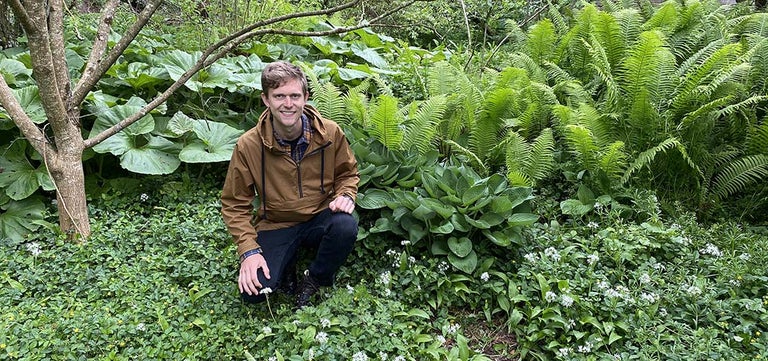
Stephen's garden demonstrates a form of managed rewilding, where plants are allowed to establish and develop with minimal intervention. Much of the management is focused on preventing natural forest succession from taking over, while still allowing the garden to produce generous harvests.
I'm not going to claim that perennial vegetables are immune to pests. However, once established, mature plants are often better able to withstand damage from slugs and other grazers than small, vulnerable annual . A well-established perennial may be able to recover from some damage and continue growing, whereas the loss of a young annual seedling can mean starting again from scratch.
Established perennial vegetables can develop extensive root systems that allow them to explore a greater volume of soil and access nutrients from deeper layers. This can reduce their reliance on additional fertilisers, depending on the crop and the condition of the soil. Using fewer fertilisers can also reduce gardening costs. It has wider environmental benefits too, by reducing the demand for the energy-intensive production and transport of fertilisers.
Unlike many annual vegetables, which are harvested before they have the opportunity to flower, perennial vegetables can often be left to bloom. They also come in a wide range of shapes and sizes and remain in the garden throughout the year. Together, these qualities can provide a greater variety of food sources and habitats for insects and other wildlife, helping to support and a more balanced garden ecosystem.
An obvious choice, perhaps, but asparagus is known as the king of vegetables for a reason. The name is particularly appropriate because male plants are generally more productive than female plants. While female plants produce red berries and seeds, male plants can devote more of their energy to producing spears. For this reason, many modern asparagus cultivars have been bred to produce predominantly, or exclusively, male plants. I'm particularly keen on ‘Backlim’ and ‘Connover’s Colossal’.

A tuberous climbing plant that works well in pots and containers where space is limited. For the best harvests, leave the tubers in the ground for two or three years to give them time to develop before harvesting.
The difference between a herb and a perennial vegetable can sometimes be blurry. For me, it comes down to how much you eat: if you eat something in quantity, I think it earns its place as a vegetable. I love lovage, which has a pungent, celery-like flavour. Because I use plenty of it in the kitchen, it definitely falls into the perennial vegetable category for me.
This hardy, herbaceous perennial climber can reach around 3m in a good season once established. It prefers slightly shadier, more moisture-retentive areas.
At Stephen Barstow's garden, I saw a 20-year-old plant that had happily self-seeded, producing plenty of young plants nearby. The young shoots and leaves are best harvested in spring, but tender new foliage can be picked throughout the .
One of the highlights of my trip to Norway was visiting the Chicago Onion Garden at the Ringve Botanic Garden, where Stephen Barstow manages a collection of more than 100 perennial onions. He estimates that this represents around 10% of all the perennial onion species there are to grow and eat. With such an extraordinary diversity of plants in one place, I find it almost impossible to pick a favourite!

I know this blog is really about vegetables, but in the UK our diet is unlikely to be entirely perennial, and annual crops still have an important place in the garden. Growing alongside perennials can create a diverse and productive polyculture, combining the long-term benefits of permanent crops with the versatility and high yields of seasonal ones.
Tomatoes are a perfect example. There is no perennial equivalent that is suitable for growing outdoors in the UK, and I certainly wouldn't want to be without this delicious crop. I love harvesting a glut of tomatoes to make and freeze sauces for winter, but they are equally good eaten fresh. I usually enjoy them in salads, although they also make a great quick frittata.
Tomato and feta frittata
Ingredients:
Method:
My favourite variety is the blight-resistant ‘Crimson Cherry’, but I also love the trailing bush variety ‘Tumbling Tigress’. Over the years, I've grown everything from enormous beefsteaks to tiny micro-cherries, in almost every colour imaginable.

It has finally rained, and the soil is beginning to recover from the dry summer, so I might do some autumn seed sowing to set myself up with plenty of winter salads.