See all the National Plant Collections at RHS Gardens
Across our five RHS Gardens we hold National Plant Collection status for 32 collections registered as part of the Plant Heritage scheme

With its popularity soaring through the 1970s, heather was once synonymous with English gardens. Today’s gardeners however might find it difficult to imagine how heathers fit into the more naturalistic planting styles that are now commonly favoured. At RHS Wisley, we’re on a mission to bring heathers back into the present so their diversity and wildlife credentials can be enjoyed once more
Much like the evolving trends of garden fashions, the National Plant Collection of heather has taken many forms at RHS Wisley . For its first introduction to Howard’s Field in 1987, the collection was showcased within island beds with a backdrop of dwarf conifers and finely manicured lawns. In 2017, however, Mark Tuson and the Welcome and Riverside team at RHS Wisley took inspiration from the rolling landscapes of natural heathlands to create the Heather Landscape that can be seen today.
The sandy, acidic soil makes the Heather Landscape a challenging area to garden, however many heather species are adapted to these harsh conditions and thrive against the odds. Densely planted drifts of Erica, Calluna , and Daboecia create flowing swathes of pinks, purples and whites, which are boldly contrasted by the striking shapes of Yucca rostrata and Verbascum thapsus . Drought-tolerant, vibrant perennials accompany the heathers to make the landscape an undeniable feast for pollinators. The Heather Landscape at RHS Wisley is home to over 900 heather cultivars, creating a unique garden that will inspire the heather enthusiast and novice gardener alike.

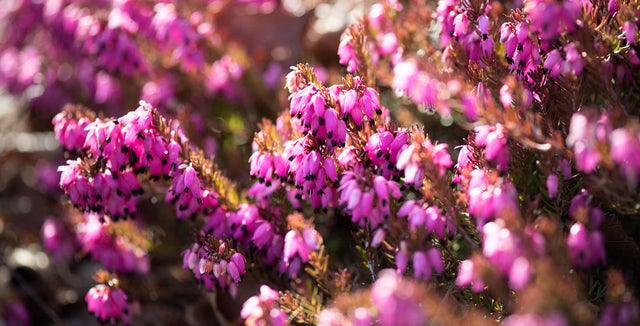
Erica is the most species-diverse of the three heather genera, where the variety of colour and form within the genus is something to be marvelled at. However, I believe that the -friendly credentials of Erica make it a genus worth celebrating beyond aesthetics, particularly of the winter-flowering species. As of March 2025, the Heather Landscape at RHS Wisley displays 416 cultivars of Erica covering 27 species and hybrids. Many of these cultivars are now endangered in cultivation, making their presence at Wisley all the more special.
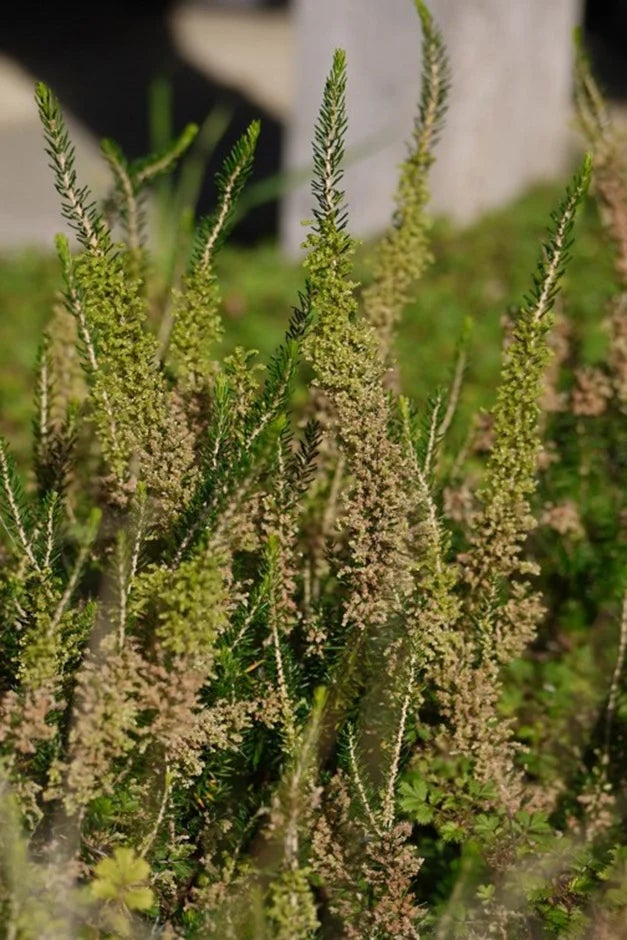
Frequent explorers of the English countryside are almost certain to have come across at least one of the four species of Erica growing in heathlands, open woodland, moorlands and bogs. Erica can be identified by their tiny evergreen needles that grow in neat whorls up the stem - easily distinguishable from the scale-like foliage of our other native heather, Calluna vulgaris .
Two species have a native distribution throughout the UK: Erica cinerea (bell heather) is abundantly seen in dry heath and grassland environments whereas Erica tetralix (cross-leaved heath) prefers a wetter environment. Erica ciliaris and Erica vagans , however, are limited to the Southwest of England, where Erica vagans is found mostly on the Lizard Peninsula in Cornwall.
It is estimated that 85% of heathland in the UK has been lost in the last 150 years, making it essential that our native heathers are conserved and habitats restored. Sand lizard (Lacerta agilis) and silver-studded blue butterfly (Plebejus argus) are just two of the many species of wildlife that have co-evolved with heathlands and are dependent on their health to thrive.
Unbelievably, there is almost always an Erica in flower in the Heather Landscape at RHS Wisley. While the summer-flowering species are impressive, it’s the species that display a profusion of flowers during the bleakest of winter months that excite me the most. Whether that be the towering columns of tree heathers, or the carpeting mounds of Erica carnea, it is a real treat to witness the annual feast provided for insects as they are just waking up for the year. The deafening buzz of satisfied insects on a cold, sunny day in March really does awaken my spirit for the to come.
It surprises me that tree heathers are a rare sight in gardens. These large, evergreen shrubs (not trees, as their name would strongly suggest) grow with an upright, softly branching habit and are blanketed in flowers anywhere between autumn and spring, depending on the species. Best grown in full sun and acidic soil, these shrubs make the perfect wildlife-friendly backdrop to any planting scheme, especially in the south of England where winters are less harsh (tree heathers may struggle in areas that experience prolonged and intense frosts).
Unlike most other species of heather, tree heathers will happily tolerate regenerative pruning. It is best to gently prune tree heathers into their desired shape when they are young, then leave them be, but suffering or unsightly plants can be harshly pruned to revive their strength. A stroll through the Heather Landscape in late winter will reveal the magic of tree heathers, where the flowering clouds of Erica arborea , Erica lusitanica and Erica × veitchii are standout features. The most surprising of all, perhaps, being the 3m tall Erica platycodon which dwarfs the 30cm mounds of Erica carnea that flower nearby. It is hard to believe that these are the same genus.

These three species are easily distinguishable by their growth habits: Erica carnea forms a low-growing carpet, Erica erigena is taller and bushy with some cultivars reaching a height of 4ft, and Erica x darleyensis,a of the two, falls between them in size.
Erica erigena is perhaps my favourite species of Erica. I enjoy how much their tall, bushy forms juxtapose the common stereotype of ‘old-fashioned’ carpeting heathers.
Unlike all other heathers, these winter-flowering species are tolerant of a much wider variety of growing conditions and soil types. This arguably makes them the most relevant for the everyday gardener. For those wondering if they can grow heathers without the acidic, free draining soil that is usually required, give one of these species a try.
Summer-flowering Erica are beginning to struggle here in the South-East. Their shallow roots make them very vulnerable to extremes of climatic conditions, including the abnormally hot and dry summers we are now experiencing in Surrey. This is worrying for our natural heathlands, as all native Erica are summer-flowering. If you are growing summer-flowering Erica in your garden, ensure your growing conditions are suitable for the species you select.

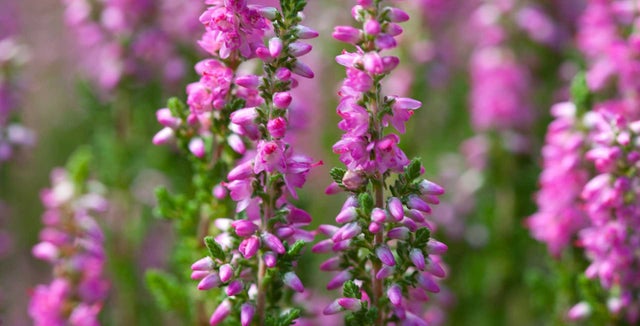
Although this genus contains only one species, the diversity across all 454 unique cultivars of Calluna vulgaris found within the Heather Landscape at RHS Wisley is extraordinary. Variations in foliage, growth habit and flower form are numerous, so gardeners are spoilt for choice. Take a walk through the Heather Landscape from early to late summer to indulge in their carpets of colour; from the delicately soft lilac flower of Calluna vulgaris ‘Jan’ to the fiery foliar oranges, reds and yellows of Calluna vulgaris ‘Easter Bonfire’ .
Calluna vulgaris is the dominant heather that you might see thriving on a heathland, moorland, or bog where it grows unrestricted by the acidic and infertile conditions. The self-seeding nature of the uncultivated species allows it to quickly colonise a heathland as it fills every crack and crevice nature provides. The scale-like, overlapping leaves distinguish Calluna vulgaris from the needle-like leaves of Erica, the other heather genus commonly found in UK landscapes. Differing also in flower form, Calluna vulgaris has dense racemes of urn-shaped flowers that are more accessible to pollinators than the tightly arranged flowers of Erica, providing an invaluable nectar source for pollinators into late summer. This precious nectar source is more than just food, too – researchers have discovered that a compound found within the nectar of Calluna vulgaris, aptly called callunene, protects bumblebees from the fatal parasite Crithidia bombi. Flowers truly are medicine.
It is not just pollinators that benefit from healthy habitats of Calluna vulgaris, however. The mosaic of niches created by established colonies of Calluna vulgaris across heathlands – including a mix of bare ground, foliage cover and older, sparser growth – provide basking areas for reptiles and safe nesting sites for solitary bees, wasps and birds. Pockets of moist shade provide the perfect habitat for mosses, lichen and fungi while beetles, bugs, butterfly and moth larvae eat the plant for essential . Next time you walk through a heathland, imagine it as a miniature forest for insects and small mammals alike.
The risk climate change poses to the health of our heathlands, the heathers in your garden, and the wildlife that depend on them cannot be overlooked. One example is the changing impact that the heather beetle, Lochmaea suturalis, is having on heathland heath. This native beetle can defoliate large areas of heather when outbreaks occur, an event that is becoming more common as our climate warms. Our cold winters and cooler springs used to help keep egg populations of this beetle small, however warming seasons are throwing these populations out of balance increasing the risk the beetle poses to our heathlands.

Although gardeners may not have the right conditions, resources or desire to grow Calluna vulgaris on the scale of the National Plant Collection of heather at RHS Wisley, this is not to say that including a small pocket of the species within your beds will not bring huge benefits for the wildlife in your garden. Calluna vulgaris is the perfect companion for acidic soils in full sun, where a light, annual clipping of its foliage will help keep a compact habit (don’t be shy, Calluna vulgaris was once a preferred food for grazing livestock!). If you have a heavy or , try adding horticultural grit and use an , or grow in a well-drained pot with ericaceous .
For those who do not enjoy the bold and contrasting palettes that Calluna cultivars are perhaps known for, the softer, more subtle cultivars may be more preferred. Calluna vulgaris ‘Johnson’s Variety’ provides the Heather Landscape with sprays of lilac flowers in airy racemes throughout late summer, and the silvery mauve carpets of ‘Jan Dekker’ rival even the most loved lavenders. A stroll through the Heather Landscape at RHS Wisley from early to late summer may just reveal a new favourite to the most unexpecting eye.
Calluna vulgaris ‘Wickwar Flame’ is among the many colour-changing cultivars that will please the most adventurous of gardeners. Mauve flowers are held above contrasting gold foliage, which turns neon shades of orange and red when fully exposed to winter cold. It’s not a personal favourite, but I appreciate its boldness.
Attention must also be paid to the Garden Girls Series of Calluna vulgaris. Bred with the intention of extending their season of interest well into the autumn, these cultivars are ‘ bloomers’ whose buds do not open into flowers. This prevents pollinators from accessing the floral resources of the plant, allowing the bud to look fresh and colourful for many months. The double-flowered cultivars, such as Calluna vulgaris ‘Peter Sparkes’ , pose an equally frustrating challenge to pollinators but make excellent dried flowers. This is not to say the wildlife-focused gardener must abandon these intriguing cultivars – accompanying them with other more open and accessible flowers ensures pollinators will still have food aplenty.
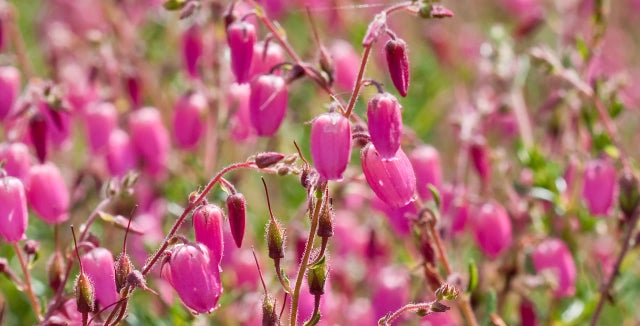
Daboecia is perhaps the most surprising genus to be included within the heather bracket, with flowers and foliage dissimilar to the more commonly known heather genera, Erica and Calluna. Being much more reminiscent of a leafy shrub, the leaves of Daboecia are elliptical and leathery with silvery undersides. The feature most linking Daboecia to the heather family is its urn shaped flowers from June to October. Unlike the small flowers of Erica and Calluna that are held within the foliage stems, the flowers of Daboecia are large and held on upright flowering stems that extend above the foliage.
The National Plant Collection of heather at RHS Wisley currently showcases 51 unique cultivars of Daboecia cantabrica and Daboecia x scotica, which give a display of colour in the landscape that is most spectacular in late summer. Many cultivars, however, are endangered in cultivation and are not easily accessible to gardeners.

The genus derives its name from the Irish description of the plant, St. Daboec’s heath. The most widely distributed species of the genus, D. cantabrica, is native to the coastal regions of western Europe and the Connemara region of Ireland where it can still be found growing today. The native range of this species give an indication of its growing requirements – the plant may struggle in frosts but will tolerate exposed, windy and salty conditions. Like all heather genera, acidic soil and full sun make for ideal growing conditions.
Daboecia azorica, native to the Azores, is the second species in the genus but it is not currently in cultivation. D. azorica and D. cantabrica accidentally hybridised in cultivation however, to produce a hybrid that has become a successful garden plant - Daboecia x scotica. The leaves of D. x scotica are smaller than those of D. cantabrica, making it more successful as weed-supressing ground cover. D. x scotica ‘Ben’ is an extreme example of this, producing minuscule leaves in a very tight mound. D. x scotica is also observed to flower earlier than the straight species. The National Plant Collection of heather begins to see the first of the Daboecia x scotica flowers in May, whereas the straight species waits until June.

Flower colour of Daboecia ranges from white to red, with many pinks and purples being observed in-between. Most cultivars present a delicate, nodding flower, however D. cantabrica ‘Pink Blum’ , ‘Purple Blum’ and ‘Pinky Perky’ orient their flowers towards the sky. D. cantabrica ‘Romantic Muxoll’ and ‘Charles Nelson’ are the few double-flowered cultivars, however the difference is best observed up close. ‘Charles Nelson’, a variation found in Galway, interestingly produces single flowers at the start of the season and transitions into double flowers as summer progresses, giving pollinators a short window to access its nectar.
Unlike its Erica and Calluna cousins, the Daboecia genus provides less opportunity for bold colour palettes as many cultivars are much more subtle in their aesthetic. D. x scotica ‘Jack Drake’ , for example, presents warming ruby flowers nodding over dark green foliage, and D. cantabrica ‘Rosella’ creates shell pink mounds. For those looking for a contrasting pop of colour, the bright purple flowers and golden yellow foliage of D. x scotica ‘Golden Imp’ will be sure to please.