Helenium (sneezeweed) trial results 2022–2025
Objectives and purpose of the trial
Fiery heleniums lighting up the RHS Bridgewater trial beds in 2025
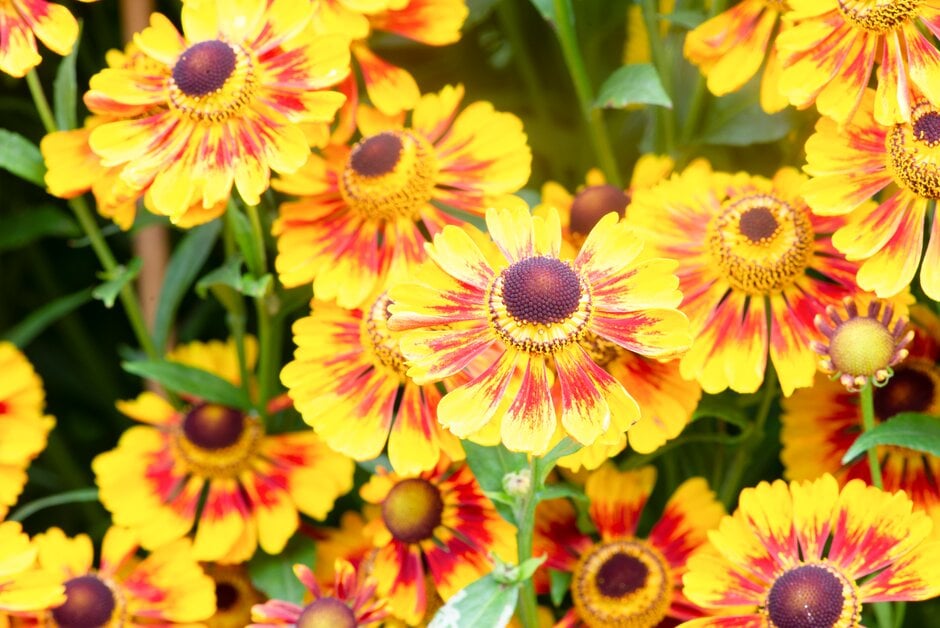
Colours of Helenium MARDI GRAS (‘Helbro’) add a wow factor
What is an RHS Recommended: Award of Garden Merit?
The RHS Recommended: Award of Garden Merit is intended to help gardeners choose reliable plants and is only awarded to plants that are:
- Healthy, with good overall growth and appearance
- Excellent performers, resilient in the right conditions
- Available to buy in garden centres or online
- Reasonably resistant to common pests and diseases
- True to type, keeping a consistent colour and form
Judging criteria
The following factors were all taken into consideration as part of the judging of the trial:
- Flowering impact, including size/quality of flower, quantity of flower and length of flowering
- Habit and demeanour, including shapeliness of plant, with or without support, presentation of flower and appearance after flowering
- Resilience, including pest/disease resistance, tolerance of a range of growing conditions and vigour
Helenium – RHS Recommended: AGM winners
Helenium 'Goldrausch'
sneezeweed 'Goldrausch'
- 1–1.5 metres
- 0.1–0.5 metres
Helenium 'Baudirektor Linne'
sneezeweed 'Baudirektor Linne'
- 1–1.5 metres
- 0.1–0.5 metres
Helenium 'Goldrausch'
sneezeweed 'Goldrausch'
- 1–1.5 metres
- 0.1–0.5 metres
Helenium 'Baudirektor Linne'
sneezeweed 'Baudirektor Linne'
- 1–1.5 metres
- 0.1–0.5 metres
The trial confirmed that heleniums are fantastic garden plants, erupting into flower from mid-summer onwards with warm tones from vibrant yellows through to deep reds.

Why the RHS Recommended: AGM was awarded
Golden petals of Helenium ‘El Dorado’ shine brightly
Heleniums nearing their peak at RHS Bridgewater in 2025
RHS Recommended: AGMs rescinded
Plants and location
What was planted?
Native to North America, Helenium is a sun-loving perennial in the daisy family (Asteraceae). Prized for its long season of interest, it produces vibrant flowers in shades of yellow, orange and red from midsummer into autumn, providing a valuable source of late-season colour. Its naturalistic character and ability to combine well with ornamental grasses and other herbaceous perennials have made it a popular choice for borders, prairie-style plantings and wildlife-friendly gardens.
Throughout the trial, the RHS Trials team monitored plants at regular intervals, recording flower colour, size and intensity, flowering period, foliage characteristics and plant habit. The balance between flowers and foliage, the appearance of flowers at different stages of development and overall garden performance were also considered to identify cultivars that combine long-lasting colour with excellent garden performance.
Where was it planted?
The heleniums were planted directly into the open ground in the trial beds within The Old Frameyard at RHS Bridgewater, creating a vibrant late-summer display that showcased the diversity of the group. Here are some considerations for growing heleniums:
- Plant heleniums in well-drained soil in a sunny, sheltered spot for the best flowering display
- Avoid shady areas, as plants will produce fewer flowers
- Choose a cultivar to suit your space, as heleniums can grow from 50cm to almost 2m tall
- Stake taller varieties to prevent them from flopping over in summer
- For more compact plants, carry out a Chelsea chop in late May by cutting stems back by one-third to one-half
- Water at soil level to help prevent leaf spot, remove affected leaves promptly and protect young shoots from slugs
Cultivation
Planting process
The Helenium entries were planted out in the trial beds by a team of horticulturists in June 2022. A total of 59 cultivars were arranged in groups of three plants, set out in a triangle. Smaller cultivars were planted closer together, at 75cm between plants and 1m between entries, while taller and more vigorous selections were given more room to develop their natural shape, with 1m between plants and 1.5m between entries.
Before planting, the beds were prepared using loamy topsoil to provide a uniform growing environment across the site. Soil tests were carried out before planting and repeated each spring throughout the trial. Having previously been used for a vegetable trial, the beds were carefully monitored and nutrient levels adjusted where needed to maintain healthy growth and provide consistent growing conditions for all entries.
A layer of strulch (straw-based mulch) was applied to help suppress weeds, while leaving bare soil around the crown of each plant. Watering was carried out during dry periods using a lance and hose from a borehole and, after the first year, permanent irrigation lines were installed to make watering easier during future hot spells.
Strong winds during the first summer damaged some stems, causing them to bend, collapse or snap. Most plants were supported ahead of the first assessment and support methods were adapted as the trial progressed. Bamboo canes were used initially, followed by metal half-hoop supports in later years. By the final year, staking was kept deliberately light and loose so judges could assess each cultivar’s natural habit and ability to remain upright.
Several cultivars supplied to the trial were found to be mixed or incorrectly named during the first assessment. Replacement plants were sourced where necessary and entries were relabelled or repositioned to ensure all cultivars could be judged accurately.
To assess different maintenance techniques, several pruning and deadheading techniques were trialled. In 2024, one plant from each entry was Chelsea chopped in early June, another was deadheaded regularly as flowers faded, while a small number of early-flowering cultivars were cut back hard after their first flush of blooms. These techniques allowed judges to compare how different cultivars responded to common garden practices.
How plant health was managed
Weather and environmental conditions
The trial experienced a remarkable range of weather conditions. Soon after planting, temperatures reached almost 40°C during the summer heatwaves of 2022, followed by winter lows of -8.5°C after an unusually mild autumn. The following years brought prolonged wet weather, waterlogged soil, storms and periods of drought. These challenging conditions put the plants to the test and helped identify cultivars that maintained good health, structure and flowering performance despite difficult growing conditions.
Challenges
Plants were checked regularly throughout the trial, with any unusual symptoms reviewed by RHS specialists.
Slugs, caterpillars and spittlebugs were seen at various times, particularly during the prolonged wet period between late 2023 and spring 2024. Aphids were also occasionally present.
In 2022, leaf spotting and blackened foliage raised concerns about disease, but the symptoms were eventually linked to environmental conditions rather than infection.
One of the more unusual cases occurred in 2023, when a plant of Helenium ‘Moerheim Beauty’ developed distorted growth and flattened flower stems. The symptoms closely resembled Aster Yellows, but the cause was later identified as a species of Alternaria fungus.
In 2024, one entry developed yellow markings linked to a plant virus, although growth and flowering were largely unaffected. Another entry was affected by foliar and bud nematodes, causing distorted growth and dieback. With no effective treatment available, the plants were cut back and monitored closely. Two plants eventually died, while a third survived with reduced vigour.
How to grow heleniums
Explore all the information you need to know to grow and care for heleniums in your garden
Discoveries
Farewell to an old favourite | August 2025
A comparison of old and new cultivars showed that several modern introductions now outperform some long-established garden favourites. Helenium ‘Moerheim Beauty’ was found to offer a shorter season of interest and require more maintenance than many of its competitors like Helenium ‘Red Army’, raising questions about its continued status as a top garden plant.
Deadheading wasn’t always necessary | 2022-2025
One of the more surprising findings was that some cultivars remained attractive even as flowers faded. In cultivars such as Helenium ‘Red Army’, Helenium ‘Butterpat’ and Helenium MARDI GRAS (‘Helbro’), ageing flowerheads blended naturally into the display while new flowers continued to open, reducing the need for regular deadheading.
Cutting plants back | August 2024
Three early-flowering cultivars, Helenium ‘Moerheim Beauty’, Helenium ‘El Dorado’ and Helenium ‘Bruno’, were cut back to around 20cm after their first flush of flowers. None produced a worthwhile second flush later in the season and the treated plants remained noticeably smaller than untreated plants into the following year.
Chelsea chop | June 2024
One plant in each entry was Chelsea chopped in early June 2024. The results varied considerably between cultivars. Some quickly regained their height and flowered at around the same time as untreated plants, while others remained noticeably shorter, with the effects still visible during the 2025 flowering season.
Who was involved?
Judges of the trial
The Helenium judges were: Sue Beesley (Vice Chair, RHS Herbaceous Plant Expert Group), Val Bradley (Garden writer), Emily Chandler (Head Gardener, Dunham Massey), Paul Cook (former Curator, RHS Harlow Carr), Barry Grain (Owner, Rosemeade Nurseries), Robin Pearce (Retired nurseryman), Brenda Smith (Owner, Bud Garden Centre), Jack Wallington (Landscape designer), David Warden (National Collection holder), Arthur Weston (Amateur herbaceous plantsman) and Caroline Williamson (Team Leader, RHS Bridgewater).
Suppliers to the trial
List of plants in the trial
Sue Beesley’s favourite heleniums from the trial
Helenium 'Loysder Wieck'
sneezeweed 'Loysder Wieck'
- 0.5–1 metres
- 0.1–0.5 metres
Helenium Mardi Gras ('Helbro')
sneezeweed [Mardi Gras]
- 0.5–1 metres
- 0.1–0.5 metres
Helenium 'Loysder Wieck'
sneezeweed 'Loysder Wieck'
- 0.5–1 metres
- 0.1–0.5 metres
Helenium Mardi Gras ('Helbro')
sneezeweed [Mardi Gras]
- 0.5–1 metres
- 0.1–0.5 metres
Handy tools and information
- Full article - Filter RHS Recommended: AGM plants by colour, height and season
Find a plant online
Filter RHS Recommended: AGM plants by colour, height and season - Full article - Explore advice and helpful tips from our resident experts
Gardening advice
Explore advice and helpful tips from our resident experts - Full article - Check how hardy plants are using the RHS hardiness ratings system
Hardiness ratings
Check how hardy plants are using the RHS hardiness ratings system - Full article - A trusted gardening app packed with expert know-how
RHS Grow app
A trusted gardening app packed with expert know-how
Get in touch
For more information on our RHS Plant Trials or to access older trial reports, please get in touch with our team via email at [email protected].
Get involved
The RHS is the UK’s gardening charity, helping people and plants to grow - nurturing a healthier, happier world, one person and one plant at a time.