Getting Started
Planted in a sunny, sheltered spot, ideally trained against a warm wall, a peach tree will reward you with pretty spring blossom followed by a crop of sweet, juicy, succulent fruits in summer. Compact varieties can also be grown in containers.
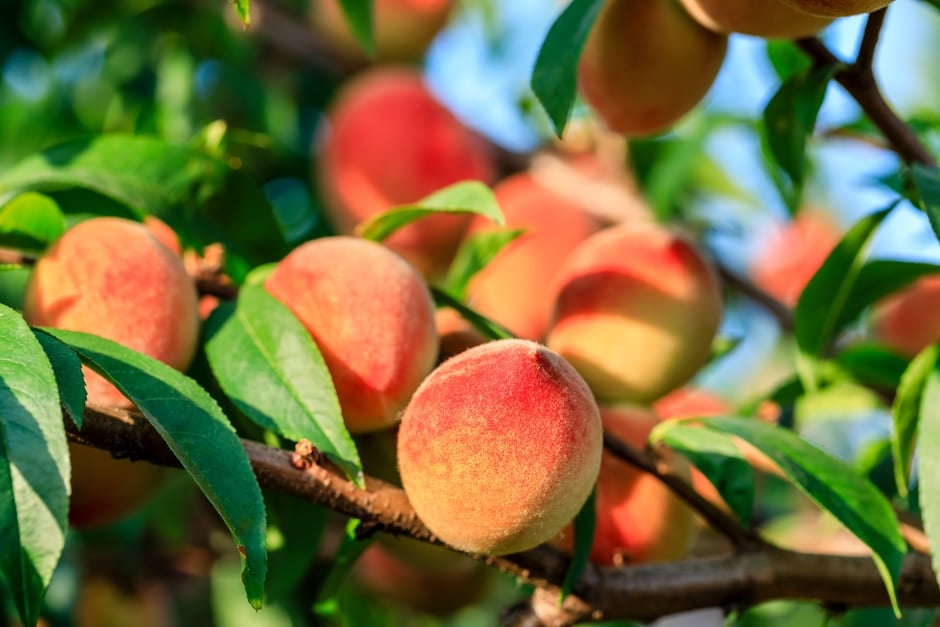
Although you may think peaches can only be grown in warmer climes, many varieties will crop successfully in the UK in a sunny, sheltered spot, such as against a south- or south-west-facing wall or in a container on a sunny patio. In fact, there is a long history of growing peaches in the UK – you’ll often find glass ‘peach houses’ in the walled kitchen gardens of stately homes, where peach trees were fan-trained against the back wall to provide ‘exotic’ fruit before the era of refrigerated transportation. Today, peaches can be grown outdoors as well as in a greenhouse, and in even the smallest of gardens.
Peaches (Prunus persica) are very similar to nectarines (Prunus persica var. nectarina). Peaches have a fuzzy, velvety skin, compared to smooth-skinned nectarines. They are both grown in the same way, although nectarines usually need slightly warmer conditions to ripen in the UK.
Jobs to do now
Harvest ripe fruit
Month by Month
Plant
Harvest


Choosing What To Grow
There are many peach varieties to choose from, producing fruits of different sizes, flavours and levels of sweetness. Rounded or slightly flat, the fruits ripen to various shades of red, orange and yellow on the outside, with golden, red or white flesh inside. Fruits can be ‘free-stone’ – where the flesh separates easily from the stone, or ‘cling-stone’ – where the flesh doesn't detach easily from the stone.
Depending on the variety, the crop will ripen at different times from July through to September, and some varieties are more hardy and reliable in the UK climate. A few offer some resistance to peach leaf curl. All peach varieties are self-fertile, so you only need one tree for a good crop. Peach varieties are usually grafted onto a rootstock called ‘St Julian A’, which restricts the tree’s vigour and size.
If you want to grow a peach tree in a container, choose a dwarf variety such as ‘Bonanza’, ‘Crimson Bonfire’ or ‘Garden Lady’. Varieties specifically bred for container growing are often sold as ‘patio peaches’, reaching only about 1.8m (6ft) tall and needing little pruning.
Although it is possible to grow peach trees from seed (stones), the resulting trees may not suit the UK climate, can take many years to bear fruit and often produce fruit inferior to the parent plant. There are also risks associated with growing from the seed/stones of supermarket-bought fruits, so this should be avoided. If you want a tree that will fruit well, it’s worth investing in a good quality tree, of your chosen variety, from a reputable UK supplier.
If you visit any of the RHS gardens, you’ll find many fruit trees grown in various ways, so you can easily compare different varieties and pick up useful growing tips.
What and where to buy
Container-grown peach trees are available all year round from garden centres and online plant retailers. They may also be sold from late autumn to early spring, from online fruit retailers. Specialist fruit nurseries offer the widest choice of peach varieties, usually by mail order. Bare-root trees are often cheaper than those in pots.
As peach trees crop best when grown as fans, it’s easiest to buy a partially trained two- or three-year-old fan. This will save you the time and trouble of training it from scratch. Trained trees are more expensive than younger untrained trees, and are usually only available from specialist fruit nurseries.
Recommended Varieties


Planting
Late autumn, when the soil is warm and damp, is usually a good time to plant a peach tree, but between November and March is also fine, which is when trees are available. Container-grown trees are available all year round and can potentially be planted at any time, but will settle in best from late autumn to spring. Planting in hot, dry conditions should be avoided.
Peach trees are best planted against a south- or south-west-facing wall or fence and trained as fans. They can also be planted as free-standing trees, but make sure they are supported with sturdy tree stakes until well established. Compact varieties can be grown in containers. As peaches flower early, it’s vital to choose a planting site that isn’t prone to frosts, which can damage the blossom. Protecting the blossom is only really practical with fan-trained or container-grown trees, so only plant peaches as free-standing trees in really warm, sheltered locations where spring frosts are unlikely.
Peaches like deep, fertile, well-drained soil. Avoid poorly drained conditions, which can cause the roots to rot. They will struggle in light or shallow soil. If you have decent garden soil, additional soil preparation before planting shouldn't be necessary. However, if your soil is poor, dig a bucketful of organic matter, such as garden compost, into the soil you remove from your planting hole and use this to backfill after planting. This minimises soil disturbance and helps your tree get off to a strong start.
Prepare your tree by giving it a good watering if it’s in a container or by standing a bare-root tree in a bucket of water for half an hour directly before planting.
Planting against a wall
Peaches crop well when fan-trained against a sunny wall, but the soil at the base of walls is often poor and dry, so mix in well-rotted organic matter when planting. Plant the tree 20-30cm (8-12in) away from the wall, angled slightly towards it. Fan-trained peaches can reach a width of 3.5–5m (11-16ft) depending on the variety, so make sure there is plenty of room either side. You’ll also need to attach horizontal wires to the wall or fence to support the fan of branches – see Pruning and Training, below.
Planting in containers
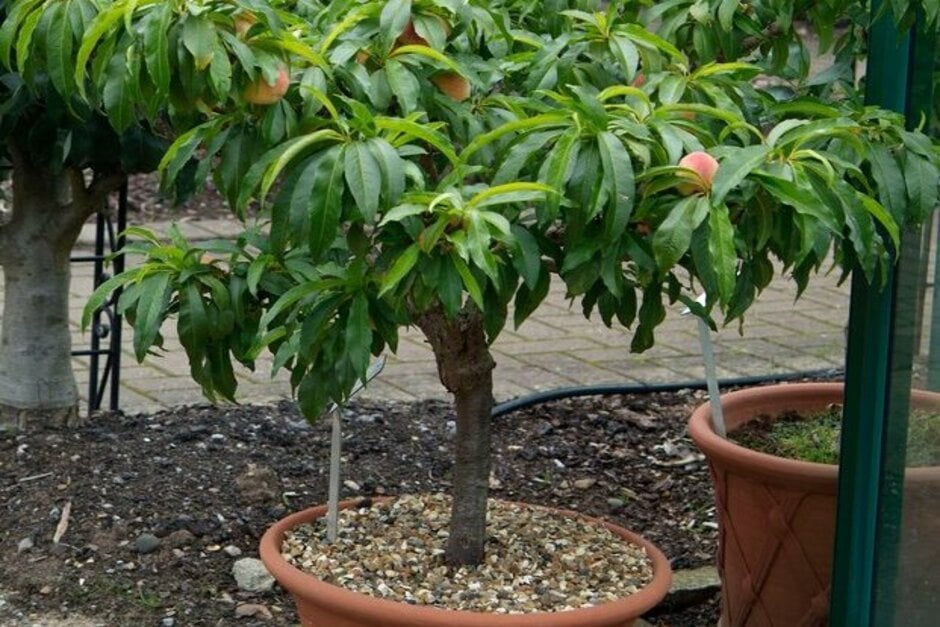
Compact varieties of peach, such as ‘Bonanza’, grow and crop well in containers. Containers will need to be positioned somewhere sunny and sheltered, a patio or courtyard is often ideal. They can also be grown in an unheated greenhouse for all or part of the year. Containers should be at least 45cm (18in) wide and deep, filled with a good quality loam-based such as peat-free John Innes No 3. They will need regular watering and feeding to keep them healthy and fruiting well.
Plant Care
Newly planted peach trees and those growing in containers need some regular attention to ensure they establish well and produce a good crop. Once established, trees in the ground need little ongoing maintenance other than annual pruning, and blossom needs protecting from frost to ensure a good crop.
Watering
- Newly planted trees – should be watered regularly during dry spells for the first couple of years after planting
- Fan-trained trees – may require some additional watering if they’re in a rain-shadow – where the wall or fence reduces the amount of rainfall they receive
- Trees in pots – need a steady supply of moisture throughout the , so water regularly in dry spells, aiming to keep the evenly moist
- Peaches in a greenhouse – need watering regularly, especially in summer
- Established free-standing trees – shouldn't need watering
A good supply of moisture is particularly important in early to mid-summer when fruits are swelling. Try to water early in the morning or late in the evening to minimise moisture loss from the soil, ideally using stored rainwater.
Ensure container-grown trees are planted in pots with good drainage, and that water continues to drain out easily as the plant grows, as roots will rot in cold, soggy compost, especially in winter.
Mulching
In late winter or spring, apply a of well-rotted organic matter, such as garden compost, around the base of peach trees growing in the ground. Mulching will improve your soil, help to retain moisture and suppress weeds. Mulch can cause rotting if it’s piled up against a tree trunk, so leave a slight gap around the base of your tree.
Feeding
Peach trees growing in regularly mulched soil shouldn't need any additional feeding. However, if harvests are particularly poor, or your tree is showing signs of nutrient deficiency, apply an organic granular general-purpose fertiliser to the soil in early spring. Use our page on nutrient deficiencies to work out what is lacking and apply the recommended feed, following instructions on the packet.
Peaches growing in containers benefit from regular feeding. Either apply an organic high-potassium liquid fertiliser every fortnight during the , or sprinkle an organic granular general-purpose fertiliser onto the each spring.
Protecting from frost
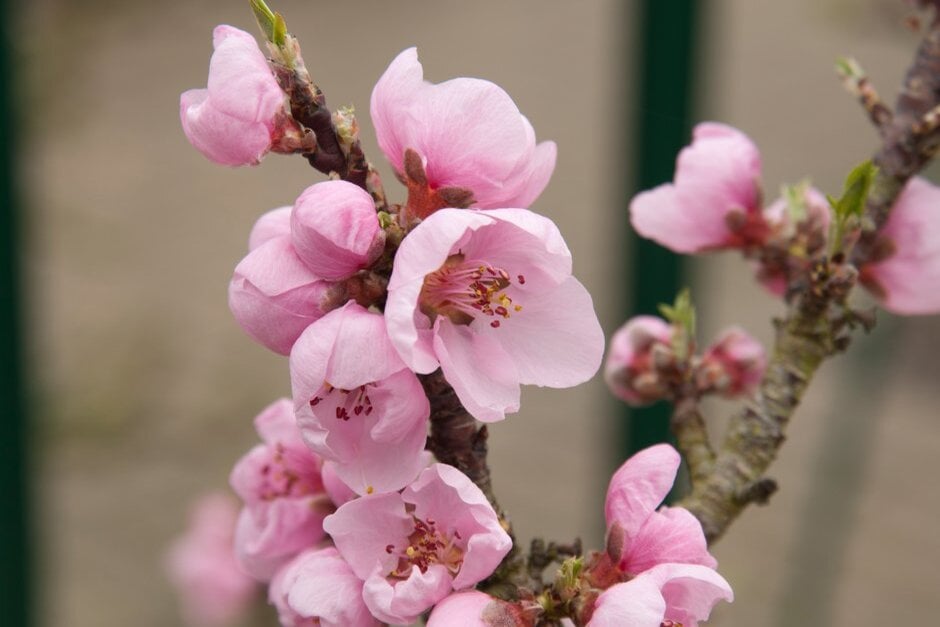
Peach trees are generally hardy in the UK, but their blossoms are susceptible to frost damage, which can reduce the crop. They flower early in the year, usually in early spring but sometimes as early as February. If frost is forecast during flowering, cover the tree overnight with , hessian or an old bedsheet, supported on bamboo canes so it doesn’t touch the flowers. Uncover the tree during the day to let in sunlight and pollinating insects. Alternatively, peach trees in pots can be moved into a greenhouse, porch or other frost-free spot during flowering, and by hand (see below).
Improving the crop
Peaches are self-fertile but they flower early in spring when few pollinating insects are around, so it's a good idea to hand-pollinate them to ensure a good crop. Do this over several dry, sunny days by taking a small paintbrush and dabbing it gently into the centre of every flower in turn. Trees grown in a greenhouse should always be hand- .
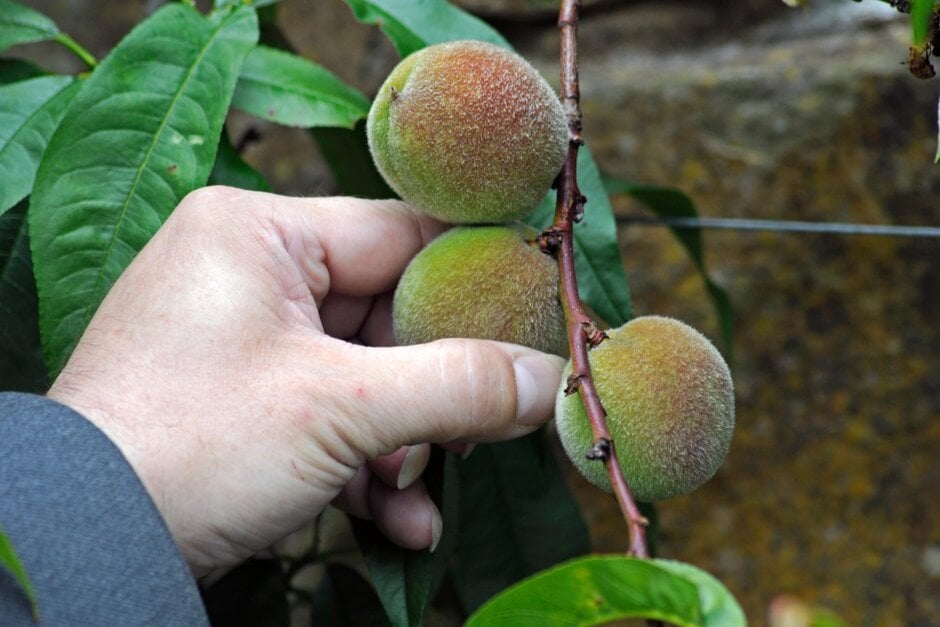
When young fruits appear, some may need to be removed to improve the crop. Do this when the fruits are between hazelnut and walnut size. Carefully snip off the or, if they are closely bunched together, cut selected fruitlets in half with secateurs – they will then drop off without damage to the shoots that carry them. Start with any awkwardly positioned, distorted or noticeably smaller fruits. Aim for evenly spaced fruitlets about 20cm (8in) apart.
Before the fruits start to colour up, they may need protection from birds and squirrels. Fruit sleeves or plastic-free or reused netting supported on a wooden frame or canes will protect ripening peaches. Move potted plants into a greenhouse or other enclosed space. Peach trees can also be grown in a fruit cage.
Pruning And Training
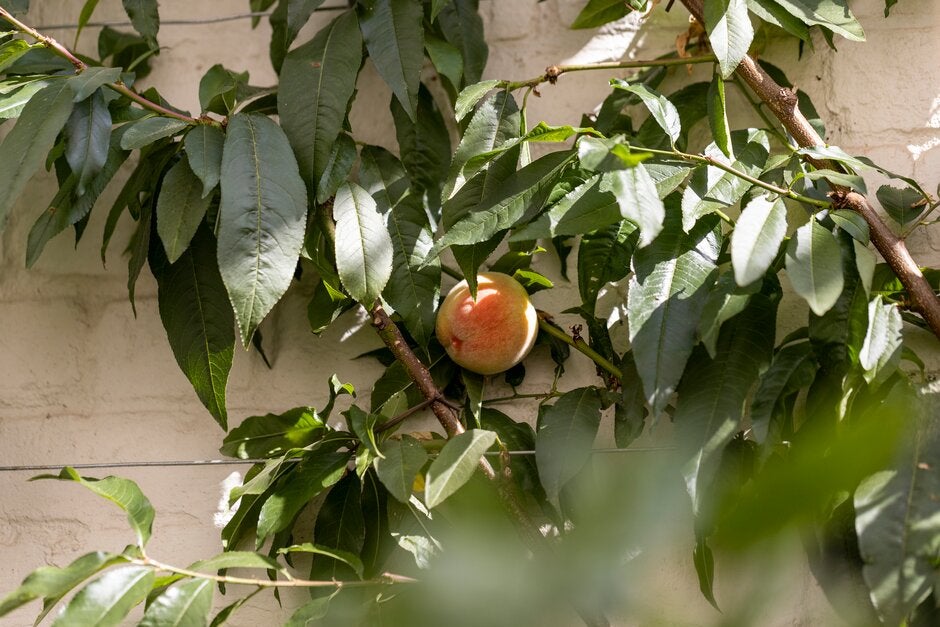
Most peaches should be pruned annually to keep them in good shape, healthy and productive, although some naturally compact varieties need little or no pruning. The fruits are produced almost entirely on shoots made the previous year, so pruning aims to replace old fruited wood with new, young wood.
Timing is important – as with other stone fruits, peach trees should only be pruned in spring or summer, to minimise the risk of infection from silver leaf disease and bacterial canker. Prune on a dry day, when dry weather is forecast for at least the next two days.
- Newly planted peach trees should be pruned soon after the buds open in early spring
- Established fan-trained trees should be pruned in spring and after fruiting in summer
- Established free-standing peach trees should be pruned in summer, after fruiting
Peach trees are best grown as fans against a sunny wall or fence, so they produce a good crop that ripens well. Fans have a short trunk topped with a flat fan of radiating branches. They are usually kept at a manageable size of about 2m (6½ft) tall and up to 5m (16ft) across. Fans make an attractive garden feature and are also useful if space is limited. However, they do need careful pruning and training – see our guides below.
In warm locations, peaches can also be grown as free-standing, open-centred bush trees with about four main branches radiating out from the top of the trunk to create a goblet shape. Remove branches that are crossing or growing towards the centre of the tree, then prune out up to a quarter of the older, fruited wood back to young side shoots – this should stimulate the production of new growth. If a tree is left unpruned or pruned too lightly, fruiting will eventually be limited to the outer edges of the canopy. For more information, see our guide to pruning plums, as the methods are similar for peaches.
Harvesting
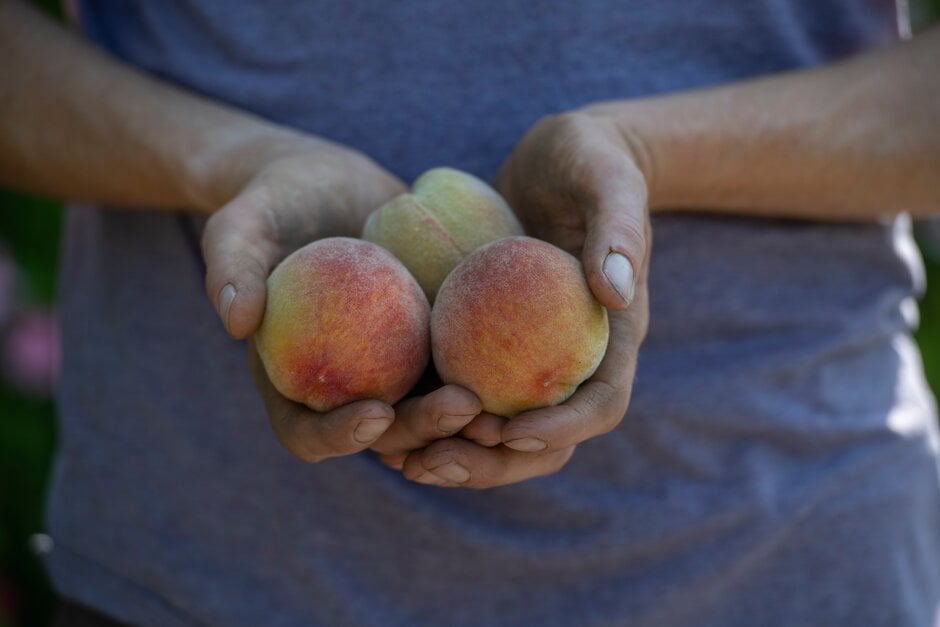
Peach fruits are ready for harvesting once they are fully coloured and the flesh near the stalk feels soft. To pick, cup the fruit in the palm of your hand and gently lift – it should easily come away from the tree. Check ripening fruits regularly, as they won’t all be ready at the same time.
Peaches are best eaten as soon as possible after picking, ideally straight from the tree when still warm from the sun. If picked before they’re fully ripe, they can be ripened indoors, but they won't taste quite as good as freshly picked fruit.
Problem Solving
Peach trees need a warm, sheltered location and lots of sunshine to fruit well and ripen fully outdoors in the UK. Fruiting problems may include:
- Lack of fruit – may be due to frost during flowering and/or poor , so protect blossom from frost and cold winds, and hand-pollinate with a small paintbrush. For more information, see our guide to unproductive fruit trees
- Failure to ripen – may be caused by cool weather and lack of sun. Training trees against a sunny wall will help to ripen the fruits. In colder regions, consider growing in a greenhouse or polytunnel
- Poor fruit development or unripe fruit dropping – may be due to insufficient or inconsistent watering
- Split fruit – may be caused by overwatering or wet weather during ripening
- Loss of ripening fruit – protect peaches from birds and squirrels by covering them with sleeves or netting. Ensure any netting is taut and fastened securely so birds and other wildlife don’t get entangled in it. Alternatively, grow trees in a fruit cage or move container-grown trees into a greenhouse once the fruits start to colour up
Peaches may be affected by some pests and diseases, see Common problems below.
Common Problems

Bacterial canker
Bacterial canker is a disease of the stems and leaves of Prunus, especially plums and cherries, but also apricots, peaches and ornamental Prunus speci...


Brown scale
Brown scale is a sap-sucking insect, evidence of which can be found on woody plants at any time of year, partly because dead scales remain attached to...