Your new book Simply Raymond Kitchen Garden is as much about gardening as it is about cooking. Why?
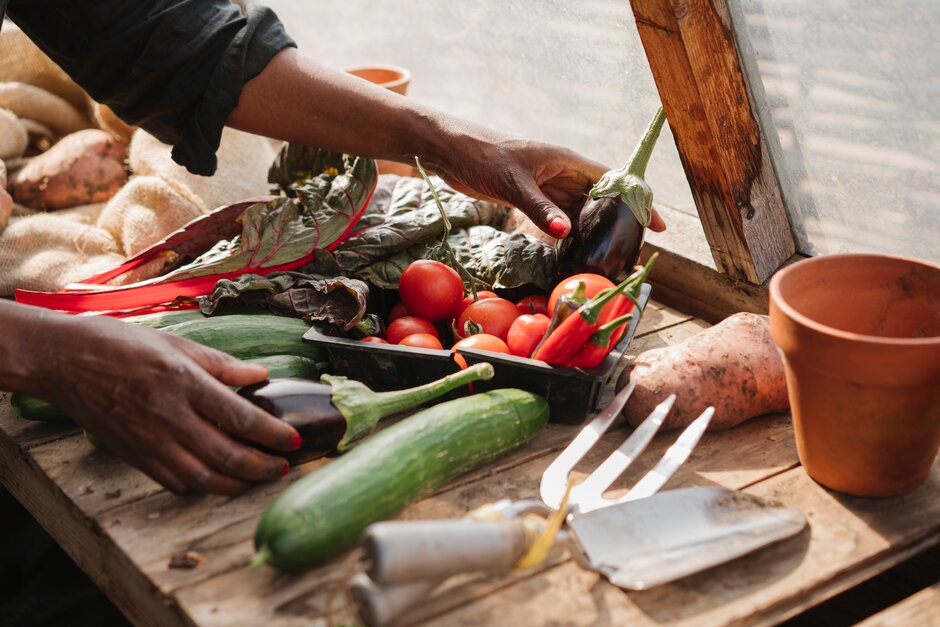
The garden is the canvas on which I grow my gastronomy. The first thing I did at Le Manoir when I got to Oxfordshire in 1984 was create the vegetable garden to provide for the kitchen, and develop a vegetarian menu, equal to the meat and fish dishes. Nobody could understand, because in the UK we saw the vegetable just as a garnish, but vegetables are just as extraordinary as meat or fish. They have layers of flavour that are intricate, especially when seasonal. Now, we grow around 150 different types of veg and herbs to discover the ones that have art, that have soul. When I was a child in France, it was as important to have a good garden as it was to have good food: gastronomy often goes wrong when the chef fails to connect with this fundamental truth.
When did your passion for gardening start?
I used to hate the garden! When my friends were playing football, my siblings and I were helping my father in the garden, which was typically French – about an acre, with a tiny lawn and the rest set to vegetables, fruit and herbs for our table. The kitchen was my Maman’s domain, and I was her dogsbody. I never minded because she was lovely company and a good boss. That strong work ethic, the connection with the earth and good food are the pillars of my life. When I first came to Le Manoir, my father spent three months digging up brambles to create the Potager – I think of it as payback for all the time I spent working in the garden as a child. For me now, a garden is complex and beautiful – it’s about growing the very best cultivars of fruit and veg. It’s also about art and beauty.
How did you first get started as a chef in the UK?
My first job in England was at The Rose Revived, a restaurant in Oxfordshire, in June 1972. I was eventually appointed head chef, but it came with a fight. The restaurant had a garden looked after by an enormous man called Mr Lay. He had strong ideas about what to grow, and his veg had to be big. You had leeks like trees. I brought in selections of mangetout, tarbais beans, French turnips, all of which he really didn’t like, so he didn’t like me. I wanted to pick them medium-sized, when they have optimal flavour. I’d go with a lamp in the garden at night to pick them, that is until one night, a full moon, I suddenly saw a shadow cast upon me. Luckily, little Frenchmen run faster than big Englishmen – I escaped with my life! I had the same problem with my first head gardener at Le Manoir. Everything was huge and cultivars didn’t matter. That’s when we started to do trials.
How do you trial veg at Le Manoir?
Trials are the foundation on which the best vegetables are chosen. If you have a bad Gardeners often use the word variety when referring to a specific plant, but the correct botanical term is 'cultivar'. Whichever word you use, it means a distinctive plant or plants, given a specific cultivar name and usually bred to enhance certain characteristics, such as flower or fruit size, colour, flavour or fragrance, plant size, hardiness, disease resistance, etc. Additionally, it is worth knowing that, botanically, variety has another meaning - it refers to a naturally-occurring distinct plant that only has slight differences in its looks. For example, Malva alcea var. fastigiata differs from typical plants by having an upright habit.
Do you favour new or old cultivars?
Many old ones are very beautiful, but don’t always taste great. Every British person will hate me, but the worst apple in the UK is ‘Bramley’s Seedling’ AGM from an old tree. It blows your head off and completely removes your taste buds. Its high acid and water content means that, when exposed to heat, it explodes and you can mash it up in two seconds, but you have to add at least a third of the weight of sugar. That’s not gastronomy for me – added sugar is the enemy of good health and taste. Thanks to recent breeding, I love modern ‘Bramley’s’ because they’ve changed completely – they still have high acidity, but balanced with much more sweetness.
Are you particularly fond of apples?
My Maman grew apple trees in the garden, especially ‘Reinette du Canada’, and today we grow 153 different apples at Le Manoir. When I first came to England, people just talked simply about ‘eating apples’ or ‘cooking apples’. Why not talk of apples for purees, for tarte tatin or for pan frying? There are thousands of cultivars and they all have their own qualities. I’ve discovered the best apple – mon Dieu – was not French, but English! ‘Cox’s Orange Pippin’ is beautiful and I never had so many aromatics in an apple. However, it’s not very disease resistant. An alternative would be the modern cultivar ‘Red Windsor’ AGM, a perfect all-rounder. ‘Adams’s Pearmain’ is a classic, ‘Devonshire Quarrenden’ and ‘Queen Cox’ are both excellent. Oh, they have such beautiful names.
Any breeders or veg growers you find inspiring?
The East Malling Research Station in Kent, one of the biggest centres of fruit science, is extraordinary. Their breeding is all about taste. They have 700 cultivars of strawberry, for example. Some yellow, some maroon, some acidic and some with all the aromas of wild woodland strawberries. They bred my favourite: ‘Marshmello’. Also inspiring is Anne-Claude Leflaive, one of the great wine-makers in Burgundy, who said, “our earth is our gold”. She meant if you don’t have good soil, you will never be able to grow the best vegetables or grapes. I keep that sentence close to my heart.
You’re a very sustainable chef, nothing is wasted. Do you have any unexpected ways of using what you grow?
“You shall waste not” were the first words my Maman told me. We grow Florence fennel as a vegetable, but also for its pollen and for drying. The pollen makes an edible garnish for fish dishes. We soak the dried seeds in water, then pan fry them. Or dry the stalks and put them under a fish with lemon, lime, a little cumin, then roll the fish over his bed of dried fennel. It is amazing.
What veg has been the biggest challenge to grow?
I was obsessed with trying to grow lemongrass because I had seen it many times in Southeast Asia. I tried and tried, protected it with Mulch is a layer of material, at least 5cm (2in) thick, applied to the soil surface in late autumn to late winter (Nov-Feb). It is used to provide frost protection, improve plant growth by adding nutrients or increasing organic matter content, reducing water loss from the soil, for decorative purposes and suppressing weeds. Examples include well-rotted garden compost and manure, chipped bark, gravel, grit and slate chippings.
For your next challenge, you are planting a vineyard at Le Manoir?
I’ve wanted a vineyard for 15 years, but the high The concentration of water vapour in the atmosphere. This affects the rate at which plants transpire (lose water from their leaf pores), which in turn affects how much water their roots absorb from the soil. If air humidity is low, plants transpire quickly and become at risk of wilting if water is lost from the leaves faster than it can be absorbed by the roots. Different plants require different levels of humidity to thrive. Many tropical houseplants need high humidity and are best grown in a steamy bathroom, misted regularly or placed on a saucer of damp pebbles. In a greenhouse, humidity can be raised in hot weather by damping down (wetting) the floor or overhead misting.
What are your hopes for the future of veg?
Some of us are lucky to have such extraordinary gardens in which to grow this food, but if you’re not as lucky, take your kids to a pick-your-own farm, grow veg in a raised bed, or plant a fruit tree against the wall of your flat. Try things that grow quickly: herbs, spinach, radishes. Teach your child to reconnect with the earth and the magic of that little seed, which will grow into a beautiful plant. If your child can own that, my God, they will have a different approach to life.
Raymond’s favourite crops