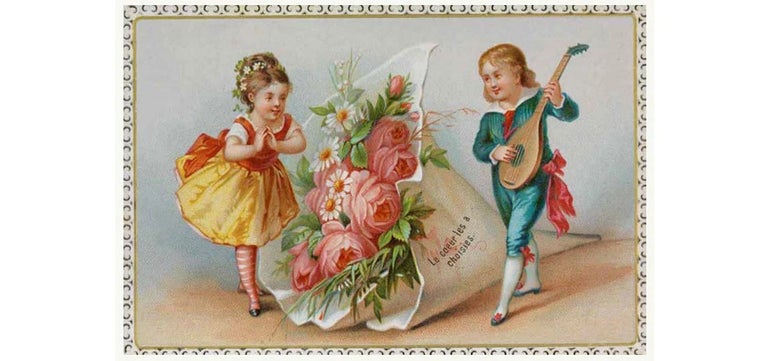
The Language of Flowers – a Lover’s Code
Most people today would understand the meaning of red roses presented to a lover, but did you know that the Victorians had a whole language for communicating through floral gifts?

Across cultures, continents and the annals of time, plants have provided not only the inspiration for body art, but also the raw materials. Here we explore the history, symbolism and enduring appeal of the botanical tattoo
You’ll see them on every high street, every residential road, every office, shop and public space in Britain. They grace ankles, necks, knuckles, legs and unseen skin besides. There’s no denying it: tattoos are everywhere. In every conceivable style, depicting every imaginable subject matter; body art, it seems, has never been more prevalent. The data certainly backs this up – the latest research suggests that 37% of 35–54-year-olds in the UK have at least one tattoo .
Such is the prominence and popularity of tattoos these days that one might suspect the trend for permanently marking oneself with indelible images is a new one. Is it really the case that tattoos have only become socially acceptable in the last few years? What about the palpable popularity of designs of a botanical bent? Is that too a recent phenomenon? Perhaps it dates back no further than 2015, when David Beckham was spotted with a rose tattooed on his neck. Or when singer and TV talent show judge Cheryl Cole, two years earlier, dared to reveal a derriere adorned with buttock-sized, illustrative tattoos of rose blooms – a decision so shocking to the mainstream press in Britain that it made headlines on BBC Radio 4’s Today programme .
No. While it is of course true that commercial tattooing is bigger in 2025 than ever before , this booming habit represents an evolution of the past, rather than a clear and dramatic break from it. Following the tendrils of history back from our present moment reveals that the insertion of ink into the skin is something which connects human beings with each other across time and geography. Through the overwhelming presence of botanical designs, inks and tools, it is a tradition that also connects us with our natural world.
The relationship between the plants that surround us and the art that covers us is an ancient one, and much more than just skin deep.


Headlines that tattoos are a new trend, and “not just for sailors any more” are commonplace even today, but similar stories have been written for more than a century. Already at the turn of the 20th century, in Edwardian London, floral tattoos were the height of fashion. Most – as reports were quick to remind their sceptical audiences – would be hidden away from all but the most intimate and trusted companions. So much of our Western tattoo history has been invisible under the “proper” clothing of modern life. Nevertheless, secreted away under suits and dresses, even on members of our own royal family, were pictures inked into skin.
While some blue-blooded men at the turn of the 20th century opted for enormous copies of allegorical salon paintings or Japanese dragons, many discerning, tattooed women selected dainty designs drawn from wildflower meadows and ornamental gardens alike. As the Tulsa Daily World put it in April 1906, “Dame Fashion demands that the pretty design be tattooed where it will be hidden from the eyes of the mob. In strict accordance with this demand, some of the butterflies are hovering over beds of poppies and pansies high on the shoulder… and some are fluttering amid gorgeous blooms on the calf of the leg.”
Tattooing had become a properly commercial trade in Western Europe and the United States in the latter decades of the 19th century, as men – and the occasional woman – who had been merrily pricking friends and shipmates in intimate surroundings, suddenly found their skills in demand from wealthy clients. Though there are several drivers of this trend, the most important is perhaps the opening of Japan to global trade in the 1850s and ’60s, when Japanese tattooers saw an opportunity to capitalise on the influx of foreign visitors keen to take some authentic local artwork home with them on their skin. As one anglophone guidebook to Japan explained around the turn of the century, Japanese tattooing was: “an art as vastly superior to the ordinary British sailor’s tattooing as champagne is to small beer. Birds, flowers, landscapes of marvellous finish and beauty – thoroughly Japanese withal in style and conception – are now executed, some specimens being so minute as almost to render the aid of a microscope necessary in order properly to appreciate them.” When those travellers returned home – including future King George V (with a dragon), or famous stage actor Charles Sugden (with a butterfly, to which a London tattooer later added some insects and a swaying stalk of grass ) – envious friends sought to emulate them, seeking out suitable artists in major metropolitan cities. The first tattoo studio in London opened inside the Hamam Turkish Baths on Jermyn Street in around 1881. The city now boasts well over 300.


Paleoanthropologists believe that tattooing the skin is a practice likely as old, or perhaps even older, than cave painting – dating back some 45,000 years or so – and has been performed by groups of people in every corner of the globe since prehistory, with the possible exception of the isolated Australian continent. In all this time, across cultures and continents and throughout the centuries, plants and flowers have featured strongly.
In tattooing, as in the fine, folk and industrial arts, floral motifs serve both decorative and allegorical functions. So while tattoos can and do often encode deeply personal and social meanings for their wearers, serving as emotionally resonant expressions of their personal or communal lives, they are also often straightforwardly decorative. It is no surprise, then, that the images people choose to tattoo on themselves echo the aesthetic languages of their wider visual cultures – where we find floral curtains, dresses and brooches, for example, we will find floral tattoos.
Flowers are pretty, but as the genre of still-life flower painting exemplifies, they’re also delicate, fragile symbols of the ephemerality of life: sprouting, blooming and wilting in a reminder of inevitable mortality. Specific motifs take on their own poetic allusions, becoming iconographic shorthand for the most universal of human emotional experiences. Roses as symbols of the duality of human life – soft and scented, but also prickly and dangerous to the unwary, forget-me-nots as mythological representations of the blue eyes of romantic couples in love, cherry blossoms as resonant reminders of spring and rebirth, clover-leaves as totemic talismans of luck. The three-leafed clover or shamrock is also a symbol of Ireland, and is one of many flora that take on such national, patriotic significance, becoming emblems of identity as well as simple bouquets. Think of the Welsh daffodil, Scottish thistle , English rose and Canadian maple leaf.
Accordingly, flowers are perhaps the most persistent and culturally widespread category of tattoo designs. Flower designs are too commonplace to be a trend. We find stylised flowers in the design books for tattoos carried out on 17th- and 18th-century pilgrims to holy sites in Italy and Jerusalem, and surviving paintings of pilgrims in the 1660s show garlands of leaves intertwined with religious images etched on their wrists. Some 20% of American seafarers were estimated to have tattoos between 1796 and 1818 , of which 1% had flowers. Many men and women transported as criminals from Britain to Australia in the 19th century had tattoos recorded as “flowers”, “ flowerpots ” and “ wreaths ”. One Thomas Deller for example, in 1804, was described as being marked with a laurel , a tree, and a flowerpot on his arms. We find innumerable floral designs in the compendia of tattoos observed in European prisons and seaports before the First World War too, and reproduced on the flash design sheets that filled the walls of tattoo shops from the mid-century onwards. Though law-abiding folk did not have their tattoos systematically recorded, we can infer from criminal and military record sets that these design patterns were similarly popular among tattooed people who mercifully avoided the long arm of the law.
Beyond our shores, Japanese irezumi – a bodysuit tattooing tradition that emerged in the 18th century – often drew upon floral design staples such as peonies and chrysanthemums , with their culturally-specific resonances. Indigenous traditional designs around the globe, too, from the jungles of Borneo to the steppes of western Asia, often feature local flora but plants haven’t only provided inspiration for body art, they’ve provided the means.
Joseph Banks, perhaps the most famous botanist in English history and one of the founders, in 1804, of the Royal Horticultural Society , was tattooed. Though the precise details of the “characters stain’d” upon his arm are lost to history, the operation was likely carried out in Tahiti, forever connecting the history of tattooing in Europe with the story of botanical exploration during the 18th-century colonial period.
Banks of course brought back innumerable botanical samples from his voyages with Captain Cook on the Endeavour. As well as , and specimens, though, he also enabled the passage to London of a man named Omai, from Raiatea in the Society Islands. Although tattooing was not – as is mistakenly often claimed – discovered in the Pacific, it is from Omai that we get the very word tattoo in English. On 1 December 1774, Omai was received to dinner by the English novelist Frances Burney, whose brother James was a friend and crewmate of Banks. Her diary for that evening records that her handsome visitor’s hands were “very much tattooed”, applying the spelling of the English word for a military drumbeat to the Tahitian word tatow which described the traditional practice of inserting ink into the skin.

Banks had rather pejoratively once described Omai as being “curiously veneered.” The “veneer” in question though, was his tattoos – formed from a charcoal produced from the burning of candlenut ( Aleurites moluccana ), diluted into ink with water or oil. British sailors at the time used lampblack soot, Indian ink or even gunpowder for their permanent marks. To the present day, most commercial black tattoo inks are carbon black, a more refined version of the same basic substance. However, many tattoo pigments used by indigenous communities around the world have botanical origins similar to those used in Tahiti.
In the southern strip of Mexico’s Yucatán peninsula, for example, peoples are recorded to have used hematine dye from the bloodwood tree ( Haematoxylum campechianum ) as a tattooing ink. The oldest pigment recipe yet discovered comes from the Byzantine Greek physician Aëtius of Amida, writing in the 5 th century, who described a substance comprised of the ash of Egyptian mimosa ( Vachellia nilotica subsp. tomentosa ) mixed with small quantities of gall nuts (the deposits of parasitic wasps left on oak trees), corroded bronze, and vitriol (iron sulphate).
Even where plants themselves did not form the coloured pigment directly, their resins and juices were used as carrier media. The juice of cashew apple ( Anacardium occidentale ) was used for facial tattooing among the Sakalava people of Madagascar, who also drew upon the vast monkey pod tree ( Samanea saman ) for healing poultices, for example. Notably, the Māori of Aotearoa (New Zealand) use the resin of local trees such as hinau ( Elaeocarpus dentatus ), mahoe or whitey wood ( Melicytus ramiflorus ), kauri gum ( Agathis australis ), koromiko (willow-leaved hebe, Veronica salicifolia ) and poroporo (black nightshade, Solanum nigrum ) as the carrier medium for a tattooing pigment made from a particular species of caterpillar. This pigment is used for ta moko, the individualised, genealogical tattooing undertaken by Māori in important, sacred rites. Note, though, that this pigment was not used for the distinctive facial tattoos so often associated with Māori people. For these applications, a blue clay is used, similar to the one now thought to have been used in this country by the ancient and infamous Picts.
For the longest time, plants have given us both the subject matter and the media for tattoos, but what about the delivery method? It’s about time I got to the point, so to speak.


No matter what is used as ink, the basic technology to create tattoos remains the same today as it was in prehistory, as the tattooing process is actually a result of our body’s immune response. Fundamentally, all that is needed to create a permanent mark in the skin is the creation of a sufficiently deep wound into which pigment particles can be inserted. Once those particles are in the epidermis, they’re enveloped by immune cells called macrophages, which then attempt to break them down so that they can be flushed through the lymphatic system. If the particles are too large, they will sit, unmoving, creating the tattoo, permanently visible through the translucent dermal layer. When the macrophage cell dies as part of the usual aging process, another will consume the freed pigment in its place, which is what causes the tattoo to blur and fade a little over time.
Modern electric tattoo machines, originally adapted from doorbells and dental drills in the Victorian era, move needles up and down into the skin dozens of times a second, creating microscopic channels into which ink can flow, but any break of the skin will do. Many indigenous peoples use groups of needles or pointed combs made of metal, bone, obsidian, stone or shell, but we also have widespread evidence of plants being used not just as inks, but as the tattooing tools themselves.
In the present-day Amazon Basin, indigenous Ikpeng still use bundled palm spines to create tattooed lines on their faces. Until the mid-20 th century, the Madagascan Sakalava people fashioned tools from bundles of spines plucked from Madagascar palm ( Pachypodium lamerei ). In Fiji, traditional tattoos for women, called qia, were performed with lemon thorns lashed to a short wooden handle well into the 19 th century, before the practice was all but eradicated by colonial order.
Deeper into historical time, archaeologists have discovered tattooing tools fashioned from skunkbush sumac ( Rhus trilobata ), cactus and yucca attributed to the 2000-year-old Basketmaker II culture of the central plains of North America, while recent archaeological work suggests that thorn clusters were used to tattoo a 50-year-old woman from the Iron Age Pazyryk culture of the Altai mountains in Siberia, who died some 2,500 years ago. This woman’s body was preserved in the bleak Siberian cold for millennia, preventing her tattoos from decaying, and the latest research suggests that a suite of designs was pricked into her arms over several sessions with a specialised multipoint tool, theorised to have been made from the thorns of a local, prickly species, perhaps sea buckthorn .
Among this woman’s tattoos, which included a complex scene of big cats hunting horned gazelles, were floral patterns tattooed on both hands. Flowers pricked with thorns. I, too, have flowers tattooed on my hands – different, of course, in form and context from hers, but analogous through time by a shared experience of pain, healing and transformation.
Tattooing should perhaps ultimately be thought of like drawing. Each design in the skin is a product of its moment of creation, and we should not overstate the similarities between a 21st-century tattooing culture and one from the 5th century BC. Through art preserved on skin – one created on the wind-swept tundra of the Siberian steppe, another on a North London high street – this ancient woman and I are connected in our shared, bodily humanity, and in our joyous appreciation of flowers.
While one famous tattooer once said that his work was guaranteed for life, plus six months (just long enough to rot away in the ground), there is a certain poetry to this ancient woman’s floral tattoos, so symbolic of the transience of a human lifespan, so stubbornly survived in the frigid ground for so long. It seems unlikely that the rose tattooed on my own neck will persist millennia hence, but who knows.
Either way, the fact remains that without plants, there wouldn’t be a tradition of permanent body art. While tattoo technology may have moved on, our appreciation for plants, our fondness for flowers, has not and it almost certainly never will. Plus, for as long as we love the natural world around us, there will be those among us – a great many – who mark this affection with tattoos. Botanical tattoos are for all time. Still-life motifs of just-ripe fruit and blooming stems are supposed to serve as humbling warnings and reminders that life is short, but art, of course, is long.
Enjoyed this article?
This piece comes from The Garden, the monthly magazine sent to RHS members. Filled with expert advice, planting inspiration and seasonal ideas, it’s one of the many benefits of RHS membership. Become a member to receive your copy each month.