Getting Started
There are several species of mulberry, but it is the black mulberry (Morus nigra) that produces the best-flavoured fruits. These look similar to large blackberries once ripe, and are deliciously sweet, aromatic and tangy. As they’re rarely found in shops, it’s well worth growing them.
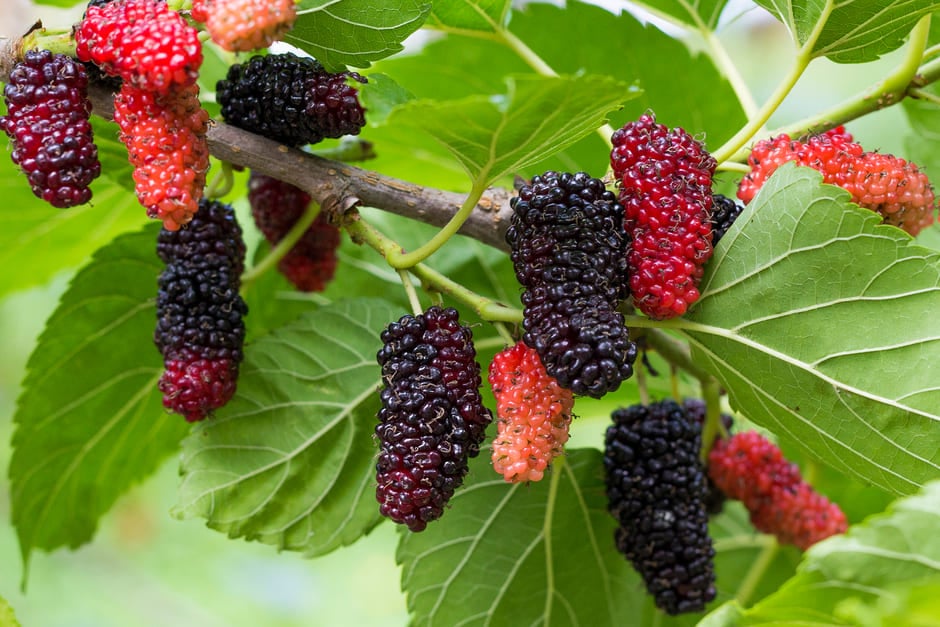
Black mulberry trees are large, attractive and long lived, ideal as a centrepiece in a large lawn, but there are also several varieties that form less expansive trees suited to smaller spaces and even containers. They can also be trained as an against a sunny wall. Black mulberry trees can be slow to start fruiting, taking around eight years, but are well worth the wait, and its varieties often fruit more quickly. Mulberry trees are self-fertile, so you only need one to produce a good crop. Once well established, they will fruit abundantly through August and September.
Jobs to do now
Preorder and plant new trees
Stake after planting
Take cuttings
Month by Month
Plant
Harvest


Choosing What To Grow
For the best fruits, take care to choose a black mulberry (Morus nigra) or one of its varieties, rather than any other mulberry species. Black mulberry trees can eventually grow very large, up to 9m (30ft) tall and wide, so need a lot of space. If you don’t have that much room there are several smaller options, including compact ‘Charlotte Russe’, which will reach only 1.5m (5ft) tall if kept in a container and which can fruit when still a young tree.
When choosing a variety, look for those with an RHS Recommended: Award of Garden Merit (AGM) as they performed well in trials.
What and where to buy
Black mulberry trees are mainly available from fruit tree suppliers, although you may find them in larger garden centres. Specialist suppliers may offer a choice of several smaller varieties, more suitable for smaller gardens.
They are usually sold in pots, in a choice of sizes. trees may also be available from autumn to spring, and can often be pre-ordered. If you buy a tree that has already been part-trained into a standard or half-standard (with a shorter trunk), it will make a well-formed tree more quickly.
Recommended Varieties


Planting
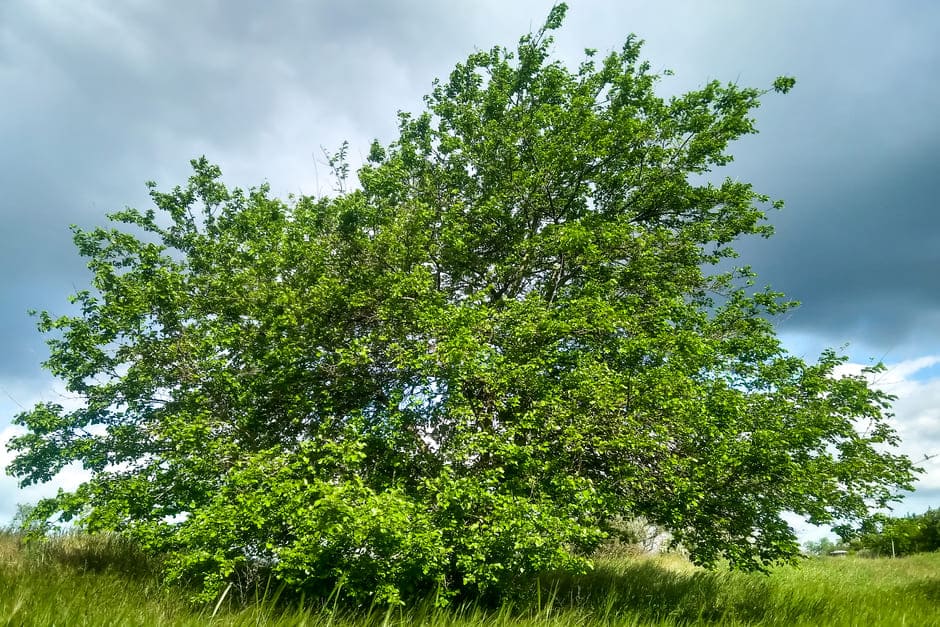
Mulberries like deep, moisture-retentive but well-drained soil. Choose a sunny, sheltered planting spot, where the tree will have plenty of room to develop its wide shape – check the plant label to see its eventual size. Mulberry trees look great as a centrepiece in a lawn, with plenty of space around them so you can enjoy their handsome, often gnarled appearance to the full. They can also be planted against a warm sunny wall, which is a good option in colder locations.
Both and container-grown trees are best planted while dormant, from autumn to spring, but should settle in best in spring as the soil is warming up. If your soil is poor, add a bucketful of garden compost or well-rotted manure to the soil you remove from your planting hole, and use this to backfill after planting. Insert a sturdy stake to support the young tree and ensure good root establishment.
For full planting instructions, see our guides below:
Planting in a container
Compact mulberry trees are suitable for growing in large containers, ideally 50cm (20in) wide and deep, or larger. Fill with a good quality, such as peat-free John Innes No.3. They should grow happily in a container for 10 years or more, as long as they are watered and repotted or topdressed regularly (see Plant Care below).
Plant Care
Once established, mulberry trees growing in the ground need very little maintenance – they are hardy, robust, slow-growing trees that can live for hundreds of years. They often make wide, lop-sided specimens over time, but that’s all part of their charm.
Compact mulberries grown in pots need regular attention to stay healthy and fruiting well, and it is important to give newly-planted trees some initial care so they get off to a strong start.
Watering
Water newly-planted mulberry trees during dry spells for the first few years. After that, they shouldn't need routine watering, except during prolonged dry spells or where they are grown in very free-draining soil.
Mulberry trees in containers need a steady supply of moisture throughout the , so water regularly in dry spells aiming to keep the evenly moist. Try to water early in the morning or in the evening to limit moisture loss from evaporation, ideally using stored rainwater.
Mulching
mulberries growing in the ground each spring, spreading a thick layer of garden or well-rotted manure on the soil around the base of the tree. This helps to enrich the soil, limit moisture loss and deter weeds. Just make sure to leave a small mulch-free circle immediately around the base of the trunk to prevent rotting.
Feeding
Mulberry trees growing in regularly mulched soil shouldn't need any additional feeding. However, if harvests are especially poor or your tree is showing signs of nutrient deficiency, apply an organic granular fertiliser to the soil in early spring. Use our page on nutrient deficiencies to work out what is lacking and apply the recommended feed, following instructions on the packet.
Mulberries in containers benefit from regular feeding. Either apply a balanced or high-potassium organic liquid fertiliser fortnightly through the or sprinkle a handful of an organic granular fertiliser onto the in early spring.
Repotting
Container-grown mulberries need repotting every few years into a larger container of peat-free, ; this is best done in spring. Once it becomes impractical to move the tree into a larger pot, repot into the same one, removing and replacing any loose and lightly trimming the roots.
In the years between repotting, topdress by removing the top layer of compost and replacing with fresh.
Supporting branches
The branches of mature mulberry trees can become low-lying and brittle with age. To prevent them being damaged in strong winds, or snapping when laden with fruit, insert sturdy Y-shaped supports. Add hessian cushioning to prevent rubbing and position so the branch sits in the fork of the Y-shape. More than one support may be needed for particularly large or long branches.
Propagating
To make new mulberry trees from an existing one, take between mid-autumn and late winter. Root these either into pots of peat-free or directly into a trench outdoors. This is a good option if you have a very old mulberry and want some exact replicas to grow on in its place. Be prepared that young mulberry trees can take around eight years to start fruiting.
Pruning And Training
Mulberries are usually grown as free-standing trees with a bare trunk topped with a wide canopy of branches. If you don’t have room for a large tree, choose a compact variety or train it as an , flat against a sunny wall or fence. Established free-standing mulberries need very little pruning and can be left to develop a naturally wide shape, often rather crooked as they age. Pruning is best done while the tree is dormant, between leaf fall in autumn and mid-winter, as mulberries bleed a lot of if pruned at other times.
The main tree forms for mulberries are:
- Bush (a tree on a short trunk) – with a young tree, prune back the main upright shoot (leader) to 70–90cm (28–32in) tall, cutting just above strong side-shoots. Allow these to develop into a framework of eight to ten branches, as for bush apples. After that, only minimal pruning is usually required, removing any dead, damaged, crossing or overcrowded branches. If you wish to keep a neat shape, also remove wayward branches and any that sprout from the trunk below the main canopy.
- Standard or half-standard trees – these are pruned in the same way as bush trees, but with a taller clear trunk of 1.2–1.5m (4–5ft) for half-standards and 1.8–2.1m (6–7ft) for standards.
- Espalier – mulberries can be trained flat against a sunny, sheltered wall, with several tiers of horizontal branches. Start with a young tree, preferably one or two years old, then prune and train as for apple espaliers. However, prune more lightly in summer than you would an apple espalier – shorten the new side-shoots that sprout from branches to three or four leaves, to produce short fruiting spurs. Do this in late summer, just as growth is slowing down.
Harvesting
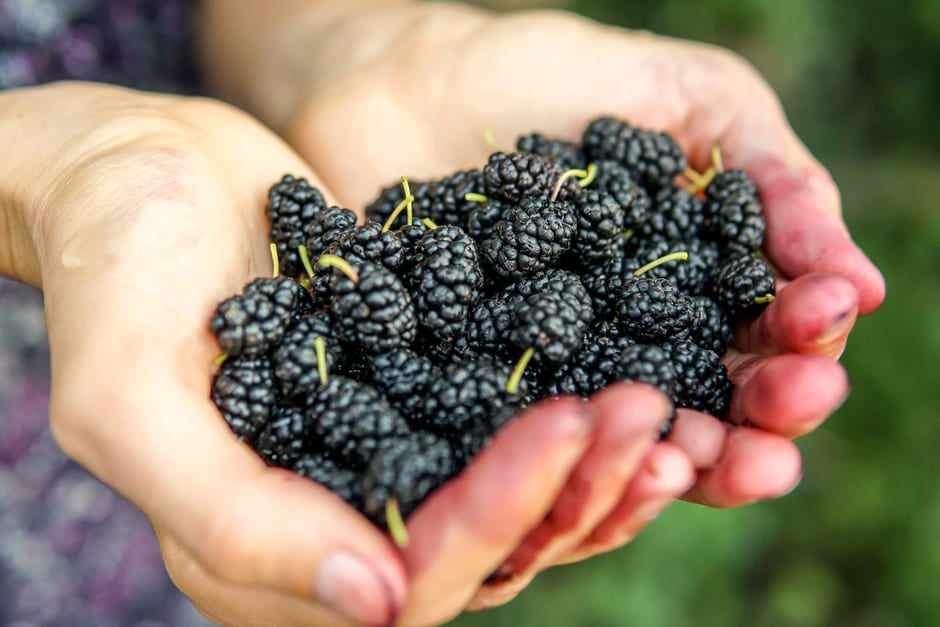
Black mulberry trees are slow to start fruiting, often taking around eight years, although smaller varieties may bear fruit in only half that time. The fruits resemble large blackberries, turning from red to glossy black when ripe – wait until they’re soft and juicy for a deliciously sweet, tangy flavour.
The main harvesting season is August and September. Pick the fruits on the lower branches individually when ripe, wearing gloves if you want to avoid staining your hands. The easiest way to gather fruit from large trees is by shaking the branches over a sheet spread on the ground.
Problem Solving
Mulberry trees are generally healthy and robust once established, but don’t expect fruit straight away – you’ll probably need to wait several years for your first crop. Birds will help themselves to the berries too, but will hopefully leave plenty, hidden among the leaves, for you to enjoy.
Common Problems

Mulberry leaf spot
Mulberry trees bear attractive leaves and tasty fruit but can be affected by a number of diseases, such as fungal leaf spot. This disease can look uns...

Coral spot
Coral spot is a fungal disease of woody plants causing branches to die back. Small orange or coral-pink raised spots (pustules) form after the branch...

Powdery mildews
Powdery mildews are a group of related fungi which attack a wide range of plants, causing a white, dusty coating on leaves, stems and flowers.
