Quick Facts
Most are easy to grow
Some keep their leaves all year, others lose them in autumn
Plant in October and April
They come in all sizes, so will fit into any garden
There are types to suit all growing conditions
Most are fully hardy


Before you get started
What is a tree?
Trees usually have a single woody trunk, topped with a permanent network of branches. Some are slow-growing, long-term plants that will often live for several decades or more. Others are fast growing, often with shorter lifespans. Some species grow quite large over time, while others stay compact. Many produce attractive flowers and edible or ornamental fruits or cones. Evergreen trees keep their leaves all year, while trees lose their leaves over winter, often after a colourful autumn display.
Choosing the right tree
With such potentially long-lived plants, it’s crucial to choose the right one for your site. Whatever your soil type and local climate, there will be trees that will thrive there. See assessing your garden conditions , as well as our guides to trees (and other plants) for wet soils, sandy soils, clay soils and chalky soil.
Getting the right look
Consider what you want from your tree, such as:
- Size and shape – eventual height and spread are prime considerations, as you’ll be buying quite a small plant that is considerably less than its mature size. Make sure you buy a tree that won’t outgrow your space, block out too much light or cause a nuisance to neighbours. See our guide to trees for small gardens.
- Evergreen or deciduous? Trees that keep their leaves retain a consistent appearance throughout the year. They’re great for winter interest, as well as for blocking out overlooking buildings. Trees that lose their leaves often produce vibrant autumn colour and let more light into the garden in winter. Their appearance changes across the year, marking the different seasons and creating renewed interest.
- Season(s) of interest – do you want flowers, fruits and colourful foliage in spring, summer, autumn or winter, or in several different seasons?
- Shade – do you want a tree with a dense canopy of leaves to provide welcome shade in summer, or would you prefer a small or light canopy that simply filters the sun?
- Flowers and ornamental fruits? Some trees offer spring blossom or catkins, while exotic species may produce more vibrant summer blooms. These may be followed by all manner of interesting and attractive fruits, nuts, berries, cones, winged seeds, pods or spiky seed cases. See our guide to flowering trees for small gardens.
- Edible fruits? Growing your own fruit or nut crop can be really rewarding – see our guide to choosing a fruit tree. Consider more unusual fruits too, like mulberry, quince or medlar.
- Traditional or exotic? Would you like a familiar, traditional garden tree that fits into the surrounding landscape? Or would you prefer something more exotic and unusual, like a palm tree, that will stand out and create a tropical feel? See our guide to native trees.
- Foliage colour – tree leaves come in every shade of green, as well as yellows, reds, blues and silvery-greys. Conifers in particular offer a wide range of hues, which makes them stand out as focal points. See our guide to colourful tree foliage.
- Wildlife-friendliness – many trees offer -rich flowers for insects, and/or fruits, nuts, berries or seeds that attract hungry birds and squirrels. Most trees also offer nesting sites and shelter.
- Instant height or smaller and cheaper? Trees are usually bought when they are still quite small, only about 60-90cm (2-3ft) tall. These settle in well and will soon put on growth. However, if you want instant height and impact, you can buy taller, more mature specimens, although these can be much more expensive and often won’t settle in as quickly or as easily.
How and what to buy
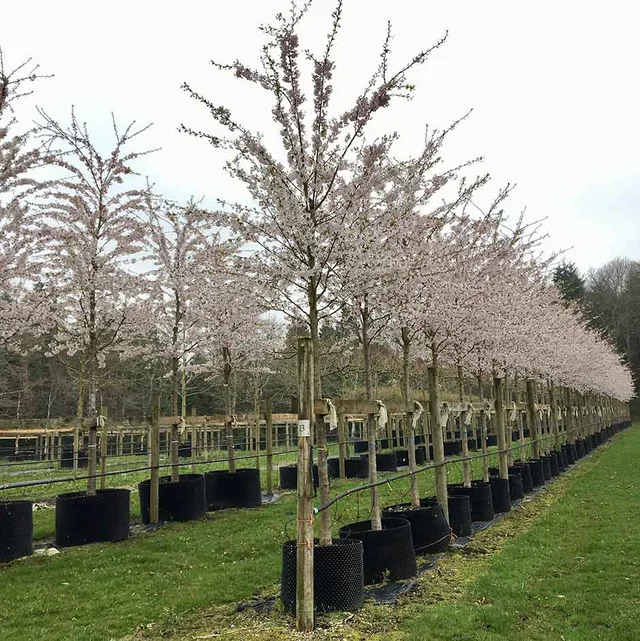
Trees are available all year round in large containers from garden centres, nurseries and online suppliers. Some, especially fruit trees and other deciduous hedgerow trees, can also be bought as dormant plants in autumn and winter, usually by mail order. Bare-root trees are cheaper, but the choice may be more limited.
Where to get ideas and advice
- Visit gardens and arboretums to see which trees you like best. All RHS Gardens feature plenty of beautiful trees, large and small, and all are labelled, so you can note down your favourites.
- Go to RHS Find a Plant – search for ‘trees’ to browse the photos and plant descriptions, and find out where to buy them. You can refine your search by specifying preferences such as ultimate size and season of interest.
- Ask at local garden centres, which should stock a range of trees that suit your local conditions.
Planting
When to plant
The ideal time to plant all trees is between autumn and early spring, whenever your soil isn’t or frozen. Container-grown trees can be planted at any time of year, but avoid planting during hot or dry weather.
Where to plant
Most trees like an open, sunny position, but there are trees to suit all growing conditions. You can even plant some trees against a wall as a fan or espalier.
To get the best crop from fruit trees, you need to plant in a site that suits their individual needs – check out our guide to positioning fruit trees.
Trees that originate in warmer climates may need a sheltered spot, or given winter protection in conditions such as potted citrus trees. The plant label will tell you how hardy the tree is.
Certain trees prefer acidic soil, such as most magnolias and witch hazels (Hamamelis spp.) and won’t cope if your soil is alkaline. See our advice on identifying your soil type, then check plant labels before buying.
Always plant trees in a position where they will have room to reach their mature size. Plant labels should give details. If your space is limited, there are many small trees available. See our guides to trees for small gardens and cherries for small gardens.
Many smaller trees can be grown in containers – this is especially useful for trees that don’t like British winters, such as citrus, as they can be easily moved into a frost free conservatory or greenhouse during this period. Many miniature forms of fruit trees are available for growing in large containers too. Check out our guides to growing trees in containers and growing fruit in containers.
Bearing in mind that trees can live for many years, with some growing to a large size, make sure you choose a site for your tree where it won’t cause problems in the future. See our advice on trees near buildings and trees and the law.
How to plant
Planting a tree is quick and easy, but worth doing carefully to ensure it settles in well and thrives for years to come.
Check out our selection of tree planting guides, for all you need to know:
Ongoing Care
Once they have settled in, most trees need very little attention. Fruit trees, however, benefit from regular pruning, while trees in containers need extra watering. Trees from warmer climes, such as citrus and may need protection over winter.
Watering
During the first two years after planting, new trees need thorough watering in dry spells to ensure the water reaches the full depth of the root system. The quantity required will vary with soil type, but would typically be four to six 9L (2 gallon) watering cans each week in dry weather.
Well-established trees which aren't grown for their fruit, generally don’t need to be watered, except in prolonged dry spells. Fruit trees on the other hand need regular access to moisture in order to produce worthwhile crops.
Feeding
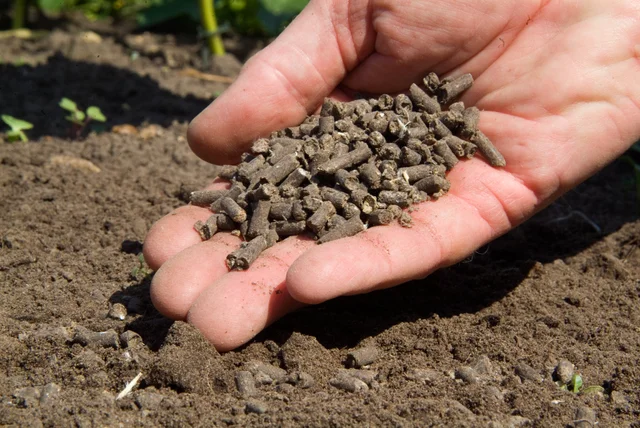
Trees don’t need fertiliser in their first , as you want the roots to grow out into the surrounding soil in search of and moisture. This will help them establish a healthy root system and become self-sufficient.
On poor soil, it may be beneficial to feed a tree the year after planting. Apply a balanced, general-purpose feed over the entire root area in spring, at about 70g per square metre (2oz per square yard).
To maximise the crop on fruit trees, annual feeding is recommended – see our guide.
Trees in containers also need feeding, as the nutrients in their will soon run out. Check out our guide to container maintenance for full details.
Weeding
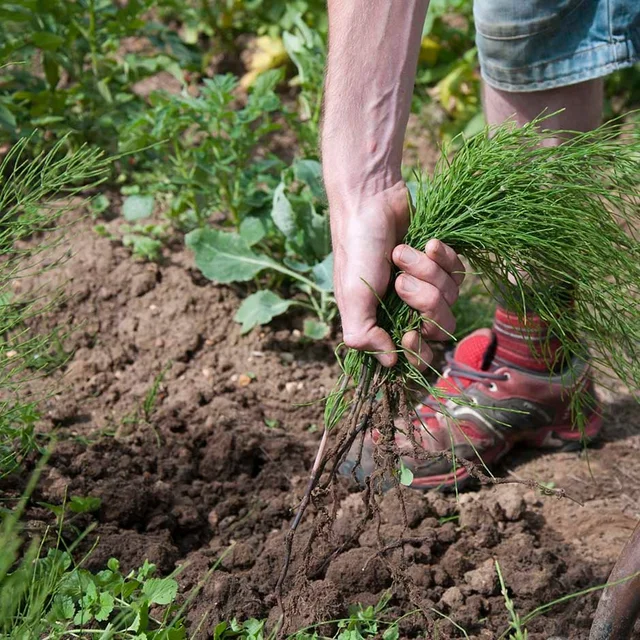
Grass and weeds compete with young trees for water and nutrients in the first five years after planting. If you plant a tree in a lawn, leave a circle at least 90cm (3ft) in diameter without turf, as a covering of plants or turf over the tree’s root area can compete with the tree for nutrients and moisture. This hinders the tree's establishment and subsequent growth.
Mulching
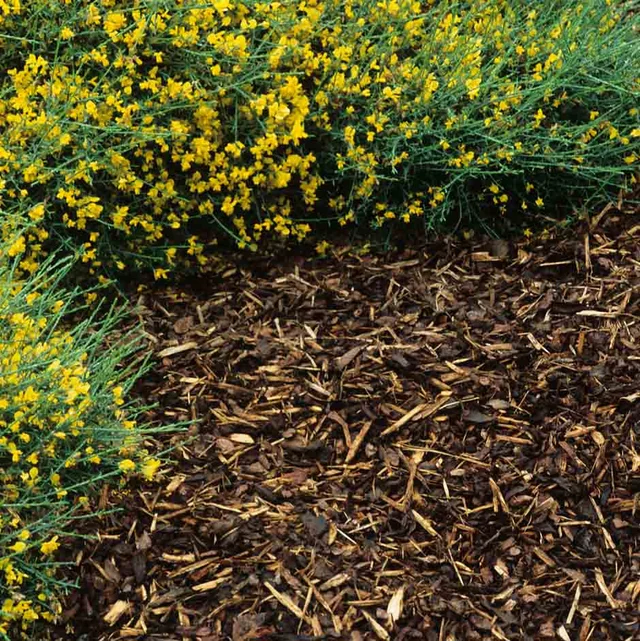
It’s best to lay a of well-rotted manure, garden compost, chippings or leafmould around the base of all trees, but particularly newly planted ones. This will suppress weeds, provide nutrients, hold in moisture, improve the soil conditions and support the growth of beneficial mycorrhizal fungi in the soil.
After clearing any weeds, spread a 7.5cm (3in) layer of mulch over the root area, but leave a gap of 10-15cm (4-6in) around the base of the trunk to prevent rot. The ideal time to do this is in late winter, after any fertiliser has been applied, to conserve winter moisture in the soil. Top up the mulch whenever necessary and re-apply every year.

Overwintering
- Hardy trees need no additional winter protection – check plant labels for hardiness before buying.
- Small, early-flowering fruit trees, such as nectarines, need protection if frost is forecast when they’re in blossom. If the flowers are damaged, the future crop will be reduced or destroyed. For full advice, see our guide to protecting fruit from frost.
- Tender trees are best grown in containers, then moved into conditions over winter.
Looking after trees in containers
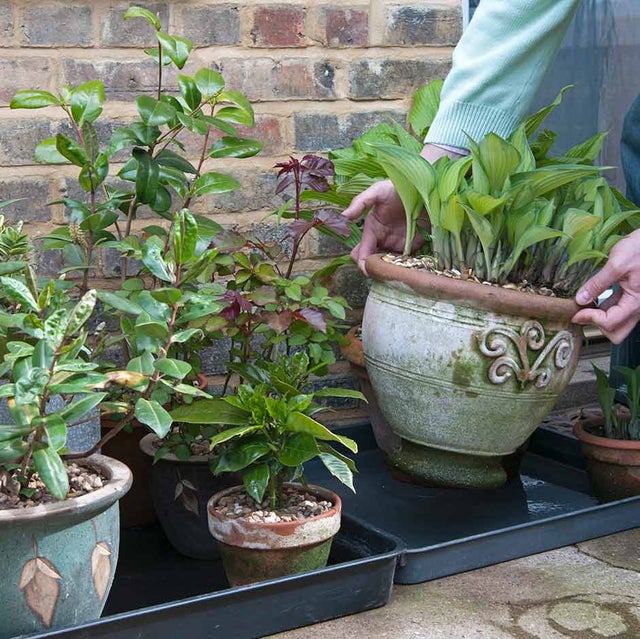
These need additional watering and feeding, and regular repotting into larger containers as they grow.
Adjusting ties and removing stakes
Inspect tree ties every spring and autumn and adjust any that have become too tight, as they can damage the trunk. After two years, the tree should have made sufficient root growth to anchor itself firmly in the soil and the stake can be removed.
Pruning and Training
Pruning ornamental trees
After planting a new tree, you can simply leave it to grow as it pleases. However, if you want to ensure it forms a clear trunk with an even, well-balance canopy, you can give it some initial pruning over the first few years – see our guide to formative pruning.
Once the formative pruning is complete, most ornamental trees won’t need regular pruning. However, do check them occasionally for damaged, diseased or dead stems, which should be removed, and for uneven growth or other problems that need remedying. These include:
- Suckers – some trees produce vigorous shoots from the base or below ground, which need to be removed regularly – see our guide to removing suckers.
- Reversion – trees with or coloured foliage can sometimes produce vigorous shoots that are plain green. These should be removed before they take over – see our guide to reversion.
- Outgrowing its space – if a tree has grown too large or its canopy is too broad or dense, it is possible to reduce its height, thin out the branches or lift the crown by careful pruning – see our guide to reducing size safely. It may also be possible to pollard or coppice it, depending on the species.
For a full guide to pruning ornamental trees, see pruning established trees.
Pruning fruit trees
Fruit trees also need formative pruning in the first few years – see our guide to pruning new apples and pears and fan-trained trees: initial pruning.
Established fruit trees are best pruned once or twice a year, to keep them in good health and cropping well. Check out our selection of guides for full instructions:
- Apples and pears: pruning made easy
- Winter pruning apples and pears
- Summer pruning apples and pears
- Identifying fruit buds
- Pruning fan-trained trees
- Pruning plum trees
Fruit trees that are not pruned regularly will decline in health and productivity. To revive a neglected apple or pear tree, see our guide to renovating pruning.
Training
Fruit trees are often trained into formal shapes, such as fans and espaliers, against a wall or fence. This maximises the amount of fruit you can grow in a small space. Apple and pear trees can also be trained as step-overs – low-level horizontal edging for beds in a kitchen garden. See the following guides for more details:
Another popular systems of formal training is pleaching, which is a way of interlacing the branches of a row of trees on a framework, to form a living screen. Lime trees and hornbeams are often used.
See our guide to pleaching.
Propagating
Many trees can be raised from seed, although if the tree is a , the offspring may differ slightly from the parent.
You can also take of most trees. There are three different types, taken at specific times of year:
- In spring and early summer, take softwood cuttings.
- In late summer to early autumn, take semi-ripe cuttings.
- In mid-autumn to late winter, take hardwood cuttings.
Experienced gardeners may also enjoy the challenge of propagating cultivars by grafting or budding (chip budding
Problems
Most established trees are robust, long-lived and relatively trouble-free, as long as they’re grown in conditions that suit their needs.
Signs of problems to look out for include:
- Brown leaves and Yellowing leaves can be caused by a number of problems.
- Bleeding from pruning cuts, especially those made in spring, may be problematic on several types of trees, including maples, walnuts and birches.
- General decline in health
Several pests and diseases can attack trees, including woolly aphids, honey fungus, silver leaf, bacterial canker, phythophthora root rot and verticillium wilt.
Newly planted trees are vulnerable and can suffer a range of setbacks – see our guide to establishment problems.
Unfortunately, trees can sometimes fail, and it’s worth finding out why, so you can prevent the same problem in other trees, and know whether you can replant – see our guide to common reasons trees and shrubs die. You could also consider getting in an expert arborist to inspect the dead tree.